

Is a Wireless Intraoral Scanner for Dentists Worth It?
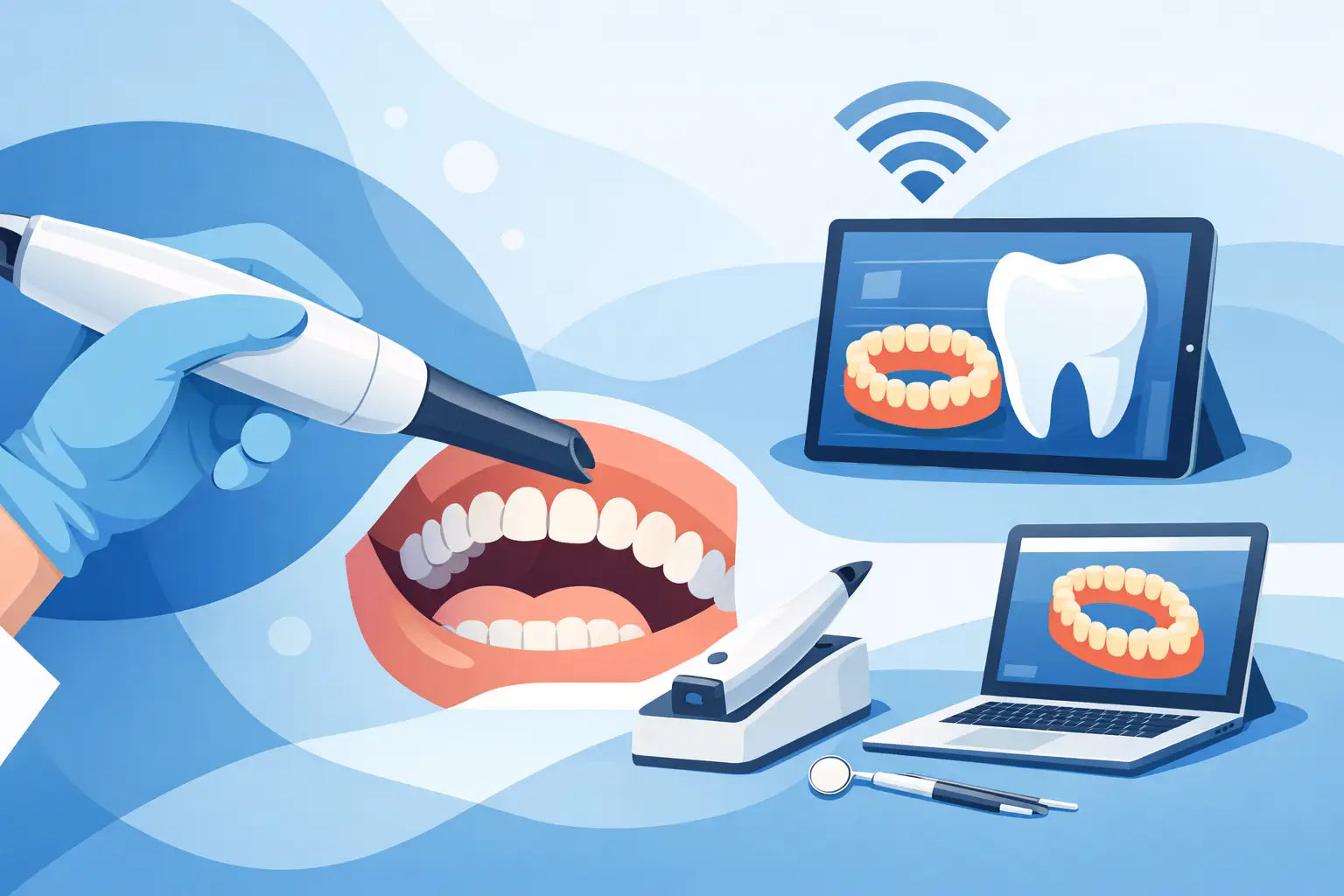
A scan that fails because a cable catches on an assistant’s stool is a small disruption, but small disruptions add up across a full clinical schedule. A wireless intraoral scanner for dentists can remove that point of friction while giving teams more freedom to scan, review, and communicate chairside. The bigger question is not whether wireless scanning looks modern. It is whether the scanner supports the accuracy, speed, software workflow, and service expectations your practice needs.
For practices moving from conventional impressions, the change can be especially meaningful. For offices already scanning, a wireless model may be the practical next step when cords, limited operator movement, or room-to-room portability are getting in the way.
What a wireless scanner changes in the operatory
The most obvious benefit is mobility. With no tether between the handpiece and cart or computer, the clinician can reposition around the patient without managing cable drag. That is useful in smaller operatories, crowded treatment rooms, and practices where assistants frequently share equipment between chairs.
Wireless scanning can also make the patient experience feel less clinical and more efficient. Patients tend to notice when a clinician can capture an impression quickly, rotate the 3D model on screen, and explain a proposed restoration or aligner case immediately. The scanner is not just an impression device in that moment. It becomes a visual communication tool that can support case acceptance.
That said, wireless does not automatically mean faster. Scan speed depends on the optical system, software processing, operator technique, case complexity, and computer performance. A well-trained team with a capable wired scanner may outpace a new wireless system during the first weeks of implementation. The value of wireless is its ability to make a strong digital workflow easier to use consistently.
Where wireless intraoral scanners earn their keep
A wireless intraoral scanner for dentists is often a strong fit for restorative and prosthodontic workflows. Single-unit crowns, bridges within the system’s indicated range, inlays, onlays, implants, and diagnostic records can all benefit from a clean digital capture process. The ability to quickly inspect margins, contacts, and missing data before the patient leaves can reduce remakes and rescans associated with incomplete conventional impressions.
For clear aligner and orthodontic records, mobility supports an efficient handoff between the clinical team and treatment coordinator. For implant workflows, the scanner must do more than produce an attractive model. It needs dependable scan-body recognition, predictable data output, and compatibility with the laboratory or planning workflow your practice uses.
Mobile dentistry providers may find wireless especially appealing because it reduces one more item to route, protect, and connect during setup. But portability should be evaluated as a full system, not as a handpiece feature alone. Consider the scanner’s charging dock, computer requirements, protective case, Wi-Fi environment, software access, and how securely patient data is handled offsite.
Accuracy is a workflow question, not a spec-sheet contest
Published accuracy figures are useful, but they are not the whole purchasing decision. Accuracy in clinical use is affected by scanning strategy, moisture control, soft-tissue management, reflective materials, edentulous span length, and the operator’s familiarity with the system.
For a routine posterior crown, many current digital systems can provide highly usable results when the preparation is visible and the scan is properly captured. Full-arch rehabilitation, multiple implants, and edentulous cases create a more demanding test. If those cases are central to your practice, ask direct questions about the scanner’s documented indications, full-arch performance, implant workflow, and recommended scanning protocol.
Do not buy on a color map or marketing claim alone. Request a live demonstration using a case type similar to the work you perform. Look at how the software flags missing data, handles rescanning, identifies the margin area, and exports files. A scanner that is clinically accurate but difficult for your team to operate can still become an expensive underused device.
The software and lab connection matter
Every scanner purchase is also a software decision. Review whether the system uses open-file exports, subscription requirements, cloud storage, laboratory integrations, and case-management tools. An open workflow may provide more lab flexibility. A more controlled ecosystem may offer a tightly integrated experience. Neither approach is automatically better.
The right choice depends on your preferred laboratory partners, in-house design plans, and comfort with ongoing software costs. Before ordering, confirm which file formats your lab accepts and whether any additional design, cloud, or communication fees apply. Transparent cost visibility matters just as much as the upfront scanner price.
Battery life and connectivity deserve a realistic review
Wireless freedom depends on battery management. A scanner with swappable batteries can be a practical advantage for multi-provider offices or long clinical days. A built-in battery may be perfectly adequate for a single-doctor practice with planned charging between patients. What matters is whether the equipment matches your patient volume and staffing pattern.
Ask how long the battery lasts under active scanning conditions, not only on standby. Find out charging time, battery replacement options, warranty coverage, and what happens if the connection drops during a case. Many systems are designed to preserve scan data and reconnect quickly, but the exact behavior is worth understanding before it becomes a busy-Friday problem.
Reliable Wi-Fi is equally important. A wireless scanner does not eliminate the need for a well-organized digital environment. Assess signal strength in every operatory, network security, available computer ports, graphics specifications, and any IT policies that could slow installation. If your office network is inconsistent, fix that foundation before judging the scanner.
Compare total ownership cost, not only purchase price
A lower-priced scanner can be an outstanding investment if it provides the clinical functions your practice needs, has responsive support, and avoids surprise fees. A more expensive unit may be justified if its advanced software, specialty workflow, service coverage, or established lab integration directly supports high-volume production.
Build the comparison around total cost of ownership. Include the scanner, laptop or cart if needed, software subscriptions, cloud services, training, replacement tips or sleeves, batteries, warranty options, and potential laboratory savings. Also consider the cost of not scanning: impression material, shipping, retakes, chair time, and delays when a case needs clarification.
For many practices, the return is not one dramatic number. It comes from a series of modest gains: fewer impression-material purchases, faster case review, clearer patient conversations, smoother lab communication, and a more modern clinical experience. Those gains need to be realistic for your workflow, not simply promised in a brochure.
Questions to ask before you buy
A purchasing conversation should go beyond, “What is the sale price?” Ask whether the device is FDA-cleared for its intended use and whether the supplier can provide clear documentation, product training, warranty details, and responsive technical support. Confirm that the seller serves licensed dental professionals and understands the clinical applications you plan to use.
You should also ask about turnaround for support requests, return terms, included accessories, software-update policies, and compatibility with your current computers and lab partners. A dependable supplier relationship is particularly valuable with digital equipment because a scanner is only productive when it is working, connected, and understood by the team.
ProElite Dental Supply focuses on bringing professional-grade digital equipment within reach of practices that want strong clinical capability without defaulting to legacy-brand pricing. The best purchase is still the one that aligns with your actual case mix, operational needs, and long-term technology plan.
Plan adoption before the scanner arrives
Implementation determines whether the scanner becomes a daily workhorse or stays in its case. Choose a small group of early cases, such as single crowns or diagnostic scans, and assign one lead clinician and one lead assistant to learn the workflow first. Build a simple protocol for patient positioning, isolation, scan path, review, file submission, and cleaning.
Schedule training when the team can focus rather than between fully booked patients. Keep conventional impression supplies available during the transition, especially for complex cases. That is not a failure of digital dentistry. It is sensible clinical risk management while your team develops confidence.
The right wireless scanner should create less friction between diagnosis, treatment discussion, and final restoration. When its clinical indications, software ecosystem, support plan, and total cost fit the practice, it can add the kind of efficiency that patients feel and teams appreciate at the end of a busy day.