

Sonic vs Ultrasonic Irrigation: Metal vs Polymer Tips in Endodontics
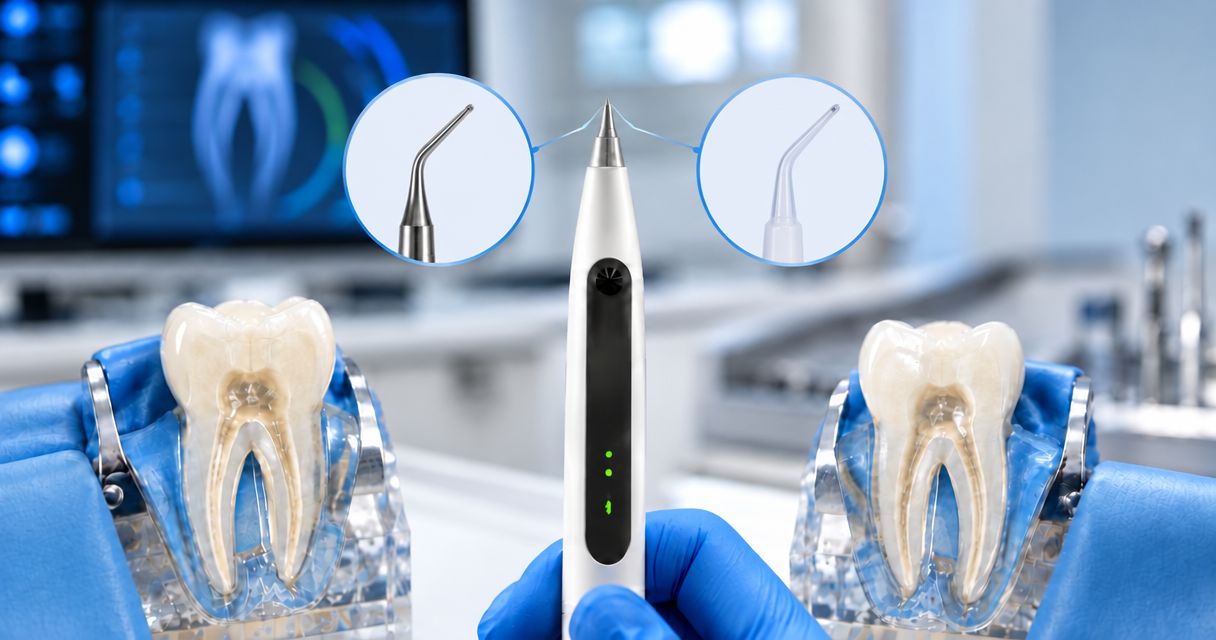
Choose metal-tip ultrasonic activation when a prepared canal allows the tip to oscillate freely; consider polymer-tip sonic activation when flexibility and controlled adaptation to curvature are priorities. This sonic vs ultrasonic irrigation guide compares their benefits, limitations, and practical case selection without treating either approach as a universal winner.
- Sonic vs ultrasonic irrigation is a device-and-anatomy decision, not simply metal versus polymer.
- Ultrasonic activation supports acoustic streaming but requires appropriate tip clearance and controlled use.
- Polymer sonic tips offer flexibility; they still require free movement and careful depth control.
- EDDY research does not establish equivalent results for SurfyONE or every other sonic system.
- Neither activation method replaces shaping, irrigant chemistry, replenishment, or extrusion precautions.
Why the working tip matters in endodontic irrigation
Instrumentation prepares the main canal, but fins, isthmuses, and other irregularities remain difficult to clean mechanically. Irrigant activation moves solution within that anatomy rather than relying on delivery alone. The clinical objective is chemical cleaning supported by fluid movement, not additional cutting by the activation tip.
ProElite Dental Supply offers both the Ultra X™ Cordless Ultrasonic Activator and the SurfyONE | Sonic Activator. These illustrate the two approaches, but device specifications should not be confused with proof of comparative clinical outcomes.
This discussion concerns endodontic irrigant activation, not endotoxin elimination specifically. Better debris removal, microbial reduction, endotoxin reduction, and periapical healing are different endpoints; evidence for one does not automatically establish the others.
Sonic vs ultrasonic irrigation at a glance
| Comparison | Metal-tip ultrasonic activation | Polymer-tip sonic activation |
|---|---|---|
| Best for | Prepared canals with sufficient clearance for the selected ultrasonic tip | Cases where a flexible, noncutting tip suits canal anatomy and the device instructions |
| Energy delivery | Ultrasonic-frequency oscillation transfers energy into irrigant | Sonic-frequency oscillation agitates irrigant through the selected polymer tip |
| Practical benefit | Established acoustic-streaming approach with multiple tip configurations | Flexible working tips and noncutting designs support anatomy-conscious handling |
| Canal curvature | Feasibility depends on alloy, tip design, preparation, and clearance | Flexibility can help accommodate curvature, but binding still limits function |
| Wall-contact concern | Repeated contact can alter oscillation and cause unwanted dentin interaction | Lower cutting potential does not make forced insertion or wall contact harmless |
| Principal limitation | Metal fatigue, separation risk, and technique sensitivity | Performance varies substantially between sonic systems and tip designs |
| Clinical evidence | Evidence supports cleaning effects, not universal superiority | EDDY has comparative laboratory evidence that cannot represent every sonic device |
| Ownership considerations | Compatible tip selection, inspection, reprocessing, and replacement | Device-specific disposable or reusable tips, inspection, and reprocessing requirements |
Tip material does not define the energy category. Polymer ultrasonic tips also exist. This article compares the common metal-ultrasonic and polymer-sonic configurations, not an absolute rule that all ultrasonic devices use metal or all polymer tips are sonic.
Ultrasonic activation: benefits of a metal working tip
Ultrasonic irrigant activation uses high-frequency oscillation to generate fluid motion around the working tip. Acoustic streaming is central to its cleaning rationale. Cavitation can occur under suitable conditions, but the word should not be used as a guarantee of cleaning throughout every part of a clinical canal.
The 2023 systematic review by Chu and colleagues described ultrasonic devices operating at 25,000–40,000 Hz. ProElite Dental Supply's current Ultra X listing specifies 45 kHz. These are device descriptions, not a ranking: frequency alone does not determine cleaning, and amplitude, geometry, clearance, irrigant conditions, and technique also matter.
Metal-tip ultrasonic activation benefits:
- Supports irrigant agitation in prepared canals without intentionally using the activation tip for shaping.
- Offers tip choices that can be matched to the available canal space and access.
- Fits a dedicated ultrasonic irrigation workflow when the selected tip moves freely.
- Provides an established approach with a substantial laboratory literature on cleaning performance.
Metal-tip ultrasonic activation limitations:
- Canal-wall contact can change oscillation and introduce unwanted mechanical effects.
- Tips require inspection for damage and fatigue; separation is a recognized risk.
- Curvature and restricted access can prevent an otherwise suitable tip from moving freely.
Not every metal tip is equally stiff. The Ultra X listing describes X Blue and X Silver as flexible options, so a fair comparison must evaluate the actual tip rather than assuming that metal always means rigid.
Sonic activation: benefits of a polymer working tip
Sonic activation uses a different oscillating system to move irrigant. Flexible polymer working tips are designed for agitation rather than dentin cutting. Their main practical attraction is the ability to accommodate canal anatomy with a noncutting working element.
However, sonic is not one standardized performance category. ProElite Dental Supply lists SurfyONE irrigation activation modes from 100–400 Hz. By contrast, Dentsply Sirona specifies 5,400–6,600 Hz for EDDY, an airscaler-driven polymer-tip system. A positive EDDY study does not validate SurfyONE's cleaning performance or establish equivalence between these devices.
Polymer-tip sonic activation benefits:
- Flexible working tips can be useful when curvature makes metal-tip clearance difficult.
- Noncutting designs reduce the concern associated with intentional dentin cutting during activation.
- Dedicated handheld systems can provide a practical irrigant-agitation workflow.
- Different tip sizes and designs allow device-specific selection for the prepared anatomy.
Polymer-tip sonic activation limitations:
- Flexibility does not eliminate binding, deformation, breakage, or extrusion risk.
- Motion and cleaning behavior differ between sonic drivers and polymer designs.
- Cleaning claims from one system cannot be transferred to another on the basis of tip material alone.
Do not describe polymer activation as risk-free, or promise that it cannot damage a canal. The safer message is that a flexible, noncutting tip addresses certain mechanical concerns while leaving normal clinical safeguards essential.
Which cases favor ultrasonic activation versus sonic activation?
Prepared straight canals: ultrasonic activation is a practical option
In a straight or relatively accessible prepared canal, ultrasonic activation is a reasonable choice when the selected tip fits passively and has room to oscillate. The benefit is fluid activation within an established ultrasonic workflow, not permission to scrape the walls.
A polymer sonic tip can also be used if its instructions and dimensions suit the preparation. Straight anatomy does not prove that ultrasound will produce a better clinical outcome. It simply makes appropriate tip clearance easier to achieve in some cases.
Curved molar canals: evaluate polymer flexibility first
For a curved mesial canal in a molar, a flexible polymer tip is worth evaluating when a metal activator repeatedly contacts the wall or cannot reach its instructed position without force. The deciding factor is controlled, passive fit, not the tooth label alone.
A suitably flexible metal tip remains an option when it can operate as intended. Conversely, a polymer tip that binds is not an acceptable solution just because it bends. Do not enlarge a canal unnecessarily solely to accommodate an activator.
Oval canals, fins, and isthmuses: prioritize the whole irrigation protocol
Both approaches aim to improve irrigant action in areas that instruments do not directly contact. Neither working tip needs to enter every fin or isthmus to generate useful fluid movement, and neither guarantees complete cleaning of those spaces.
Select a system that functions freely in the prepared canal, then maintain irrigant delivery and replenishment. Laboratory comparisons in complex anatomy have produced mixed results; an isthmus is not, by itself, evidence that one category must win.
Retreatment: separate filling removal from final irrigant activation
Retreatment introduces residual filling material and an existing preparation, sometimes with altered anatomy. Ultrasonic or sonic activation can form part of cleaning after appropriate access and material removal, but an irrigation activator is not interchangeable with a dedicated retreatment instrument.
Do not use a smooth activation tip as a cutting or retrieval tool unless the manufacturer specifically indicates that application. The relevant questions are what remains, where it remains, and which instrument is indicated for that task.
Open apices, resorption, or perforation: safety changes the decision
An open apex or suspected communication changes the risk of irrigant extrusion. A soft polymer tip does not make aggressive activation safe, and changing from ultrasound to sonic motion does not remove the hazard.
These cases require an anatomy-specific irrigation plan, appropriate depth and delivery control, and specialist judgment where indicated. Do not apply a routine activation protocol simply because the tip appears flexible.
What does the research actually support?
A 2023 systematic review and meta-analysis by Chu and colleagues included 19 laboratory studies comparing EDDY with ultrasonically activated irrigation; seven contributed to meta-analyses. The authors reported comparable cleaning performance overall for the evaluated smear-layer and debris outcomes, while emphasizing limited evidence and the need for randomized clinical trials.
That supports a balanced conclusion: ultrasonic activation is not automatically better because it operates at a higher frequency, and polymer sonic activation is not automatically better because its tip is flexible. Laboratory cleanliness is also not the same outcome as long-term tooth survival, postoperative comfort, or periapical healing.
A 2026 in vitro study of polymer and metal ultrasonic tips found better apical smear-layer removal with a polymer tip under its experimental conditions. Importantly, both tested tips were used on an ultrasonic device. It was not a trial of SurfyONE versus Ultra X and cannot support that product comparison.
For ProElite Dental Supply buyers, the useful distinction is between verified product specifications, laboratory evidence for a named system, and demonstrated patient outcomes. Keep those three categories separate when evaluating a manufacturer's brochure or sales claim.
Practical selection and safe-use checks
Use the current instructions for the exact handpiece and tip combination. Insertion depth, activation duration, permitted irrigants, power, and tip reuse are device-specific; copying another system's settings is not a reliable protocol.
Before selecting either approach:
- Confirm the canal preparation permits passive fit and the intended tip motion.
- Confirm working length and use the manufacturer's depth guidance.
- Verify the compatible tip, attachment, and activation setting.
- Maintain appropriate isolation, irrigant replenishment, and coronal fluid management.
- Inspect tips and follow validated reprocessing and replacement instructions.
For example, Dentsply Sirona's EDDY guidance specifies keeping the tip short of the apex and identifies EDDY as sterile and single-use. Those instructions must not be generalized to every polymer tip: ProElite's SurfyONE listing describes reusable, autoclavable tips. Confirm the current manufacturer instructions before establishing the practice's reuse policy.
This article is an equipment-selection guide for dental professionals, not a substitute for clinical training, case assessment, or the device instructions for use.
Ultra X and SurfyONE: purchasing considerations
Ultra X: best for a practice seeking a dedicated cordless ultrasonic irrigation workflow. The current listing specifies a 45 kHz output, two power modes, and multiple autoclavable tip options. Confirm the appropriate tip configuration and its replacement requirements rather than selecting by frequency alone.
SurfyONE: best for a practice seeking polymer-tip sonic activation with a separate sealer-delivery function. The current listing describes a brushless motor, multiple irrigation activation settings, and reusable polymer tips. Treat the sealer-delivery function as a separate indicated application, not evidence that it improves obturation outcomes compared with another device.
Ask ProElite Dental Supply to confirm compatible consumables, current instructions, product-specific warranty coverage, and service arrangements before ordering. Include tip replacement and reprocessing in your ownership comparison; a reusable design is not an unlimited-use design.


FAQ
Is sonic or ultrasonic irrigation better for endodontics?
Neither is universally better. Choose according to canal anatomy, passive tip fit, the specific device, and its evidence; findings for one sonic system do not establish the performance of all sonic activators.
Why use a metal tip for ultrasonic irrigant activation?
A compatible metal tip transmits ultrasonic oscillation into the irrigant to support acoustic streaming. It requires appropriate clearance, controlled use, and inspection for damage or fatigue.
What is the benefit of a polymer sonic activation tip?
A flexible, noncutting polymer tip can help accommodate curved canal anatomy. It still needs passive fit and appropriate depth control and does not eliminate extrusion or breakage risk.
Are polymer sonic tips better for curved root canals?
Polymer flexibility can be useful when a metal tip cannot operate freely in a curved canal. The appropriate choice depends on the actual tip and preparation; curvature alone does not establish better cleaning or healing.
Do all sonic activators perform like EDDY?
No. EDDY, SurfyONE, and other sonic systems differ in drive frequency, tip design, and operating conditions, so comparative EDDY research cannot be used as proof of equivalent results for another device.
Does a polymer tip mean the device is sonic?
No. Polymer tips are also used on some ultrasonic systems. Tip material and activation frequency are separate characteristics.
Can sonic or ultrasonic activation replace sodium hypochlorite and EDTA?
No. Activation supports irrigant movement rather than replacing chemical action; sodium hypochlorite and EDTA perform different roles within an appropriately selected irrigation protocol.
Can polymer activation tips be sterilized and reused?
Reuse depends on the exact product. Some polymer tips are single-use, while others are listed as reusable; follow the current manufacturer instructions rather than making a material-based assumption.
One last thing: buy for free tip movement, not the highest frequency
For ProElite Dental Supply endodontic buyers, the best-fit activator is the one whose indicated tip can operate freely in the prepared anatomy. Ultrasound and polymer sonic activation can both earn a place in a practice, but neither compensates for a binding tip, an unsuitable irrigation protocol, or incorrect depth control.