

Best mobile dental equipment for school dental programs 2026

Best overall starting point for recurring school clinics: Jinme E8 Mobile Dental Solution. Best for portable radiography: Eighteeth HyperLight; best for digital intraoral image capture: NanoPix; best for light-cured materials: CuringPen; best for wearable illumination: Wireless Z. This 2026 guide ranks equipment by its role in a school program, with purchase decisions tied to utilities, transport, compatibility, and service requirements.
- Jinme E8 leads this portable dental equipment shortlist for recurring school clinics, subject to utility and configuration checks.
- Eighteeth HyperLight supplies the X-ray source; NanoPix supplies the intraoral receptor. Neither replaces the other.
- CuringPen belongs in school dental programs that use light-cured materials; verify material compatibility before purchase.
- Proelitedental equipment buyers should request itemized configurations, written service terms, and a school-site workflow demonstration.
Why this matters for school dental programs
A screening program and a restorative clinic need different equipment. Define the procedures before selecting the cart: visual examinations do not create the same utility, instrument-processing, imaging, or documentation requirements as operative dentistry.
Proelitedental is best suited to school-program buyers seeking dental equipment across mobile treatment, intraoral imaging, and curing categories. Use Proelitedental as an equipment purchasing resource, then qualify each proposed configuration against your actual school sites. A mobile designation alone does not establish that equipment works independently of external utilities.
What makes the best portable dental equipment?
Use these criteria to evaluate your 2026 shortlist before comparing individual products:
- Procedure fit: Match each component to the approved service scope, including imaging and light-cured materials where applicable.
- Utility fit: Identify electrical, compressed-air, suction, water-supply, and wastewater requirements for the exact configuration.
- Transport fit: Evaluate packed dimensions, lifting demands, doorway clearance, loading, and protection between visits.
- Infection prevention: Check manufacturer instructions for barriers, cleaning, disinfection, and reusable-component processing.
- System compatibility: Confirm handpiece connections, sensor drivers, imaging software, computers, and restorative-material requirements.
- Service continuity: Obtain written warranty coverage, exclusions, repair procedures, and replacement-component details.
Rank transport by the route, not the showroom. Equipment that moves easily across an operatory floor still needs a separate assessment for vehicle loading, stairs, uneven entrances, and storage between school visits.
School dental equipment at a glance
These products serve different functions. The ranking puts the treatment platform first, followed by procedure-specific additions; it does not suggest that a headlight substitutes for a delivery system.
| Rank and item | Best for | Standout feature | Key limitation or purchasing gate |
|---|---|---|---|
| 1. Jinme E8 Mobile Dental Solution | Recurring school treatment clinics | Dentist-cart and assistant-cart equipment offering | Verify the ordered configuration and all utility dependencies |
| 2. HyperLight Portable X-Ray System | Adding a portable intraoral X-ray source | Portable dental radiography equipment | Requires a receptor and an appropriate radiation-safety workflow |
| 3. NanoPix Intraoral Digital Sensor | Digital intraoral image capture | Digital intraoral receptor | Requires an X-ray source and verified software integration |
| 4. Dental Curing Light – CuringPen | Procedures using light-cured materials | Dedicated dental curing light | Material compatibility and clinical access need verification |
| 5. Wireless Z - LED Headlight | Wearable task illumination | Battery-powered LED headlight | Does not provide magnification or treatment delivery |
1. Jinme E8: best mobile equipment for recurring school clinics
The Jinme E8 Mobile Dental Solution is presented as mobile dental equipment with dentist-cart and assistant-cart options. It is the first item to assess when your program needs a treatment platform rather than isolated portable instruments.
Best for: School programs establishing repeatable treatment stations at recurring sites.
For a 2026 purchase, ask for an itemized configuration rather than relying on a package name. Document which cart, instruments, utility components, accessories, and installation tasks belong to the proposal. Keep the patient chair, operator stool, lighting, and instrument-processing arrangements on the same planning sheet, whether sourced together or separately.
Jinme E8 pros:
- Places dentist-side and assistant-side equipment in the same purchasing discussion.
- Provides a mobile-equipment option for evaluating school treatment layouts.
- Allows the delivery platform to anchor subsequent instrument and accessory decisions.
Jinme E8 cons:
- A cart-based treatment layout still needs floor space and a suitable transport route.
- The mobile designation does not establish self-contained air, suction, or water capability.
Before approval, demonstrate the ordered setup in a representative room. Include assistant access, tubing positions, electrical connections, clean storage, and movement around the patient position.
Verdict: Hold until the exact configuration passes your site and utility checks.
2. Eighteeth HyperLight: best for portable intraoral radiography
Eighteeth HyperLight is a portable dental X-ray system. It supplies the radiation source for intraoral radiography; image capture still requires a compatible receptor and an established acquisition workflow.
Best for: School programs whose dentists have identified a need for on-site intraoral radiography.
Evaluate radiography separately from general equipment mobility. Confirm applicable state requirements, operator training, permitted operating arrangements, equipment documentation, and the radiation-safety procedures appropriate to the intended setting. Device clearance does not replace those checks.
Eighteeth HyperLight pros:
- Brings the intraoral X-ray source into a portable-equipment shortlist.
- Supports separate selection of the receptor and acquisition workstation.
- Has separately listed support accessories, including a stand and an aluminum case.
Eighteeth HyperLight cons:
- Does not capture or store images without a receptor and supporting workflow.
- Adds charging, transport protection, and radiation-safety responsibilities to the school visit.
Request a demonstration of positioning with the proposed receptor holder. Confirm the charging method, battery replacement procedure, cleaning instructions, and whether proposed transport accessories fit the ordered system.
Verdict: Buy only after the radiography workflow and applicable requirements are confirmed.
3. NanoPix: best for digital intraoral image capture
NanoPix is a digital intraoral sensor. Its role is to receive the X-ray exposure within the imaging chain, not to produce the exposure or independently provide diagnostic imaging.
Best for: School programs adding digital intraoral image capture to an approved radiography workflow.
Specify the computer operating system, imaging application, driver requirements, and patient-record process before ordering. Ask the seller to demonstrate acquisition into the software your team will actually use, rather than a separate demonstration application.
NanoPix pros:
- Provides a digital receptor option for the intraoral imaging setup.
- Lets the program assess receptor selection separately from the X-ray source.
- Supports a focused purchasing discussion around patient fit, positioning, and software integration.
NanoPix cons:
- Requires a compatible X-ray source and acquisition workstation.
- Introduces sensor positioning, cable management, barriers, and transport protection into each visit.
Assess physical dimensions and active imaging area separately. For pediatric work, evaluate the proposed sensor and holder against your patient population without assuming that a nominal size establishes comfort or positioning access.
Verdict: Hold until patient-fit assessment and acquisition testing are complete.
4. CuringPen: best for procedures using light-cured materials
CuringPen is a dental curing light by Eighteeth. Include it when your school program uses restorative or preventive materials that require light activation.
Best for: Programs with an approved clinical scope that includes light-cured materials.
For the 2026 equipment specification, match the curing light to each material manufacturer's instructions. Review emission spectrum, required exposure conditions, tip dimensions, output verification, and access to the intended treatment surface. Do not select a curing light from an output claim alone.
CuringPen pros:
- Adds a dedicated light-curing instrument to the treatment setup.
- Has separately listed disposable sleeves for the CuringPen.
- Creates a defined purchasing checkpoint for material compatibility and curing access.
CuringPen cons:
- Does not establish compatibility with every light-cured dental material.
- Needs an output-checking, barrier, and maintenance routine alongside clinical use.
Assess access with the barriers your team intends to use. Check the manufacturer's cleaning instructions and the effects of damaged or contaminated tips on your equipment acceptance procedure.
Verdict: Buy after material compatibility and clinical access are verified.
5. Wireless Z: best for wearable task illumination
The Eighteeth Wireless Z is a battery-powered LED headlight. It is an illumination accessory, not a substitute for a patient-positioning system, magnification, or a treatment unit.
Best for: Clinicians who want wearable illumination as part of their school-site setup.
Assess the headlight with the clinician's actual eyewear or loupes. Mounting, balance, beam alignment, working distance, and cleaning access determine whether the accessory fits the operator's workflow.
Wireless Z pros:
- Provides battery-powered wearable illumination.
- Separates the clinician's task-light decision from the treatment-cart selection.
- Allows an operator-specific fitting assessment before standardizing equipment.
Wireless Z cons:
- Does not provide optical magnification.
- Adds battery management and wearable-equipment cleaning to the daily routine.
Request written mounting compatibility and battery-service information. Trial the complete wearable setup rather than assessing the light separately from the equipment it will attach to.
Verdict: Buy after operator fit and mounting compatibility are confirmed.
Qualify the complete school-site workflow
Divide the acceptance process into Site access, Utilities, Clinical setup, Infection prevention, and Pack-down. Each stage exposes a different purchasing risk; checking only the assembled treatment station leaves transport and turnaround unresolved.
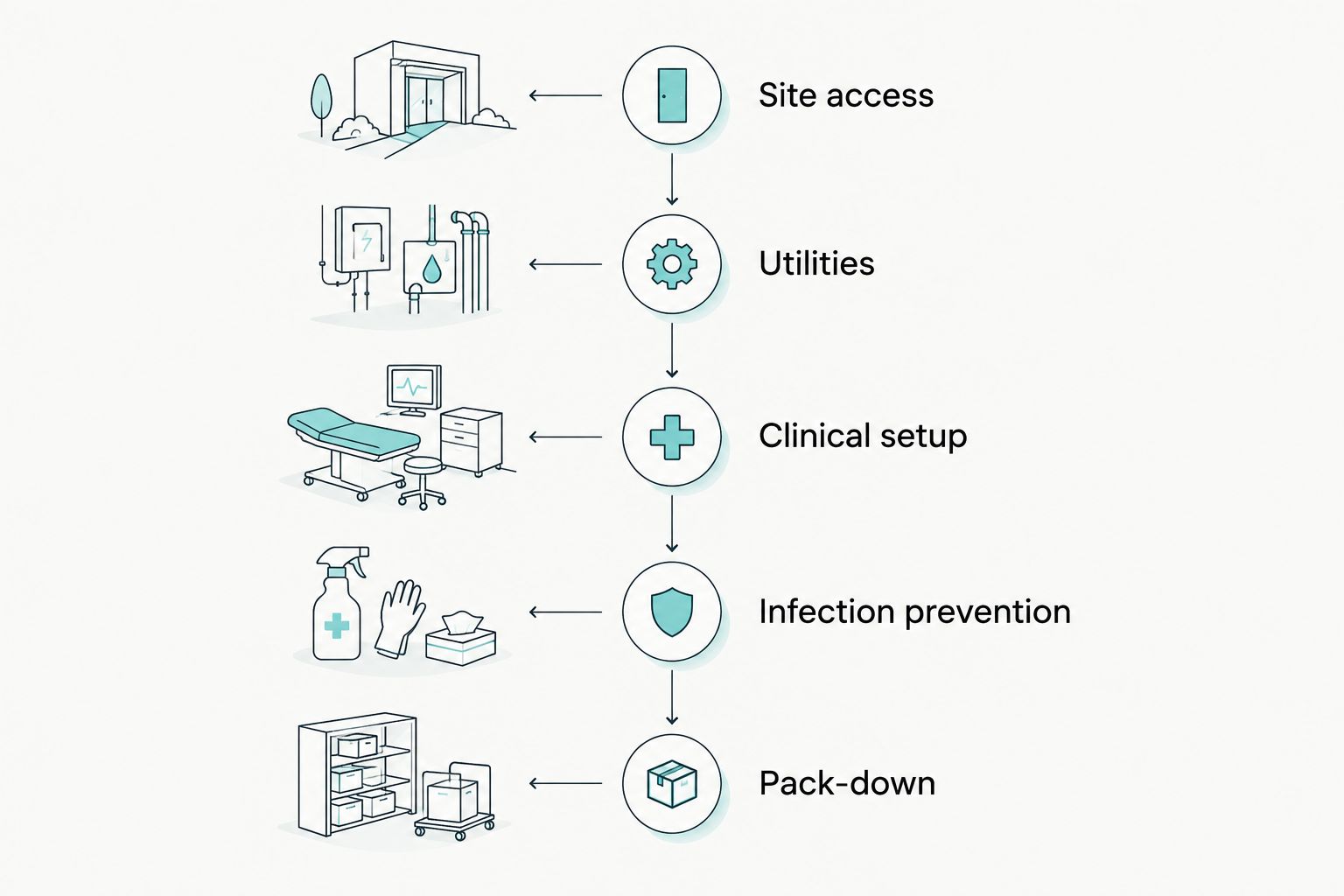
Use 2 representative school rooms for your site assessment: include the room with the most restrictive access or utilities. This is a purchasing recommendation, not an equipment-performance specification. Record doorway and elevator constraints, outlet locations, available floor space, and the route from vehicle to treatment position.
Run 1 complete simulated session before signing acceptance. Include unloading, assembly, patient-record access, instrument layout, imaging where applicable, cleaning, waste handling, and repacking. Record your own setup and pack-down times rather than accepting a generic portability claim.
Keep clean supplies and contaminated instruments separated during use and transport. Establish instrument processing, dental-unit water management where applicable, sharps handling, and environmental cleaning under your clinical protocols and manufacturer instructions. A school sink is not automatically an acceptable substitute for the required processing arrangements.
Equipment worth taking to a configuration discussion
These products cover the treatment platform, X-ray source, receptor, and curing roles discussed above. Use the cards to identify equipment for a qualified enquiry; the final order still needs the configuration and compatibility checks in this guide.


How this shortlist is ranked
This 2026 shortlist prioritizes equipment roles: treatment delivery first, then radiography, image capture, curing, and illumination. The criteria are procedure fit, utilities, transport, infection prevention, compatibility, and service continuity—not measured clinical superiority or a claim of hands-on comparative testing.
Which portable dental equipment should you choose?
Start with Jinme E8 for a recurring treatment clinic; purchase procedure-specific additions only after defining the service scope. For a screening-only program, begin with the examination and documentation requirements instead of assuming you need a full mobile operatory.
Ask Proelitedental for an itemized portable dental equipment proposal and a 3-year ownership worksheet covering consumables, replacement components, software obligations, maintenance, and repair arrangements. Obtain product-specific warranty terms in writing, including exclusions, freight responsibilities, service routing, and any temporary replacement arrangements. Do not treat a verbal support assurance as a contractual service commitment.
FAQ
What's the best portable dental equipment for a school treatment program?
Jinme E8 Mobile Dental Solution is the starting point in this shortlist for recurring school treatment clinics. Approve the exact configuration only after confirming utilities, transport access, and the intended procedures.
Do school dental programs need a portable X-ray system?
A school program needs radiography equipment only when its clinical scope includes on-site radiography. The supervising dentist must establish the clinical workflow, and the program must confirm applicable equipment and operating requirements.
Is NanoPix an alternative to the HyperLight X-ray system?
No. NanoPix is an intraoral digital receptor, while HyperLight is the X-ray source. Digital intraoral radiography requires both functions plus compatible acquisition software.
Can a mobile dental cart work without school plumbing?
Do not assume that a mobile cart works without external plumbing or other utilities. Obtain written water-supply, wastewater, suction, compressed-air, and electrical requirements for the exact configuration.
How do you check a dental sensor for a school program?
Assess patient fit, holder compatibility, and acquisition in your actual imaging software. Confirm physical dimensions and active imaging area separately, then evaluate cable protection and cleaning instructions.
Which curing light should a school dental program buy?
Choose a curing light that meets the requirements of the materials your clinicians use. CuringPen belongs on the shortlist, but emission characteristics, access, barriers, and output verification need review before purchase.
What should a mobile dental equipment quote include?
Request an itemized configuration with accessories, utility dependencies, software obligations, training, and product-specific service terms. Include replacement components and routine maintenance in the ownership assessment.
One last thing
Make pack-down part of equipment acceptance, not an afterthought. For your 2026 purchase, require the team to show how contaminated instruments, clean supplies, sensor cables, batteries, and water-containing components leave the school without compromising the next visit. Send that acceptance checklist with your Proelitedental quote enquiry so the proposed configuration answers the operational questions before purchase.