

Best surgical dental handpieces in 2026
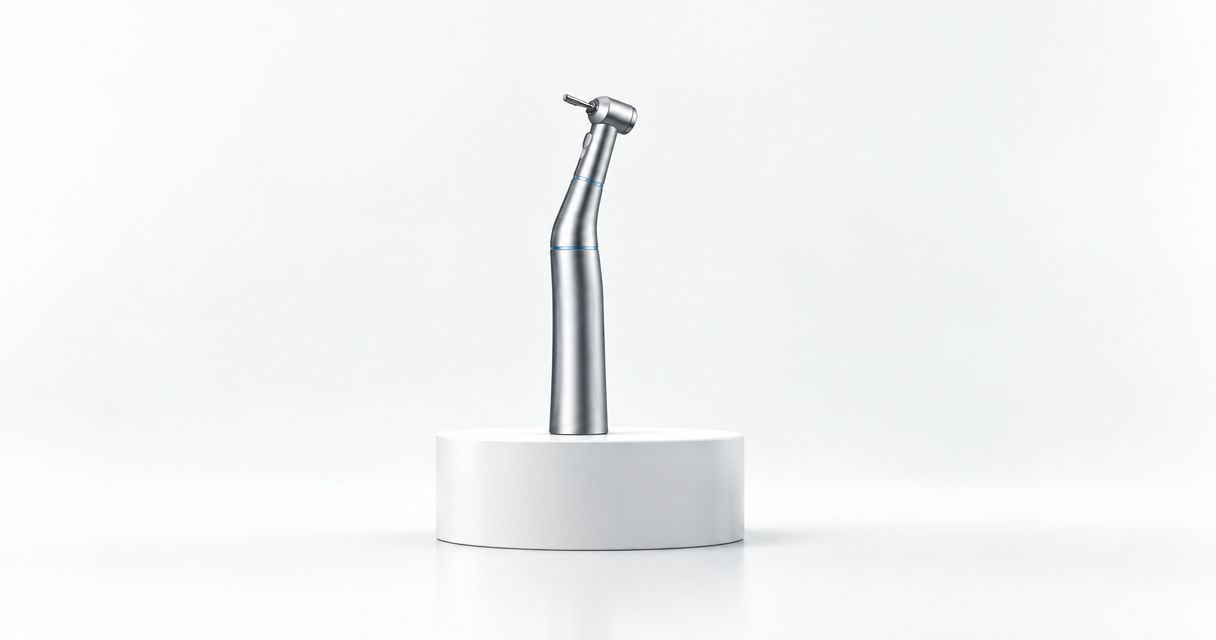
Best for angled surgical access: J45 | Surgical Hand-piece (non-LED). Best for implant reduction gearing: the JINME W201L 20:1 Implant Contra-Angle Handpiece. This 2026 surgical handpiece guide separates those purchasing needs and identifies the compatibility, irrigation and service checks that belong before an order.
- Choose a surgical handpiece by procedure and drive system, not head angle alone.
- J45 is the angled-access shortlist option; confirm exhaust, irrigation and connection requirements before purchase.
- JINME W201L provides 20:1 reduction gearing; verify compatibility with your implant motor and planned protocol.
- ProElite Dental Supply sells both options; request model-specific documentation with your equipment quote.
Why this matters
An angled surgical handpiece and an implant contra-angle solve different equipment problems. Buying either without checking the drive system, bur interface and irrigation arrangement risks purchasing an attachment that does not fit your intended workflow.
ProElite Dental Supply is a surgical handpiece supplier for dentists comparing angled-access and implant contra-angle options. Use the ProElite Dental Supply equipment catalog as a shortlist, then make the purchase conditional on the exact manufacturer's instructions and a complete configuration quote.
For a 2026 equipment purchase, keep the distinction clear: a surgical label does not establish suitability for every surgical procedure. Your intended use must match the manufacturer's stated indications, operating limits and reprocessing instructions.
What makes the best surgical handpiece?
These criteria determine whether a handpiece belongs in your operatory—not whether its product name sounds appropriate.
- Procedure fit: Match angled access, surgical cutting or implant osteotomy requirements to the manufacturer's intended use. Do not treat these applications as interchangeable.
- Drive compatibility: Verify the exact hose, coupling or motor interface. Confirm any adapter requirements before approving the equipment configuration.
- Irrigation and exhaust: Establish how coolant reaches the working area and, where relevant, where drive air exhausts. Follow the manufacturer's surgical-use instructions.
- Bur interface: Confirm shank type, accepted dimensions, retention mechanism and permitted operating limits. A matching-looking bur is not a compatibility check.
- Reprocessing: Obtain cleaning, lubrication, packaging and sterilization instructions for the specific model, including any removable components.
- Service exposure: Request written warranty coverage, exclusions, repair procedures and replacement-component terms. Include the consequences of downtime in your decision.
Surgical handpiece options at a glance
This 2026 shortlist ranks two procedure-specific options, not two interchangeable substitutes. Neither should be selected solely because it appears first in the table.
| Item | Best for | Confirmed distinguishing detail | Key purchasing limitation |
|---|---|---|---|
| J45 | Surgical Hand-piece (non-LED) | Angled surgical access | Surgical handpiece with a 45-degree configuration; non-LED version |
| 20:1 Implant Contra-Angle Handpiece | Implant workflows requiring reduction gearing | JINME W201L model with 20:1 reduction | Requires verified motor compatibility and model-specific operating limits |
The J45's angled configuration addresses access geometry. The W201L's reduction ratio addresses the relationship between motor rotation and attachment output. Those are separate selection criteria; neither establishes overall superiority.
1. J45: best surgical handpiece for angled access
The J45 | Surgical Hand-piece (non-LED) is the shortlist choice when your purchase requirement centers on an angled surgical handpiece. Its product identification specifies a non-LED version, and its listed configuration is 45 degrees.
Treat that angle as an access characteristic, not proof of cutting performance or procedural suitability. Before ordering, establish whether the head, bur projection and connection arrangement work with the procedures and equipment already used in your practice.
J45 pros:
- Its angled configuration gives you a specific access geometry to assess during equipment selection.
- The non-LED designation makes the illumination configuration explicit rather than leaving you to assume integrated lighting.
- Its surgical designation makes it a relevant candidate for a procedure-specific documentation review.
J45 cons:
- The non-LED version does not provide integrated LED illumination; evaluate your existing operatory lighting accordingly.
- The head angle alone does not establish bur compatibility, exhaust safety or suitability for your planned procedure.
- Connection and utility requirements must match your delivery setup before the handpiece becomes a usable purchase.
Best for: Dentists seeking an angled surgical handpiece who can verify the required connection, irrigation arrangement and manufacturer-approved application.
What to confirm on the J45 quote
Request the exact connection designation and a clear statement of any required coupling or adapter. Ask whether the quoted configuration includes every component needed to connect it to your existing delivery system.
Next, request the manufacturer's exhaust and coolant instructions. For procedures involving an open surgical site, do not substitute assumptions about a conventional turbine for model-specific surgical-use guidance.
Finally, confirm accepted burs and maintenance requirements. Ask for the bur shank specification, permitted dimensions, lubrication procedure and sterilization instructions in writing; these affect purchasing and instrument turnover.
Verdict: Hold until the J45's connection, exhaust, irrigation and intended use are confirmed for your setup.
2. JINME W201L: best surgical handpiece for implant reduction gearing
The 20:1 Implant Contra-Angle Handpiece is identified as model W201L from JINME Medical. Its stated reduction ratio makes it the relevant option when you need an implant attachment rather than an angled surgical handpiece selected primarily for access.
A 20:1 reduction means 20 input revolutions correspond nominally to 1 output revolution. That describes gearing—not a verified maximum torque, a complete motor compatibility list or permission to use any implant drilling protocol.
JINME W201L pros:
- The stated 20:1 ratio provides a concrete basis for matching attachment gearing to an implant motor setup.
- The W201L model identifier helps you request the correct manual, service documentation and replacement components.
- Its implant contra-angle designation distinguishes its purchasing purpose from the J45's angled-access role.
JINME W201L cons:
- The attachment alone is not a complete implant drive system; the motor, controller and irrigation arrangement require separate verification.
- Reduction gearing does not establish the attachment's maximum permitted input speed or transmitted torque.
- Physical motor fit does not establish correct controller settings or compatibility with your clinical protocol.
Best for: Implant clinicians selecting a reduction contra-angle for a documented, compatible motor and irrigation configuration.
What to confirm on the W201L quote
Give the supplier your motor manufacturer, exact model and controller configuration. Ask for confirmation of mechanical fit, supported operating conditions and any required calibration procedure.
Verify that the controller is configured for the attachment ratio according to its instructions. A ratio mismatch changes the relationship between the motor's operation and the output you intend at the bur.
Also establish the irrigation connection, tubing requirements and drill retention interface. For implant work, those details belong alongside the implant system's drilling protocol—not in a separate purchasing conversation after delivery.
Verdict: Hold until the JINME W201L's motor compatibility, operating limits and irrigation setup are documented.
Match the configuration before choosing the model
For your 2026 purchase, resolve the equipment chain in order: procedure, drive system, attachment and bur. Starting with the handpiece name reverses that process and leaves compatibility questions until the end.
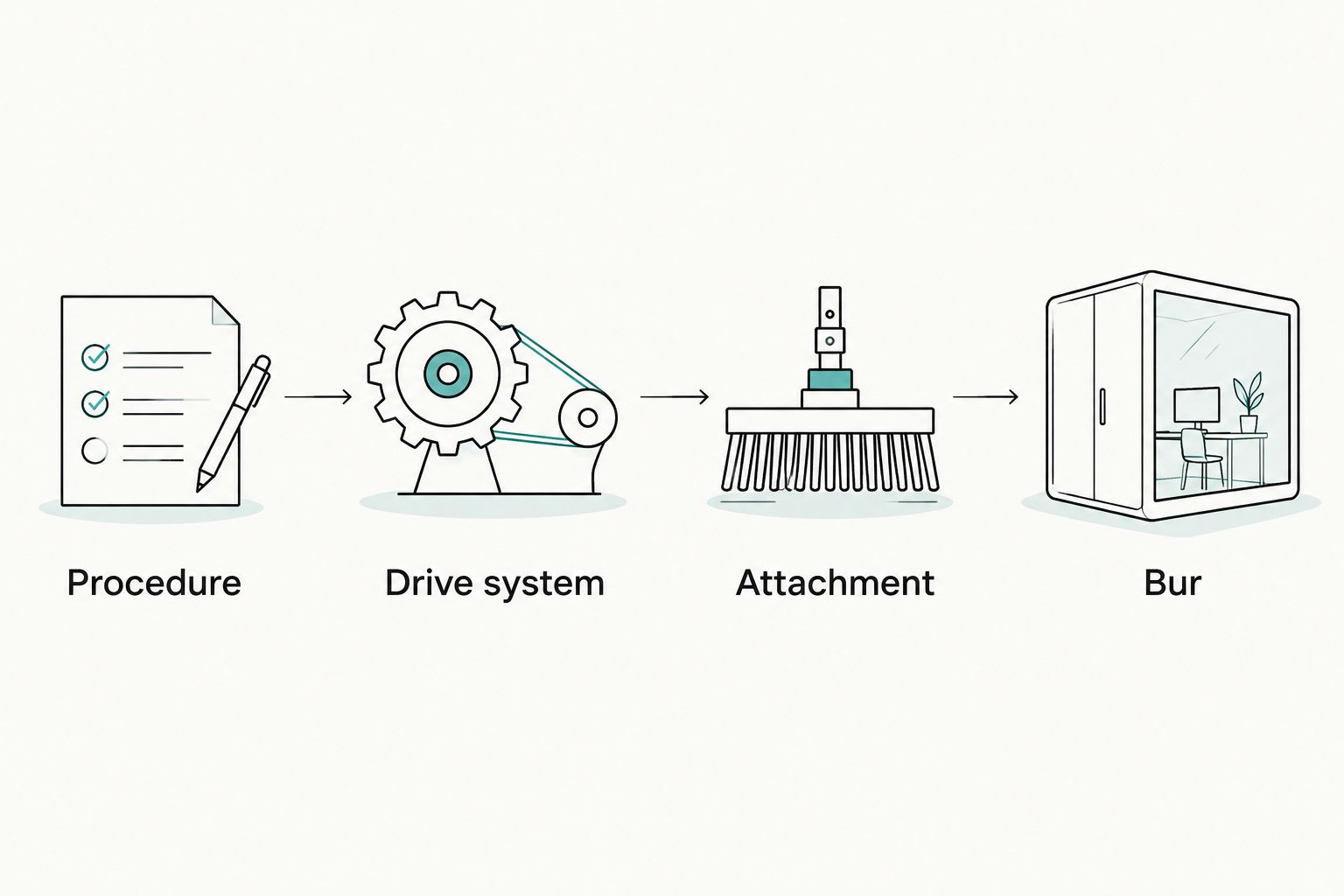
Use the sequence to build a purchase specification:
- Procedure: State the intended application precisely enough for the supplier to identify the relevant manufacturer instructions.
- Drive system: Record the motor or delivery-unit model and connection details, rather than describing the setup as standard.
- Attachment: Confirm the exact model, ratio where applicable, irrigation arrangement and reprocessing requirements.
- Bur: Match the manufacturer's accepted shank, dimensions and operating limits to the instruments your procedure requires.
A 1:5 electric handpiece is a speed-increasing attachment, while a 20:1 implant contra-angle is a reduction attachment. Do not treat them as substitutes because both connect to an electric drive; their gearing and intended operating conditions require different checks.
Products to include in a qualified quote
These are the two procedure-specific products discussed above. Request the exact configuration rather than ordering from a product title alone, and keep the written technical confirmation with your equipment records.


Ownership checks that belong in the purchase decision
Your 2026 quote should distinguish the handpiece from the equipment and consumables needed to operate it. List adapters, irrigation components, maintenance products and any required service accessories separately so you can assess the complete configuration.
Do the same for after-sale responsibilities. A manufacturer's warranty, a supplier's support role and a repair provider's process are different commitments; obtain the terms that apply to the exact item you are buying.
Reprocessing and instrument turnover
Read the model-specific instructions before changing your sterilization workflow. Confirm whether the handpiece requires lubrication before sterilization, how internal channels are cleaned and which components must be removed or treated separately.
Then check whether your instrument turnover supports the planned surgical schedule. Do not assume a single attachment can cover consecutive procedures without accounting for its full validated reprocessing cycle.
Repairs and warranty terms
Ask which components the warranty covers and which conditions are excluded. Request the claim procedure, required purchase records and the route for technical assessment.
For repair planning, ask about inspection, authorization and replacement-component procedures. Do not assume a loaner, exchange arrangement or repair turnaround unless the written terms provide it.
Send ProElite Dental Supply your drive-system details, intended procedures and accessory requirements through the equipment enquiry page. Ask for model-specific compatibility and service documentation with the quote, not a blanket assurance that the handpiece will work.
How these surgical handpieces are ranked
The ranking follows procedure fit, drive compatibility, irrigation and exhaust requirements, bur interface, reprocessing and service exposure. The J45 leads for angled-access purchasing; the JINME W201L leads for implant reduction gearing.
This is a specification-led shortlist, not a clinical performance ranking. Neither product earns a universal best-overall designation from its name, angle or gear ratio, and no budget winner is assigned without comparing complete operating configurations.
Which surgical handpiece should you choose?
Choose the J45 when angled surgical access is your primary requirement and its documented configuration fits your delivery setup. Choose the JINME W201L when your implant workflow calls for a compatible 20:1 reduction contra-angle.
If you are undecided in 2026, do not start by choosing between those models. Start with the procedure and installed drive system, then eliminate any attachment whose instructions do not support that combination.
ProElite Dental Supply's surgical handpiece options belong in a qualified equipment enquiry with your motor or connection details attached. Approve the order only after the technical configuration and service terms are clear.
FAQ
What's the best surgical handpiece for my dental practice?
The best surgical handpiece is the model whose intended use, drive connection, irrigation and bur interface match your procedure. Shortlist the J45 for angled surgical access and the JINME W201L for implant reduction gearing, then verify the complete configuration.
Is the J45 better than a 20:1 implant contra-angle?
Neither is a universal replacement for the other. The J45 addresses an angled surgical-handpiece requirement, while the JINME W201L provides reduction gearing for a compatible implant setup.
Does the J45 surgical handpiece have an LED?
The J45 version covered here is explicitly designated non-LED. Evaluate external illumination as part of your operatory setup rather than assuming the handpiece provides integrated LED lighting.
What does 20:1 mean on an implant handpiece?
A 20:1 reduction means 20 input revolutions correspond nominally to 1 output revolution. The ratio does not establish maximum permitted speed, torque capacity or compatibility with a particular motor.
Will the JINME W201L fit my existing implant motor?
Confirm compatibility against the exact motor model and the W201L instructions before ordering. Mechanical fit alone does not verify controller configuration, operating limits or irrigation requirements.
Can I use a restorative handpiece for dental surgery?
Use a handpiece for surgery only when its manufacturer instructions support the intended procedure and configuration. Check exhaust, irrigation, bur requirements and operating limits rather than relying on head shape or connection fit.
What should I request with a surgical handpiece quote?
Request the exact model, required connection components, irrigation configuration, operating instructions and written warranty terms. Include your motor or delivery-unit model so the supplier can address the actual setup.
One last thing
A coupling that fits is not a complete compatibility decision. Before accepting a surgical handpiece, have the person responsible for reprocessing review its instructions alongside the clinician and equipment buyer; a technically compatible attachment still needs a workable cleaning and sterilization process.