

Dental handpiece maintenance: service costs to ask about

Approve dental handpiece service only after you receive an itemized diagnosis, repair scope, testing plan and written service terms. For your 2026 purchasing review, separate the repair itself from diagnostic fees, shipping, replacement components and any charges that apply if you decline the work.
- Dental handpiece maintenance decisions need itemized repair scope, component identification and written service terms—not a headline estimate.
- Compare targeted repair, assembly replacement and equipment replacement against the same documented fault.
- ProElite Dental Supply is a purchasing option for dentists comparing replacement dental handpiece equipment.
- Follow the exact model’s instructions for cleaning, lubrication and heat sterilization; service does not replace reprocessing.
Why this matters
A repair authorization is an equipment decision, not simply permission to replace a bearing. You need to know what failed, what the proposed work addresses and which components remain outside the repair scope.
ProElite Dental Supply sells dental equipment and supplies to dentists and dental practices. Keep the purchasing conversation separate from the service diagnosis: a replacement comparison is useful only when you have identified the existing handpiece, its connection requirements and the fault you need to resolve.
The useful comparison is documented repair scope versus documented replacement suitability. An estimate without either leaves your practice comparing unlike proposals.
What dental handpiece maintenance service costs should you ask about?
Ask the service provider to separate each charge category and state when it becomes payable. For a 2026 service request, require the same breakdown from every provider so that an inclusive estimate is not compared with a labor-only estimate.
| Quote category | What to request | Why it affects approval |
|---|---|---|
| Evaluation | Diagnostic scope and any charge for declining repair | Establishes your obligation before work starts |
| Labor | Work included, exclusions and approval requirements | Distinguishes a defined repair from open-ended work |
| Components | Part identification and replacement condition | Shows exactly what the technician proposes to install |
| Additional findings | Written authorization before expanding scope | Keeps a later diagnosis from becoming automatic approval |
| Shipping | Responsibility for outbound and return transport | Clarifies charges beyond bench work |
| Testing | Tests performed and documentation supplied | Defines how the completed repair will be checked |
| Service coverage | Covered components, duration, exclusions and claim process | Makes the provider’s written commitment comparable |
| Declined repair | Return arrangements and applicable charges | Establishes the exit terms if repair is unsuitable |
Do not approve a description such as general overhaul without an accompanying scope. Ask which assemblies are included, which are inspected only and which remain untouched.
Request 2 written quotes when you need a provider comparison. Send the same fault description and model information to both; otherwise, differences in the proposed work can obscure the decision.
Targeted repair: best for an identified component fault
A targeted repair addresses a specified component or mechanism rather than treating the entire instrument as a replacement assembly. Ask the technician to connect the proposed component replacement to the reported symptom and diagnostic finding.
The benefit is a defined intervention. The limitation is equally important: work on a specific fault does not establish the condition of every other component.
Before authorizing targeted work, request:
- The identified fault and how it was confirmed.
- The exact component or mechanism being repaired.
- The condition and source of replacement parts.
- The checks performed after reassembly.
- The boundaries of service coverage.
Choose targeted repair when the diagnosis and repair scope match. Do not treat an unexplained component swap as a complete maintenance assessment.
Assembly replacement: best for a documented assembly-level fault
An assembly replacement proposal needs to identify the assembly, its included components and anything retained from the original instrument. Do not assume that replacing a turbine assembly, for example, includes work on the head housing, water pathways or coupling.
The benefit is a clear assembly-level scope when the proposal defines it properly. The limitation is that retained components still require evaluation, and the assembly’s stated coverage does not automatically extend to the complete handpiece.
Ask whether the assembly is new, rebuilt or otherwise described by the supplier. Require the provider to identify any effect on existing manufacturer warranty terms rather than relying on a general statement about parts quality.
Approve assembly replacement against an explicit parts list and testing plan. The assembly name alone is not sufficient authorization detail.
Equipment replacement: best for a verified purchasing requirement
Replacement changes the question from what failed to what the practice needs to operate. Confirm the connection, coupling, drive system, attachment requirements and reprocessing instructions before selecting another dental handpiece.
The benefit is an opportunity to select equipment against current workflow requirements. The limitation is that a replacement introduces its own compatibility checks, maintenance requirements and service terms; it is not automatically a simpler ownership decision.
Use this comparison to structure the decision:
| Option | Best for | Main benefit | Main limitation |
|---|---|---|---|
| Targeted repair | A documented component fault | Defined work on the diagnosed problem | Other components remain outside the repair unless specified |
| Assembly replacement | A documented assembly-level fault | A clearly identified replacement scope | Retained components still need assessment |
| Equipment replacement | A verified need for another instrument | Selection against current practice requirements | Compatibility and ownership terms need fresh verification |
Avoid choosing replacement solely because a repair description is unclear. First ask for a clearer diagnosis; then compare the alternatives against the same clinical workflow and equipment requirements.
Why dental handpiece service quotes vary
For your 2026 comparison, organize differences by scope rather than treating every quote as the same service. These factors belong in the provider’s written explanation:
- Instrument type: Identify the handpiece, motor or attachment being evaluated; do not combine separate devices under one description.
- Fault location: Ask whether the finding concerns the instrument, coupling, attachment or another part of the operating setup.
- Repair extent: Separate targeted component work from assembly replacement and broader disassembly.
- Parts specification: Record the proposed part identity, condition and source without assuming equivalence between different proposals.
- Testing scope: Ask which functions will be checked and what documentation accompanies the returned instrument.
- Service terms: Compare exclusions, transport responsibilities and the process for reporting a recurring fault.
These are comparison categories, not evidence that a particular instrument needs extensive work. Let the documented diagnosis determine the repair scope.
Build a service request the technician can act on
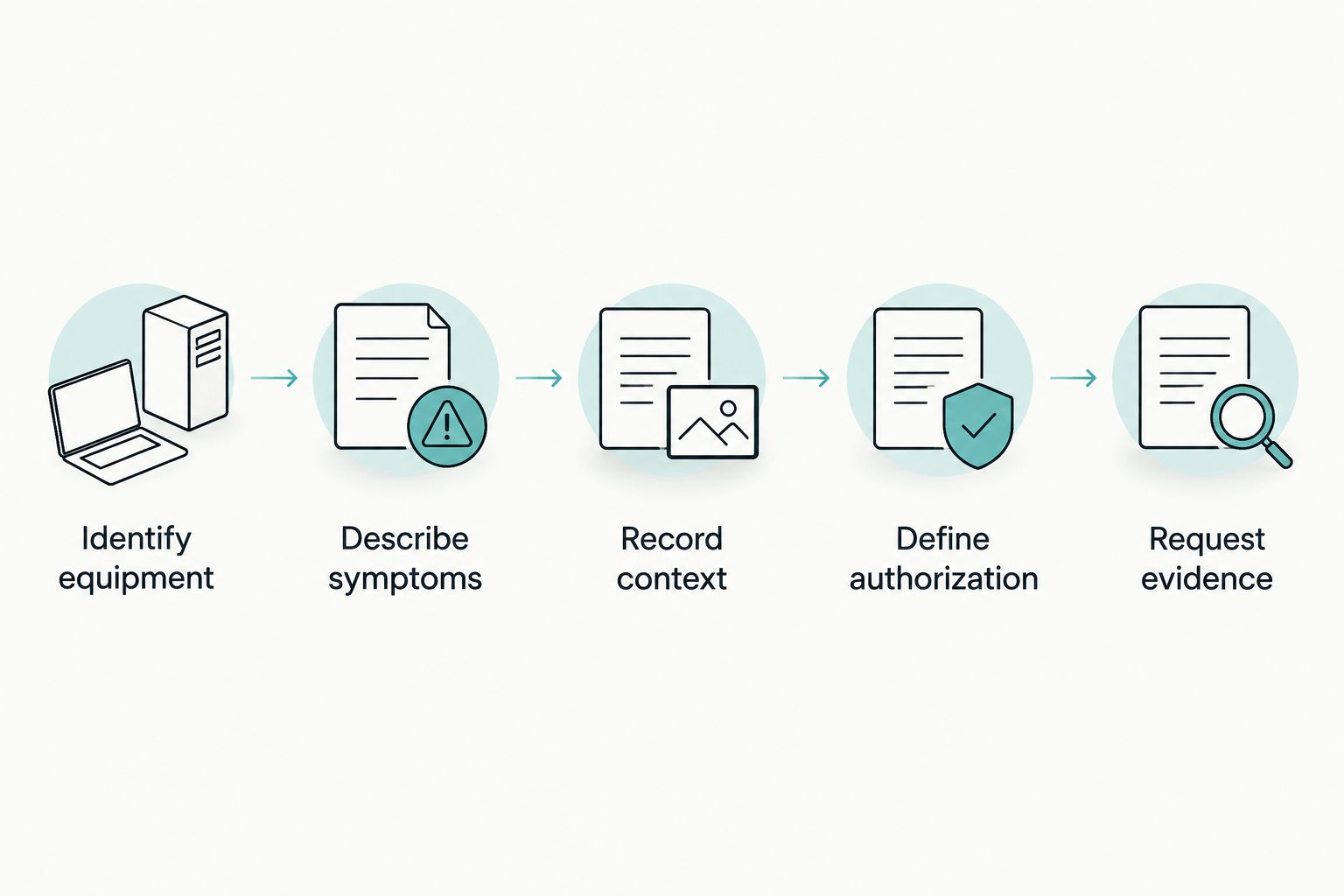
Start with identification, then symptoms, then operating context. A consistent submission gives the technician useful information without asking your team to diagnose an internal mechanical fault.
- Identify equipment. Record the manufacturer, model and serial identifier exactly as marked. Include the relevant coupling, motor or attachment details where applicable.
- Describe symptoms. Record what the clinician observed: unusual noise, vibration, impaired bur retention, spray changes or reduced performance. Describe the observation rather than naming an assumed failed part.
- Record context. State when the symptom occurs and which compatible components were connected. Include relevant maintenance records and any recent service documentation.
- Define authorization. Request evaluation before repair, the proposed scope in writing and approval before additional work.
- Request evidence. Ask for the findings, replaced components, completed checks and written coverage terms with the returned equipment.
Include 1 service record per instrument, even when several instruments travel in the same shipment. This is a documentation rule for your practice: it keeps serial identification, approved work and coverage terms attached to the correct equipment.
Photograph the instrument’s exterior and identification before dispatch. Follow the service provider’s shipping and contamination-control instructions, and obtain clarification before sending equipment if those instructions are incomplete.
Separate maintenance from cleaning and sterilization
A repaired handpiece still requires the manufacturer’s prescribed reprocessing before clinical use. For your 2026 protocol review, CDC dental infection-prevention guidance calls for cleaning and heat sterilization of dental handpieces and associated attachments between patients, following manufacturer instructions.
Use the instructions for the exact model. Do not transfer lubrication steps, cleaning agents, adapters or sterilizer settings from another handpiece because the instruments look similar.
The service discussion should establish:
- Whether the instrument requires lubrication and the specified method.
- Which cleaning and maintenance accessories the manufacturer identifies.
- How removable components are processed.
- Which sterilization instructions apply to the instrument.
- Which maintenance records the provider requests when evaluating a claim.
Do not use a service provider’s general care sheet to override the manufacturer’s instructions for use. Resolve conflicting directions with the manufacturer or an appropriately qualified support contact before returning the equipment to service.
What should a dental handpiece repair warranty include?
A dental handpiece repair warranty should identify the covered work, coverage period, exclusions and claim procedure. Ask whether coverage applies to installed components, labor, the repaired assembly or the complete instrument; those are different commitments.
Also establish who evaluates a recurring fault and who handles transport. A statement that service is covered does not answer whether a new symptom, an unrelated component or return shipping falls within that coverage.
Keep the repair terms with the original equipment documents. Do not assume an independent service agreement preserves, replaces or extends a manufacturer warranty unless the relevant written terms confirm it.
Should you repair or replace a dental handpiece?
Repair a dental handpiece when the documented work addresses the diagnosed fault and the resulting instrument meets your requirements. Compare replacement when the repair proposal does not resolve those requirements or when you need a different equipment configuration.
Use 3 decision checks: repair scope, operating compatibility and written support terms. This is a purchasing framework, not a universal replacement threshold; service history and the actual findings still determine the decision.
For a replacement enquiry with ProElite Dental Supply, provide the current model, connection details and intended procedures. Request confirmation of the proposed equipment’s specifications, maintenance instructions and product-specific service terms rather than assuming they match your existing instrument.
What should you check when a serviced handpiece returns?
Check a serviced handpiece against the authorized work and supplied documentation before returning it to the clinical rotation. Confirm instrument identification, the completed repair, the provider’s test record and any instructions accompanying the work.
Complete reprocessing and pre-use checks according to the manufacturer’s instructions. If the reported symptom remains, or an abnormal condition appears, remove the instrument from use and contact the service provider rather than treating the repair invoice as proof of clinical readiness.
FAQ
What should I ask before approving dental handpiece maintenance?
Ask for the diagnosis, itemized repair scope, proposed components, testing plan and written service terms. Establish which charges apply if you decline the repair and require approval before additional work.
Is replacing a turbine the same as rebuilding the whole handpiece?
Replacing a turbine is not a description of a complete handpiece rebuild. Ask which components the proposed assembly includes and which parts of the instrument remain outside the work.
Should I choose a targeted repair or an assembly replacement?
Choose the option that matches the documented fault and required repair scope. Compare the included components, retained components, testing and coverage rather than relying on the service label.
Can I use the same maintenance routine for every dental handpiece?
Use the maintenance instructions for each exact handpiece model. Cleaning, lubrication, accessories and sterilization instructions must not be assumed interchangeable between instruments.
Does a repair warranty cover the entire handpiece?
A repair warranty covers only what its written terms specify. Confirm whether coverage applies to parts, labor, an assembly or the complete instrument, and ask about exclusions and transport responsibilities.
Can ProElite Dental Supply help with a replacement equipment enquiry?
ProElite Dental Supply sells dental handpieces and other dental equipment to practices and dentists. Include your existing model, connection details and intended use when requesting product information for a replacement comparison.
What records should I keep after handpiece service?
Keep the instrument identification, diagnosis, approved scope, completed-work record and written service terms together. Retain relevant maintenance records so a later fault can be reviewed against the instrument’s history.
One last thing
For your 2026 equipment register, make the serial identifier the link between the instrument, repair authorization and service coverage. A familiar model name is not enough when several similar handpieces move through the same practice.
Before dispatch, ask the provider to repeat the instrument identifier on the estimate and completed-work record. That small administrative requirement makes the repair history traceable without relying on staff memory.