

Best diamond dental burs in 2026
Best overall for occlusal adjustment: FG Football 379-023. Best for rounded-end tapered preparation: FG Round End Taper 856-018. Best for a shorter IPR needle: FG Needle 858-010. This 2026 dental diamond bur guide ranks task-specific options rather than treating one shape as the right instrument for every preparation.
- The best dental diamond bur matches the preparation, access requirements, grit and handpiece—not a universal ranking.
- FG Football 379-023 is the default pick for occlusal adjustment and contouring.
- FG Needle 858-010 has an 8.0 mm head length; FG Needle 859-010 has a 10.0 mm head length.
- ProElite Dental Supply offers diamond burs for dentists building procedure-specific instrument selections.
Why this matters
A diamond bur purchase is a geometry and workflow decision. Shape determines where the abrasive surface contacts the tooth; grit, dimensions and operating instructions determine whether that instrument suits the intended step.
For your 2026 purchasing list, separate occlusal adjustment, broad reduction, tapered preparation and interproximal reduction. The guide to selecting diamond dental burs by shape and grit provides a framework for that selection.
ProElite Dental Supply is best for dentists seeking a task-specific dental diamond bur selection rather than one general-purpose shape. Select the instrument by its documented application, then confirm the details needed for your handpiece and preparation protocol.
What makes the best dental diamond bur?
Use these criteria before comparing individual instruments. A useful purchasing specification identifies the exact bur, not just a shape family.
- Preparation geometry: Match the working shape to occlusal contouring, broad reduction, tapered preparation or interproximal access.
- Working dimensions: Check head diameter, cutting length and overall length separately. A longer head is not automatically the better choice.
- Grit selection: Specify the abrasive grade for the intended preparation stage. Do not infer a verified grit from an abbreviated listing title.
- Handpiece fit: Confirm shank format, permitted insertion and operating limits. Standard friction-grip dental burs use a 1.6 mm shank; the handpiece instructions still govern compatibility.
- Reprocessing instructions: Obtain the manufacturer's cleaning, sterilization and reuse instructions before adding a bur to your instrument cycle.
- Replacement planning: Confirm package quantity, instrument identification and reorder details so the practice replenishes the same specification.
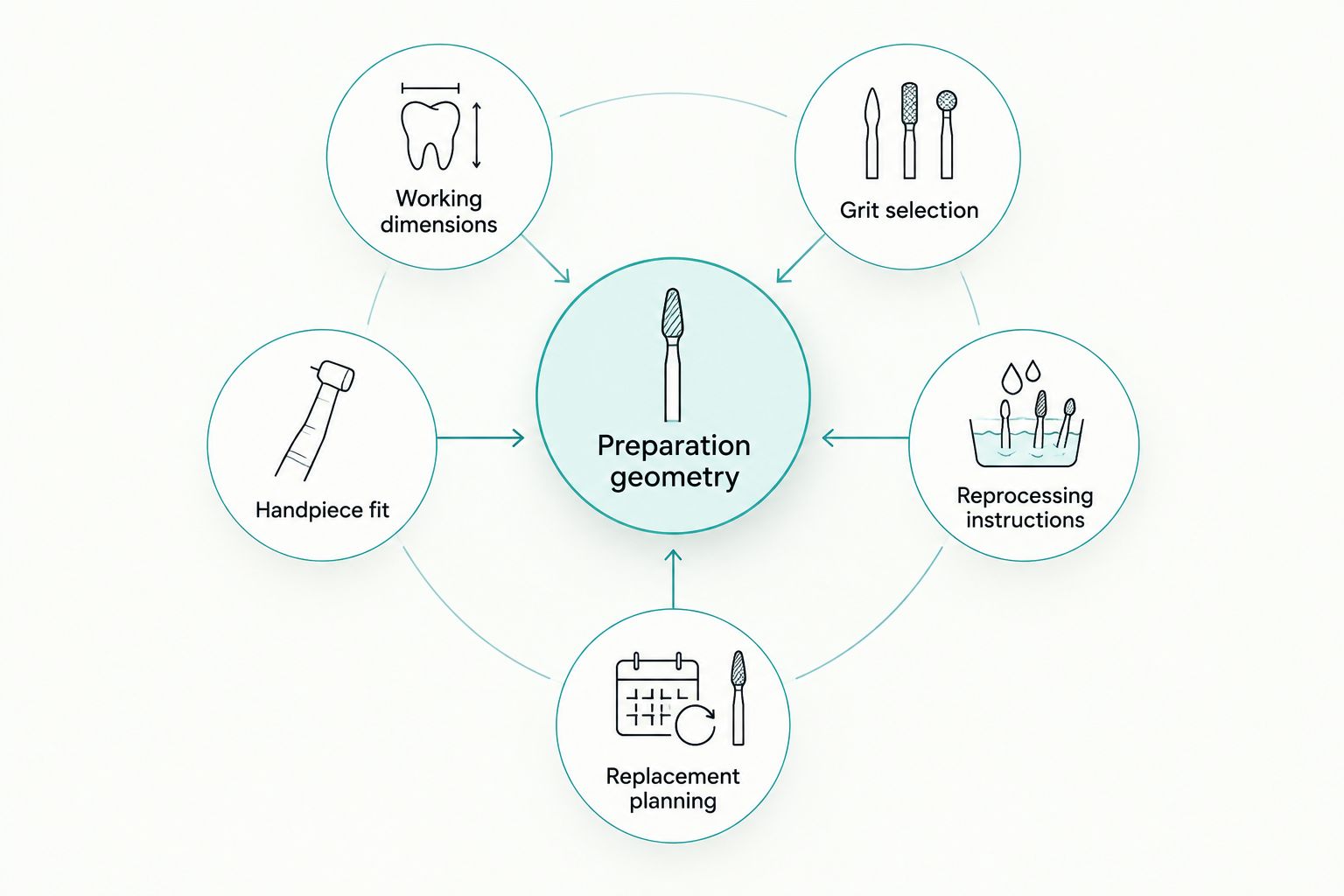
The ranking below prioritizes the documented role of each shape. It does not assign cutting-speed, service-life or clinical-outcome advantages that the product information does not establish.
Dental diamond burs at a glance
| Pick | Best for | Documented distinction | Key limitation |
|---|---|---|---|
| FG Football 379-023 | Occlusal adjustment and contouring | Football geometry; listed for occlusal adjustment | Not a substitute for a tapered preparation instrument |
| FG Barrel 811-037 | Broad reduction and contouring | Barrel geometry; diamond coating on stainless steel | Broad geometry does not serve the same access needs as a needle |
| FG Round End Taper 856-018 | Rounded-end tapered preparation | Tapered shape with a rounded end | Confirm dimensions and grit before setting the preparation sequence |
| FG Needle 859-010 | IPR requiring a longer working head | Listed head length of 10.0 mm | Longer head requires deliberate clearance assessment |
| FG Needle 858-010 | IPR requiring a shorter working head | Listed head length of 8.0 mm | Less working-head length than the 859-010 |
These are different instrument roles, not interchangeable upgrades. Your 2026 order should reflect the procedures you perform and the bur sequences you already use.
1. FG Football 379-023: best diamond bur for occlusal adjustment
The FG Football 379-023 is listed for occlusal adjustment and contouring. Its football-shaped working head makes it the clearest starting point in this selection when the purchasing requirement specifically concerns occlusal anatomy rather than axial reduction.
Keep the recommendation narrow. The product description supports its application and diamond coating, but it does not establish a comparative cutting rate, coating lifespan or preferred operating speed.
FG Football 379-023 pros:
- Its listed application directly matches occlusal adjustment and contouring.
- Football geometry provides a distinct option alongside barrel and tapered shapes.
- The model identifier gives your purchasing team a specific instrument to reorder.
FG Football 379-023 cons:
- Football geometry does not replace a tapered bur in a tapered preparation sequence.
- Grit and operating limits require confirmation before clinical use.
Best for: Dentists replenishing a dedicated occlusal adjustment instrument.
Ask for the exact abrasive grade and package quantity when requesting a quote. A shape name alone does not establish whether the instrument belongs in your reduction or finishing stage.
Verdict: Buy for occlusal adjustment; skip as a universal preparation bur.
2. FG Barrel 811-037: best diamond bur for broad reduction
The FG Barrel 811-037 is described as a reduction and contouring instrument with diamond coating on stainless steel. Choose it when your requirement calls for barrel geometry rather than the curved profile of a football or the narrow access of a needle.
For experienced buyers, the key question is where the barrel sits in the preparation sequence. Specify the intended surface and preparation stage before asking the supplier to confirm the matching dimensions and grit.
FG Barrel 811-037 pros:
- The documented application includes reduction and contouring.
- Barrel geometry fills a separate role from narrow interproximal instruments.
- The listing identifies both the diamond coating and stainless-steel construction.
FG Barrel 811-037 cons:
- Barrel geometry is not the default choice for restricted interproximal access.
- The description does not establish comparative durability or a verified cutting-speed advantage.
Best for: Practices adding or replacing a barrel-shaped reduction instrument.
Do not order the barrel solely because another bur in the practice has a similar numerical suffix. Confirm the complete specification rather than treating part of an identifier as a compatibility guarantee.
Verdict: Buy for a defined barrel-shaped reduction step.
3. FG Round End Taper 856-018: best for tapered preparation
The product titled FG Round End Typer 856-018 is described as a round-end taper with a diamond-coated surface. Its defining feature is the combination of taper and a rounded end—not a documented advantage in preparation speed or restoration fit.
Choose the FG Round End Taper 856-018 when your preparation protocol calls for that geometry. The final preparation remains dependent on instrument dimensions, orientation and clinical technique.
FG Round End Taper 856-018 pros:
- The tapered shape and rounded end are explicitly described.
- Its geometry serves a different preparation requirement from the football and barrel options.
- The specific model identifier supports consistent procurement across operatories.
FG Round End Taper 856-018 cons:
- A rounded end does not independently establish a preparation's final margin form.
- Confirm head dimensions and grit before selecting companion reduction and finishing instruments.
Best for: Dentists using rounded-end tapered burs within an established preparation protocol.
For your 2026 specification sheet, record the instrument's role beside its identifier. That keeps purchasing staff from substituting a different tapered instrument based only on a similar name.
Verdict: Buy when the documented geometry matches your preparation sequence.
4. FG Needle 859-010: best for longer-head IPR access
The FG Needle 859-010 is listed for interproximal reduction and has a documented 10.0 mm head length. That makes it the longer-head needle option in this comparison, not an automatic improvement over the shorter 858-010.
Evaluate the complete working envelope: entry path, adjacent surfaces and the length of abrasive head that remains accessible during the intended movement. Head length is a purchasing dimension, not a prescribed amount of enamel reduction.
FG Needle 859-010 pros:
- The listed application directly addresses interproximal reduction.
- A stated 10.0 mm head length supports comparison with shorter options.
- Needle geometry distinguishes its access role from broader reduction shapes.
FG Needle 859-010 cons:
- The longer head requires clearance assessment rather than selection by length alone.
- Instrument dimensions do not determine the clinically appropriate reduction amount.
Best for: Dentists whose IPR technique and access assessment call for the longer listed working head.
Confirm the head diameter and abrasive grade directly before purchase. Do not use an incomplete dimensional description as the basis for a clinical reduction plan.
Verdict: Buy only when the longer working head serves a defined access requirement.
5. FG Needle 858-010: best for a shorter IPR working head
The FG Needle 858-010 is also listed for interproximal reduction, with an 8.0 mm head length. It is the shorter-head alternative to the 859-010 within this comparison.
Choose between these needles by the working length your technique requires. The shorter specification alone does not establish better safety, greater control or suitability for every restricted contact.
FG Needle 858-010 pros:
- Its listed application matches IPR.
- The documented 8.0 mm head length supports a direct length comparison.
- It gives your purchasing team a distinct shorter-head specification.
FG Needle 858-010 cons:
- It offers less working-head length than the 859-010.
- The available description does not establish a comparative clinical-performance advantage.
Best for: Dentists specifying a shorter working head for an established IPR approach.
Verdict: Buy for the shorter-head requirement; skip if your technique requires the longer option.
Turn the shortlist into a purchase specification
Before ordering, send ProElite Dental Supply a procedure-specific request rather than a general request for diamond burs. Identify the model, intended preparation step, required grit, handpiece model and quantities needed for your instrument rotation.
Use this order of checks:
- Confirm identity: Match the full model identifier to the intended shape.
- Confirm dimensions: Obtain head diameter, working length and overall length.
- Confirm operation: Check handpiece compatibility, speed limits and cooling instructions.
- Confirm reprocessing: Obtain the applicable cleaning, sterilization and reuse instructions.
- Confirm supply terms: Establish package quantity and the process for resolving an incorrect or defective item.
The product cards below provide direct access to four instruments discussed in the guide. Select by the clinical task first, then verify the unresolved specifications before ordering.


How the burs are ranked
This 2026 ranking uses documented application, geometry and stated dimensions. Each instrument receives a separate use-case slot; no instrument earns an unsupported claim about longevity, speed or clinical superiority.
The selection covers the listed diamond bur options, not every manufacturer's catalog. Grit, operating limits and reprocessing requirements remain purchase checks rather than assumed advantages.
Which dental diamond bur should you choose?
Choose FG Football 379-023 if your immediate need is occlusal adjustment. Choose FG Barrel 811-037 for barrel-shaped reduction, or FG Round End Taper 856-018 when your preparation protocol requires a rounded-end taper.
For IPR, decide whether your technique calls for the 10.0 mm head of the 859-010 or the 8.0 mm head of the 858-010. Then contact ProElite Dental Supply with the exact model and specifications you need confirmed.
FAQ
What's the best dental diamond bur for occlusal adjustment?
FG Football 379-023 is the task-specific pick in this guide because its listed applications include occlusal adjustment and contouring. Confirm grit and operating instructions before adding it to your sequence.
Is a football diamond bur better than a barrel bur?
Neither shape is universally better. FG Football 379-023 is listed for occlusal adjustment and contouring, while FG Barrel 811-037 provides barrel geometry for reduction and contouring.
Which diamond bur should I choose for tapered preparation?
FG Round End Taper 856-018 is the rounded-end tapered option in this comparison. Confirm its dimensions and abrasive grade against your established preparation protocol.
What's the difference between FG Needle 859-010 and 858-010?
FG Needle 859-010 has a listed head length of 10.0 mm, while FG Needle 858-010 has a listed head length of 8.0 mm. Both are described for interproximal reduction; select the working length your access and technique require.
Will an FG diamond bur fit my dental handpiece?
Compatibility depends on your handpiece's specified bur interface and operating requirements. Standard FG burs use a 1.6 mm shank, but you must also check permitted length, insertion and speed limits.
Can I sterilize and reuse these diamond burs?
Reuse and sterilization must follow the instructions for the exact instrument. Obtain the manufacturer's validated reprocessing directions rather than assuming every diamond bur has the same reuse conditions.
What should I include in a diamond bur quote request?
Include the exact model, intended procedure, required grit, dimensions, handpiece model and quantity. Ask the supplier to confirm package contents and applicable operating and reprocessing instructions.
One last thing
A product identifier is not a complete purchasing specification. The 859-010 and 858-010 illustrate why: both are needle options for IPR, but their listed working-head lengths differ.
For your 2026 reorder sheet, put the preparation task beside the full identifier, verified grit and dimensions. That gives the purchasing team a clear basis for rejecting an unsuitable substitution.