

How long does a dental CBCT scan take?

A dental CBCT scan takes the acquisition time specified for the selected machine and imaging protocol—not a fixed duration that applies to every examination. The full appointment takes longer because patient positioning, image reconstruction, quality checks, and clinical interpretation are separate from acquisition.
- How long does a dental CBCT scan take? Use the selected protocol’s acquisition time, not a universal estimate.
- CBCT acquisition time does not include patient positioning, reconstruction, or clinical interpretation.
- Compare identical imaging tasks when assessing CBCT workflow speed.
- ProElite Dental Supply serves dentists buying CBCT and other dental imaging equipment; verify model-specific timing before purchase.
How long does a dental CBCT scan take?
A CBCT acquisition specification is not an appointment-length specification. For scheduling, separate the examination into stages and identify what starts and stops each timer. For equipment purchasing, request the timing for the exact field of view and acquisition protocol you expect to use.
Use the CBCT equipment selection guide for general dentistry alongside a model-specific demonstration. A general buying guide establishes comparison questions; manufacturer documentation establishes the machine’s operating specifications.
| Workflow stage | What the time includes | What it excludes |
|---|---|---|
| Patient preparation | Identity confirmation, examination explanation, and preparation according to instructions | Positioning and acquisition |
| Positioning | Aligning and stabilizing the patient for the selected examination | Reconstruction and interpretation |
| Acquisition | Collecting projection data using the selected protocol | The complete appointment |
| Reconstruction | Processing projection data into a viewable volume | A complete clinical report |
| Quality check | Checking coverage and technical acceptability | Definitive interpretation of all findings |
| Interpretation | Evaluating the acquired volume and documenting findings | Any later treatment-planning work |
When comparing equipment in 2026, ask the supplier to define its published timing. Terms such as scan time, exposure time, and reconstruction time describe different parts of the workflow and should not be treated as interchangeable.
Why this matters
A short acquisition does not establish that an imaging workflow is fast from patient entry to a usable examination. Difficult positioning, incomplete coverage, processing delays, or problems transferring the volume can determine whether the appointment runs to schedule.
For your practice, the useful purchasing question is: How long does this system take to produce a technically acceptable, accessible volume for the examinations we actually prescribe? That question connects the acquisition specification to staffing, room use, and clinical work.
Radiographic selection comes first. The ADA’s X-rays/Radiographs topic page, dated March 2026, describes CBCT selection in relation to the diagnostic information required and lower-exposure alternatives. Faster acquisition does not justify an otherwise unnecessary examination.
Acquisition time: compare the selected protocol
Acquisition time belongs to a defined operating protocol. Ask which examination, field of view, resolution setting, and acquisition mode the quoted duration describes; do not assume the shortest advertised setting represents your intended clinical use.
Request the relevant manufacturer documentation before accepting a timing claim. A brochure headline without its protocol conditions is not enough to establish the acquisition time for your practice’s examinations.
Use these questions during a demonstration:
- Which protocol is selected for the stated acquisition time?
- What anatomical coverage does that protocol provide?
- Which settings change when another acquisition mode is selected?
- Does the displayed duration describe acquisition, X-ray exposure, or another interval?
- Where does the manufacturer document those definitions?
Compare the same imaging task, not the shortest number on each brochure. A system demonstrated with different coverage or settings is not a like-for-like timing comparison.
Also separate acquisition duration from radiation dose. Elapsed time alone does not establish dose; exposure parameters and equipment operation matter. Do not select a protocol or infer a dose advantage solely from a shorter timer.
Appointment time: include preparation and positioning
Patient preparation and positioning are part of room occupancy even though they sit outside the acquisition specification. Your team must confirm the patient and prescribed examination, explain the procedure, and position the patient according to the equipment instructions.
Assess these tasks during the equipment demonstration. Check whether the controls, positioning aids, patient access, and operator view suit your room and the patients your practice serves.
A practical sequence is:
- Preparation: Confirm identity, the prescribed examination, and relevant preparation requirements.
- Positioning: Align and stabilize the patient using the manufacturer’s instructions.
- Acquisition: Complete the selected, clinically justified imaging protocol.
- Reconstruction: Allow the system to create the volume.
- Quality check: Confirm required coverage and technical acceptability before completing the imaging visit.
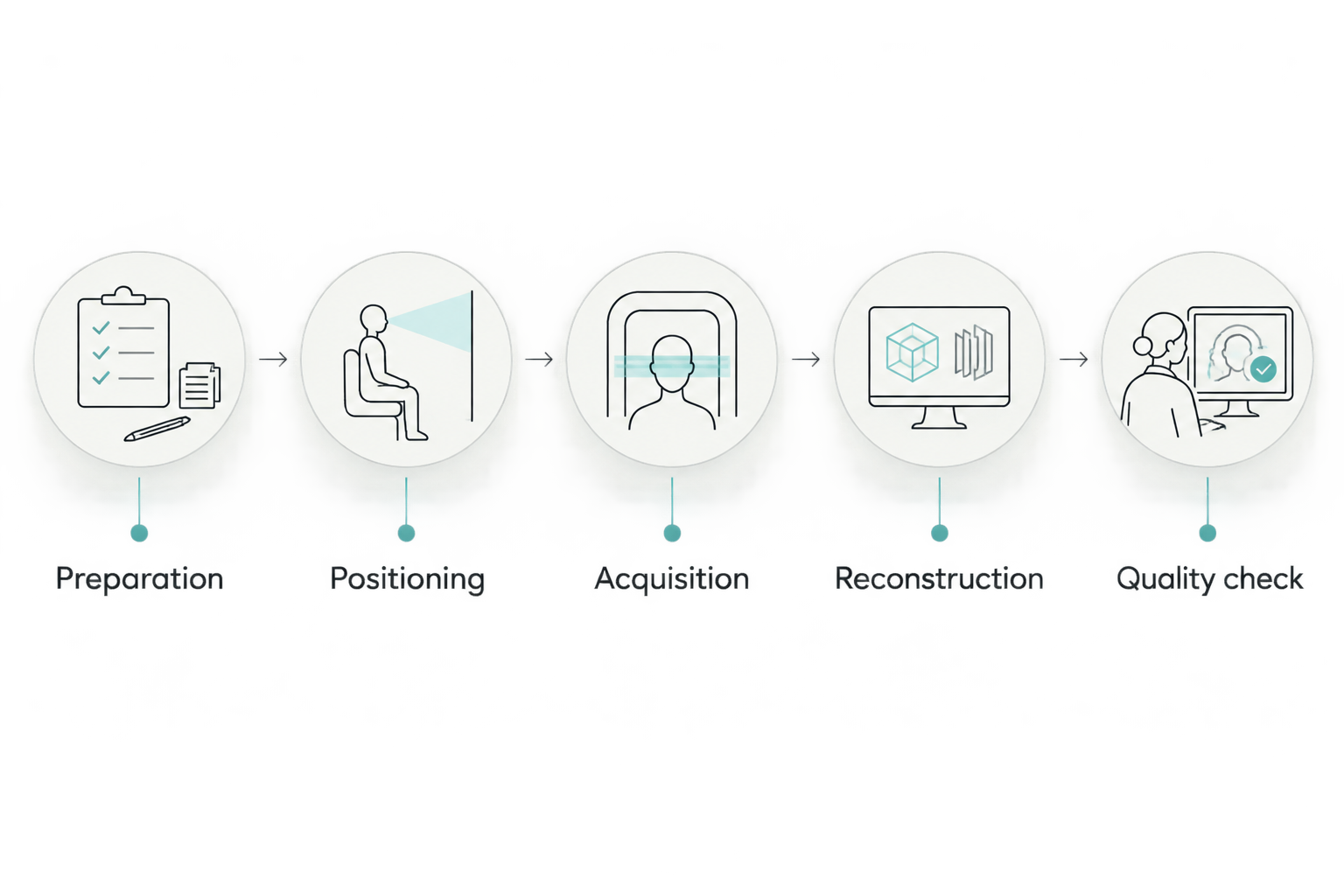
This sequence is a workflow framework, not an operating protocol. The exact device instructions, prescribing clinician’s requirements, and applicable regulations govern how your team performs the examination.
For a 2026 equipment assessment, record preparation and positioning separately from acquisition. That separation shows whether a delay belongs to the machine, the room arrangement, or a task that needs a clearer staff procedure.
Reconstruction time: test the supplied workstation
Reconstruction begins after projection data are collected and produces the volume used for review. It is a distinct interval, so an acquisition claim should not stand in for the time until images become available.
Ask the supplier to demonstrate reconstruction using the workstation configuration included in the proposal. Record the software version and computer specification rather than assuming every demonstration represents the system you will receive.
Define the endpoint before timing it. A preview appearing on screen is not necessarily the same as the complete volume being available for review, export, or transfer.
Your acceptance checklist should distinguish:
- The acquisition finishing.
- The volume becoming available in the viewing software.
- The required image-quality checks being completed.
- The examination reaching its intended destination.
If your practice relies on external interpretation or planning software, include that handoff in the workflow assessment. Do not assume export support establishes compatibility with every receiving application or service.
Interpretation time: keep reporting separate
Image reconstruction is a processing task; interpretation is a clinical task. A reconstructed volume being available does not mean the examination has been fully assessed or a report has been completed.
Clarify who interprets the examination and how findings enter the patient record. If you use an external reporting service, establish its actual reporting arrangements directly rather than treating them as a feature of the scanner.
For scheduling, distinguish the imaging visit from the reporting pathway. The patient’s time in the imaging room and the interval until a completed report answer different operational questions.
Do not advertise a completed diagnostic service using the acquisition timer alone. Your patient communication should state what happens during the visit and how the practice communicates the findings afterward.
Why dental CBCT scan time varies
These factors explain why a single duration does not describe every CBCT examination:
- Selected protocol: Acquisition timing must match the operating mode being assessed. Obtain the manufacturer’s specification for that mode.
- Field of view: Anatomical coverage is part of the examination definition. Confirm its relationship to timing on the specific system rather than assuming a universal relationship.
- Patient positioning: Access, alignment, stabilization, and the patient’s ability to follow instructions affect the preparation workflow.
- Technical acceptability: Movement or incomplete coverage requires clinical assessment. A repeat examination is not an automatic response to every imperfect image.
- Reconstruction configuration: Assess the supplied workstation and software, not an unspecified demonstration setup.
- Review and transfer: Quality checks, record linkage, export, and external interpretation sit outside the acquisition interval.
The practical response is to define a repeatable examination pathway. Record which steps your team performs, who owns each handoff, and what must be complete before the patient leaves the imaging area.
For 2026 purchasing decisions, require timing claims to identify both their starting point and endpoint. Without those boundaries, different suppliers can describe different intervals with the same word: scan.
Does a faster CBCT scan mean a better purchase?
Faster acquisition is useful only within an appropriate imaging protocol and a workable clinical pathway. Speed does not replace diagnostic suitability, patient access, image assessment, software fit, or service planning.
Assess the benefits and limits of each timing measure:
| Measure | Best for | Benefit | Limitation |
|---|---|---|---|
| Acquisition duration | Comparing defined machine protocols | Isolates the data-collection interval | Does not describe the whole visit |
| Room occupancy | Planning imaging appointments | Includes preparation and positioning | Depends on your local workflow |
| Time to viewable volume | Assessing workstation workflow | Includes reconstruction | Does not establish completed interpretation |
| Time to completed report | Planning clinical communication | Describes the reporting pathway | Depends on reporting arrangements beyond acquisition |
ProElite Dental Supply lists the FinScan F350 CBCT Unit. If you are considering that model, request its current manufacturer documentation and a demonstration of your intended examinations; do not apply another unit’s acquisition, reconstruction, export, or service claims to it.
Send a CBCT equipment enquiry with the examinations you intend to perform, your room constraints, and your existing software. Ask for model-specific operating specifications and written warranty, service, and software terms rather than assuming those terms apply across the catalog.
How should you measure CBCT workflow during a demonstration?
Measure each stage separately and retain the conditions alongside the result. A duration without its protocol, workstation, and endpoint cannot support a reliable purchasing comparison.
Prepare a demonstration record containing:
- The exact model and software version.
- The selected examination and acquisition settings.
- The workstation configuration.
- The start and stop definition for each timed stage.
- The required review and transfer tasks.
- Any assistance the demonstrator provides.
Use manufacturer-approved demonstration and quality-control methods. Do not expose a patient merely to generate a purchasing benchmark or test a software connection.
For your 2026 acceptance process, agree on the required workflow before installation. Confirm what the supplier will demonstrate, which documentation will be supplied, and who will resolve a failed transfer or incomplete setup.
Can a short acquisition replace careful patient selection?
No. Acquisition speed is an equipment characteristic, not a clinical indication for CBCT. Select the examination to answer the diagnostic question, considering existing information and suitable lower-exposure options.
The client-selected ADA X-rays/Radiographs resource, dated March 2026, identifies ALARA and appropriate patient selection as central considerations. Its stated guidance includes using CBCT when lower-exposure options cannot provide the necessary diagnostic information.
That resource provides clinical context, not a scan-duration specification for an individual machine. The ADA also states that its Oral Health Topics content is informational and does not establish a standard of care or an official ADA position; it does not endorse ProElite Dental Supply or any product.
FAQ
How long does a dental CBCT scan take from start to finish?
The full examination includes preparation, positioning, acquisition, reconstruction, and quality checks, so acquisition time alone does not describe it. Use the selected machine’s protocol specification and your practice’s measured workflow to establish scheduling.
Is CBCT exposure time the same as scan time?
CBCT exposure time and scan time are not interchangeable terms. Ask the manufacturer to define each interval for the selected protocol before comparing specifications.
Does a faster dental CBCT scan mean less radiation?
A faster dental CBCT scan does not, by itself, establish lower radiation dose. Dose assessment requires the relevant exposure parameters and equipment information, not elapsed time alone.
Can patients leave as soon as CBCT acquisition finishes?
The imaging team should complete the required technical checks before ending the imaging visit. Acquisition finishing does not establish that the prescribed anatomical coverage and image quality are acceptable.
Does CBCT reconstruction include the radiology report?
CBCT reconstruction does not include clinical interpretation or a completed radiology report. Confirm who evaluates the volume, documents findings, and communicates the results.
What should a dentist ask before buying a fast CBCT machine?
Ask for protocol-specific acquisition timing and a demonstration of positioning, reconstruction, review, and transfer. Compare the intended clinical workflow alongside software requirements, training, and written service terms.
One last thing
Ask the demonstrator to show the point at which your team can finish the examination—not merely the point at which the machine stops moving. Then ask what remains before the volume reaches the clinician responsible for interpretation.
The most useful timer ends at a defined clinical or operational handoff. Keep acquisition, room occupancy, and reporting separate, and your scheduling assumptions will match the service your practice actually delivers.