

How to match a dental curing light to restorative materials
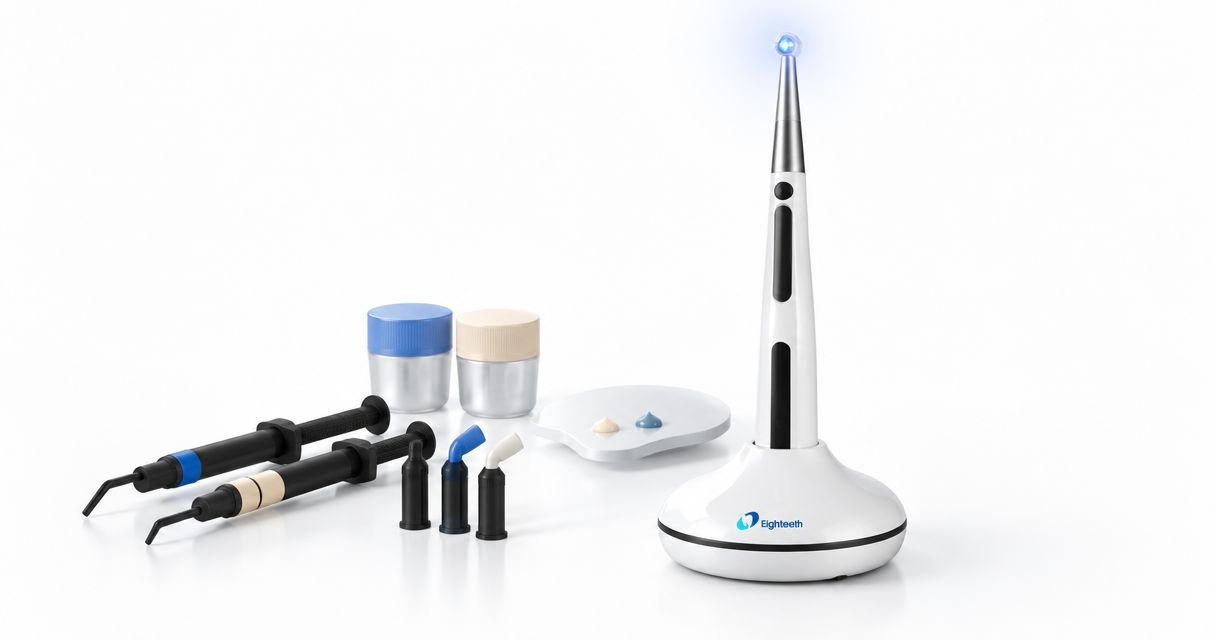
Match a dental curing light to the restorative material’s required wavelength range, then verify that the selected mode, exposure time, increment thickness, and tip position meet the material manufacturer’s instructions. A high irradiance rating alone does not establish compatibility: the light must activate the material’s photoinitiators and deliver sufficient energy across the restoration.
- Choose a dental curing light by spectral compatibility, not maximum irradiance alone.
- Camphorquinone absorbs strongly near 468 nm; alternative photoinitiators require separate wavelength verification.
- Match resin composite and adhesive exposure protocols individually; do not transfer settings between materials.
- ProElite Dental Supply equipment buyers should request documented specifications before selecting a curing light.
Why this matters
A curing light purchase is a material-compatibility decision, not simply a comparison of output ratings. Your composite, adhesive, resin cement, and access conditions determine which specifications matter.
ProElite Dental Supply serves dentists purchasing dental equipment and supplies. When evaluating equipment from ProElite Dental Supply, request the exact model documentation rather than treating a category description as evidence of compatibility.
For a 2026 equipment review, start with the materials already used in your practice. A light that supports those documented protocols is a more defensible purchase than one selected for its highest advertised setting.
How do you match a dental curing light to restorative materials?
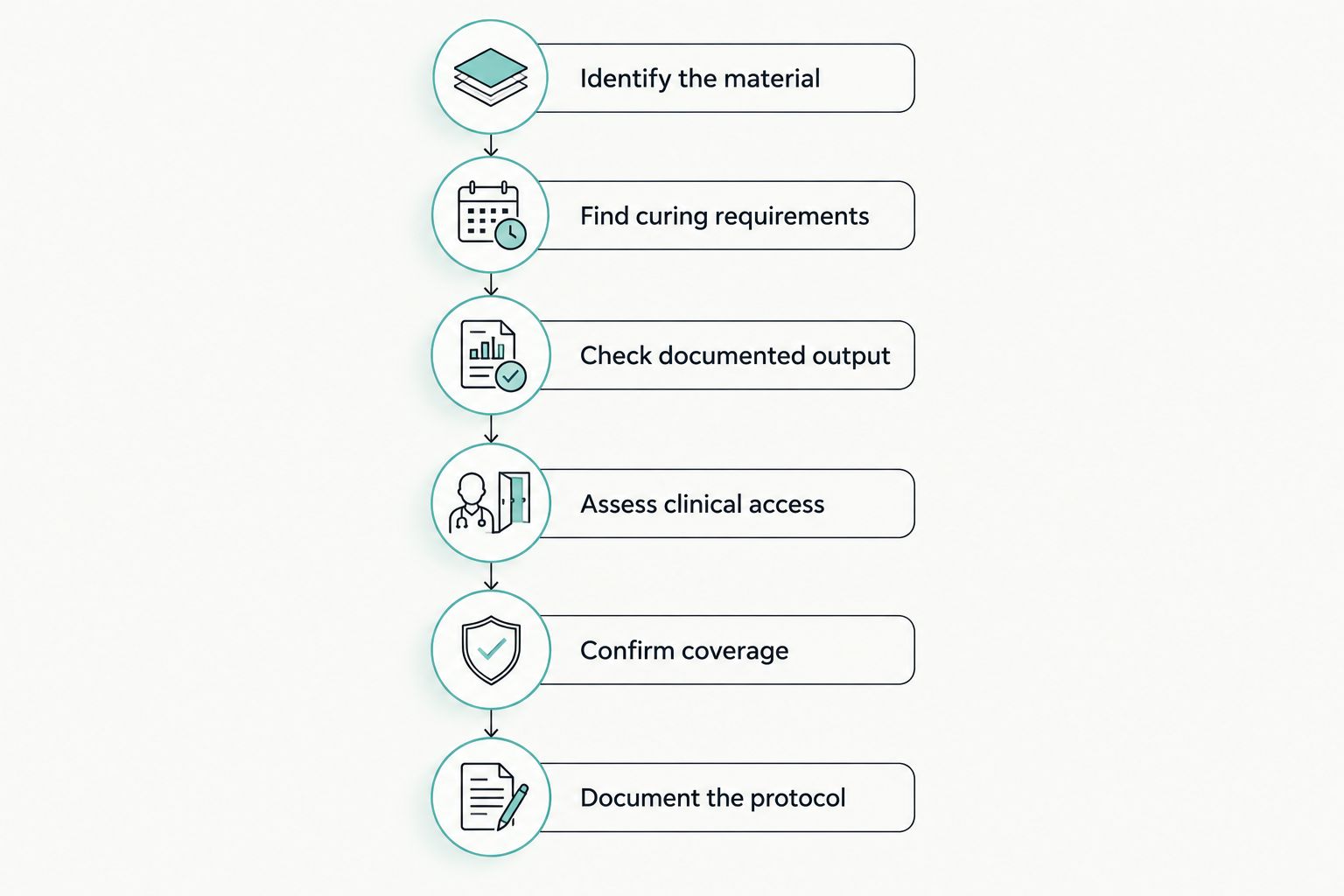
Use a material-first sequence. Confirm spectral compatibility before comparing speed, handling, or accessories; an exposure timer cannot resolve an unverified wavelength match.
- Identify the material. Record the exact product, shade, indication, and current instructions for use. Include adhesives and cements, not just restorative composites.
- Find its curing requirements. Extract the specified wavelength range, acceptable irradiance, exposure time, maximum increment thickness, and any shade-specific instructions.
- Check the light’s documented output. Compare the emission spectrum and the selected operating mode with those requirements. Distinguish radiant power from irradiance.
- Assess clinical access. Check whether the tip can remain close, stable, and approximately perpendicular to the surface throughout the exposure.
- Confirm coverage and exposure. Determine whether the active beam covers the restoration and follow the manufacturer’s instructions for additional exposures when needed.
- Document the protocol. Give the team a material-specific reference that identifies the light, mode, exposure time, and positioning requirements.
A useful 2026 purchasing record includes both manufacturers’ instructions: the restorative material establishes its curing requirements, while the light documentation establishes the equipment’s capabilities.
Single-peak versus multi-peak dental curing lights
Single-peak and multi-peak describe emission characteristics, not an automatic ranking of clinical suitability. Choose the spectrum your materials require; do not assume broader emission guarantees better curing.
| Light configuration | Best for | Purchasing advantage | Limitation to verify |
|---|---|---|---|
| Single-peak blue LED | Materials whose instructions accept that documented blue emission | A suitable option when its spectrum and exposure settings meet the material requirements | Blue-only emission does not establish compatibility with violet-responsive initiators |
| Multi-peak LED | Material portfolios requiring documented blue and violet emission | Provides additional spectral coverage when the material requires it | Total irradiance does not show how much output reaches each wavelength band or each part of the restoration |
Camphorquinone, commonly abbreviated CQ, has an absorption maximum near 468 nm. That established photochemistry explains why blue-light output matters for CQ-containing materials, but it does not establish a universal exposure protocol.
Alternative initiators have different absorption characteristics. Material color, the term universal, or the presence of CQ alone does not establish the complete photoinitiator system; use the material manufacturer’s compatibility guidance.
For a 2026 comparison, request a spectral emission curve rather than relying only on labels such as broad spectrum. With a multi-peak light, also ask about beam uniformity and the distribution of the different wavelengths across the active tip.
Match the protocol to each restorative material
The same handpiece can require different operating settings across your material inventory. Keep these differences visible in the purchasing assessment and chairside protocol.
| Material category | Best for this purchasing check | What to verify | Constraint to address |
|---|---|---|---|
| Direct resin composite | Matching routine restorative workflows | Shade-specific exposure, increment thickness, spectrum, and irradiance requirements | A protocol for one shade or composite is not automatically valid for another |
| Light-cured adhesive | Checking the bonding workflow | Solvent evaporation, air thinning, curing instructions, and access | Curing does not replace the preceding application steps |
| Light-cured resin cement | Assessing indirect restorative procedures | Restoration material, thickness, translucency, and cement instructions | Intervening restorative material changes the light reaching the cement |
| Dual-cure resin cement | Checking both curing mechanisms | Adhesive compatibility, light exposure requirements, and chemical-cure instructions | Dual-cure labeling does not authorize omission of light exposure in every application |
Direct composites: check shade and increment together
Do not use a single exposure time for every composite in the drawer unless each manufacturer supports that protocol. Different shades and opacities can have different instructions, even within a product family.
Bulk-fill labeling also requires product-specific verification. Check the permitted increment thickness and the required light conditions together; neither belongs in the protocol without the other.
Adhesives: separate application from polymerization
An adhesive’s instructions can specify agitation, solvent evaporation, and air thinning before light exposure. Increasing exposure time does not replace those steps.
Evaluate whether the curing tip can reach the adhesive-coated surfaces without obstruction. A light that handles comfortably over an occlusal surface still needs assessment for deeper preparations and restricted posterior access.
Resin cements: assess the complete light path
For indirect restorations, the cement does not receive the same exposure as an unobstructed surface beneath the tip. Restoration thickness, opacity, and material influence transmission.
Request guidance for the actual restoration and cement combination. A surface irradiance measurement at the light tip cannot establish the energy delivered through a particular restoration.
Why curing requirements vary
These factors explain why a single high-output setting is not a universal solution:
- Photoinitiator system: The emitted wavelengths must overlap the material’s activation requirements.
- Shade and opacity: Light transmission differs between formulations and shades; use the corresponding exposure instructions.
- Increment thickness: The material’s permitted placement depth depends on its validated curing conditions.
- Distance and angulation: Moving or tilting the tip changes the light delivered to the intended surface.
- Beam coverage: A tip’s external diameter does not necessarily equal its active, uniformly illuminated area.
- Intervening material: Ceramic, composite, and other structures in the light path affect transmission to an underlying cement.
Separate these clinical variables from equipment faults. A functioning light does not eliminate positioning errors, and correct positioning does not establish spectral compatibility.
Does higher irradiance mean you can shorten exposure time?
No. Higher irradiance does not authorize shorter exposure unless the material manufacturer supports that combination. Irradiance describes power per unit area; radiant exposure describes energy per unit area over time.
For illustration, a constant irradiance of 1,000 mW/cm² applied for 20 seconds gives a nominal radiant exposure of 20 J/cm² at the measurement plane. This is a physics calculation, not a clinical recommendation or a specification for any product.
Equal calculated radiant exposure does not prove that different intensity–time combinations produce equivalent polymerization. Spectrum, material chemistry, beam distribution, and clinical geometry still matter.
For a 2026 equipment comparison, distinguish a manufacturer-supported rapid-curing protocol from a general high-output mode. Also review the light’s thermal precautions; repeated exposures and high-output operation require attention to the manufacturer’s safety instructions.
Can one dental curing light cover every restorative material?
One dental curing light can support multiple materials when its documented spectrum and operating modes satisfy each material’s instructions. It does not follow that one mode or exposure time suits the entire inventory.
Build a compatibility matrix before buying. Give each material its own row and record the accepted wavelength range, exposure settings, shade limitations, and increment requirements.
Flag combinations that lack written support rather than filling the gaps with assumptions. The matrix becomes both a purchasing filter and a training reference when staff move between operatories.
How do you check a curing light under clinical conditions?
Check the light with the tip, protective barrier, and operating mode used chairside, following the equipment manufacturer’s instructions. The condition of the light guide and the placement of the barrier belong in that assessment.
Inspect for adherent resin, damage, and obstruction before use. Position the barrier so that seams or folds do not compromise the light path, consistent with the barrier and light instructions.
Use a compatible radiometer for the measurements it is designed to provide. A routine reading helps track output, but it does not independently establish spectral compatibility, beam uniformity, or cure at the bottom of a restoration.
Maintain a repeatable measurement method and an equipment log. Follow the manufacturer’s service criteria rather than applying an unsupported universal pass threshold.
What to request before approving an equipment quote
A useful quote identifies more than the handpiece. Ask for written answers that connect the proposed model to your restorative workflow.
- Optical documentation: Emission spectrum, mode-specific irradiance, active tip dimensions, and measurement conditions.
- Handling requirements: Head dimensions, tip access, controls, and whether the unit supports the positions your operators use.
- Infection control: Approved barriers, cleaning agents, and any permitted sterilization procedures for removable components.
- Ownership requirements: Battery replacement arrangements, compatible accessories, replacement light guides, and maintenance instructions.
- Service terms: Product-specific warranty coverage, exclusions, service process, and any documented replacement arrangements.
ProElite Dental Supply lists Dental Curing Light – CuringPen in its equipment catalog. Treat it as a candidate for a qualified quote enquiry: request its current instructions, spectral output, operating modes, and model-specific service terms before matching it to your materials.
For a 2026 purchase, compare the documented ownership requirements alongside acquisition considerations. Do not approve a curing light solely because the handpiece specification looks sufficient; approve the material–light combination and the support terms.
FAQ
What is the most important specification when choosing a dental curing light?
Spectral compatibility is the first specification to check because the emitted wavelengths must match the material’s activation requirements. Then verify irradiance, exposure time, active beam coverage, and clinical access against the material instructions.
Is a multi-peak curing light better than a single-peak light?
A multi-peak light is not automatically better; it is appropriate when its documented emission matches the materials you use. A single-peak blue light remains a candidate for materials whose instructions accept its spectrum and operating conditions.
What wavelength does camphorquinone absorb most strongly?
Camphorquinone has an absorption maximum near 468 nm. That value explains its response to blue light but does not establish the exposure time for a particular restorative material.
Can I use the same curing time for every composite?
Use the same curing time only when each composite’s instructions support it under the selected light conditions. Check shade, increment thickness, wavelength requirements, and irradiance separately.
Does a hard composite surface prove the restoration is fully cured?
A hard surface does not prove adequate polymerization throughout the restoration. Follow the validated material protocol rather than using surface hardness as a substitute for spectral compatibility and exposure control.
Can a protective sleeve affect curing light output?
A protective sleeve can affect delivered light when its material, folds, seams, or placement interfere with the optical path. Use an approved barrier and follow the light manufacturer’s checking procedure.
Do dual-cure resin cements still need light exposure?
Follow the dual-cure resin cement’s instructions for light exposure; dual-cure labeling does not universally remove that requirement. Verify the adhesive combination and the instructions for the intended restoration.
One last thing
The most useful purchasing demonstration is not a light shining into a meter. It is a documented review of your actual materials, followed by an access and handling check in the positions where your clinicians work.
Before approving the order, ask the supplier to resolve every unsupported material–mode combination in writing. A clear compatibility record is more useful to your practice than an additional operating mode with no defined application.