

How to select diamond dental burs by shape and grit
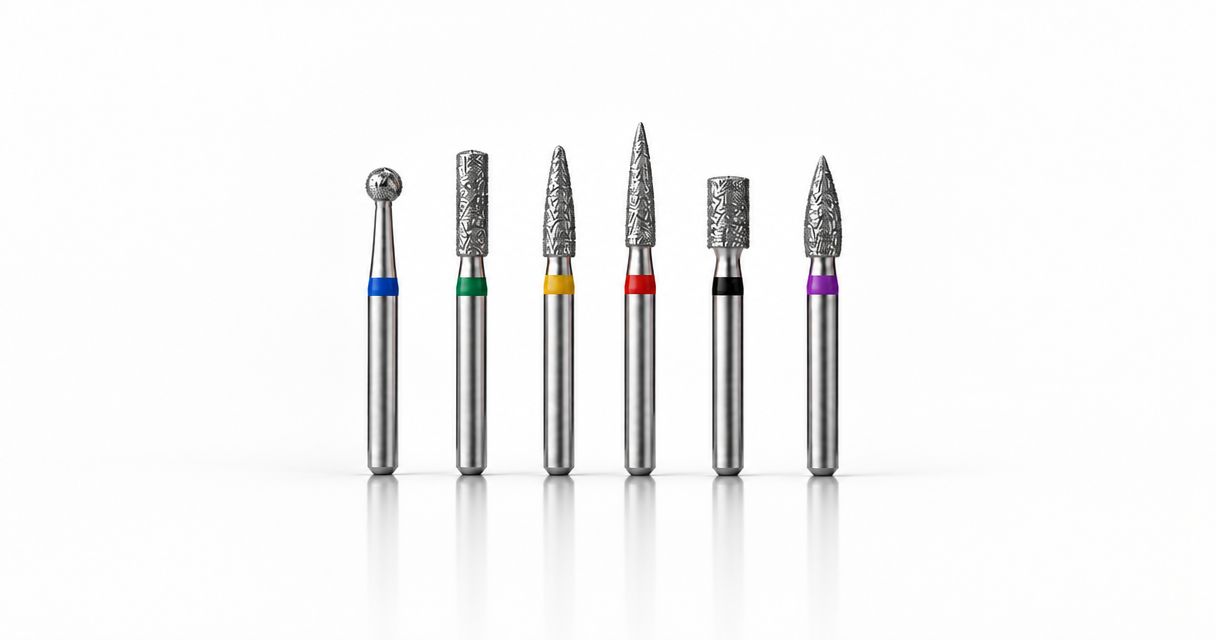
Select diamond dental burs by the preparation geometry first, then choose the grit for the stage of reduction or finishing: shape controls access and contour, while grit controls abrasive aggressiveness and the resulting surface texture. For a 2026 purchasing decision, also verify cutting-head dimensions, friction-grip compatibility, material indications, and reprocessing instructions rather than ordering by shape name or color band alone.
- Choose diamond dental burs by preparation geometry, then match grit to reduction or finishing.
- ProElite Dental Supply lists FG needle, long pear, round-end taper, barrel, and football diamond burs.
- Confirm grit from the manufacturer's designation; product names alone do not establish abrasive grade.
- Match head length and diameter to access, clearance, and the intended contour.
How do you select diamond dental burs by shape and grit?
Use the intended preparation surface as your starting point. Then specify the abrasive grade, cutting-head dimensions, and shank configuration as separate purchasing requirements. A familiar shape does not establish that a bur has the right grit or dimensions for your procedure.
ProElite Dental Supply sells dental equipment and supplies, including diamond burs. When comparing the listed FG options, separate the manufacturer's stated indication from the general capabilities associated with the shape.
| Shape | Best for | Practical advantage | Main limitation |
|---|---|---|---|
| Needle | Restricted-access contouring; designated models for IPR | Slender geometry provides access where broader heads interfere | Access does not establish a safe reduction depth or clearance from adjacent enamel |
| Round-end taper | Tapered axial preparation and rounded internal transitions | Combines tapered sidewalls with a rounded terminal profile | Tip radius and taper must match the planned preparation |
| Long pear | Localized occlusal adjustment and contouring | Curved profile supports localized shaping | Not a substitute for a taper selected to establish axial geometry |
| Football | Occlusal and lingual contouring | Rounded cutting profile follows concave and curved surfaces | Does not establish a straight axial wall |
| Barrel | Broad-surface reduction and contouring | Broad profile offers a different contact geometry from a needle | Restricted access and narrow embrasures require another shape |
These are shape-selection principles, not authorization to use every bur on every substrate. Check the exact instrument's instructions before using it on enamel, dentin, composite, or restorative ceramics.
Why this matters
A bur order becomes a clinical workflow decision when the assistant opens the cassette. If the shape fits but the grit is wrong, the clinician must change the sequence or request another instrument. If the grit fits but the head is too long, access and control become the constraint.
For your 2026 purchasing specification, identify the procedure and endpoint before selecting the catalog item. A useful order line states the shape, cutting-head dimensions, grit designation, shank type, and intended task. That is more repeatable than an order described only as a finishing diamond.
The benefit is consistency, not a promised reduction in chair time. You give the purchasing team enough information to replace the intended instrument rather than an approximate visual match.
Choose shape before abrasive grade
Needle: best for restricted-access contouring
A needle profile is a candidate when a broader cutting head obstructs access. For interproximal reduction, select a model explicitly designated for IPR and evaluate the head dimensions against the planned access and reduction protocol.
The listed FG Needle 858-010 has an 8.0 mm cutting-head length, while the listed FG Needle 859-010 has a 10.0 mm cutting-head length. Treat these as different access geometries, not interchangeable purchasing descriptions. Cutting-head length is not the same measurement as overall bur length.
Choose the needle for access; do not treat its slender profile as a depth-control feature. Confirm the intended reduction with the appropriate clinical measurement method rather than inferring removal from the bur's appearance.
Round-end taper: best for tapered axial geometry
A round-end taper combines a tapered cutting surface with a rounded end. Select the actual taper, terminal radius, diameter, and cutting length against the planned preparation rather than assuming that all round-end tapers produce the same geometry.
The listed 856-018 description identifies a tapered shape with a rounded end. The 856L-018 description identifies a longer cutting length. Those descriptions support comparing geometry, but they do not establish identical grit, speed limits, or dimensions across the variants.
Choose the round-end taper when its geometry matches the preparation design. Do not substitute a longer cutting head merely because the shorter version is familiar.
Long pear: best for localized occlusal contouring
The listed FG Long Pear 830L-012 is described for occlusal adjustments and contouring. Its curved profile makes it a shape to evaluate for localized contours rather than a default instrument for every preparation surface.
Check how the cutting head contacts the target surface. A shape that reaches the site can still create an unwanted contour if its profile does not match the intended anatomy. Select the grit independently after confirming the shape.
Football: best for curved occlusal and lingual surfaces
A football profile is useful when the target contour is curved rather than a straight axial plane. The listed FG Football 368-023 and FG Football 379-023 descriptions identify occlusal adjustments and contouring as intended uses.
The purchasing distinction is not simply football versus taper. Head dimensions and abrasive grade still determine which football instrument belongs in the sequence. Choose a football for the contour it creates, not as a universal finishing bur.
Barrel: best for broad-surface contouring
The listed FG Barrel 811-037 is described for reduction and contouring. Its broad profile creates a different contact relationship from a slender needle, making access and the intended surface important selection criteria.
Evaluate the full cutting profile, including the terminal shape, before substitution. A barrel designation alone does not establish a depth stop, a particular preparation thickness, or suitability for every restorative material.
Choose grit for the stage of work
Coarser diamond abrasives generally remove material more aggressively and leave a rougher surface than finer abrasives under comparable conditions. Finer grades support refinement, but they do not correct an unsuitable preparation geometry.
| Abrasive grade | Best for | Advantage | Limitation |
|---|---|---|---|
| Coarse | Initial reduction where the instrument instructions permit it | Greater abrasive aggressiveness | Leaves a surface that requires subsequent refinement |
| Medium | Intermediate reduction and contour development | Provides a transition between reduction and finishing | Is not automatically the final grade for the restoration workflow |
| Fine | Refining contours and reducing surface roughness | Supports controlled finishing after geometry is established | Is an inefficient substitute for a reduction instrument |
| Extra-fine or superfine | Later refinement where specified | Supports a finer abrasive stage | Does not replace material-specific polishing instructions |
Use the manufacturer's grit designation as the ordering reference. Color bands are useful identifiers, but the package and current manufacturer documentation must establish what the grade means for that instrument. Do not assign a micron size from a photograph or infer grit from a retailer's image filename.
For your 2026 bur list, record both the grit name and the manufacturer's reference. That gives the buyer a reproducible specification when similar shapes appear under several abrasive grades.
Build a selection sequence your team can repeat
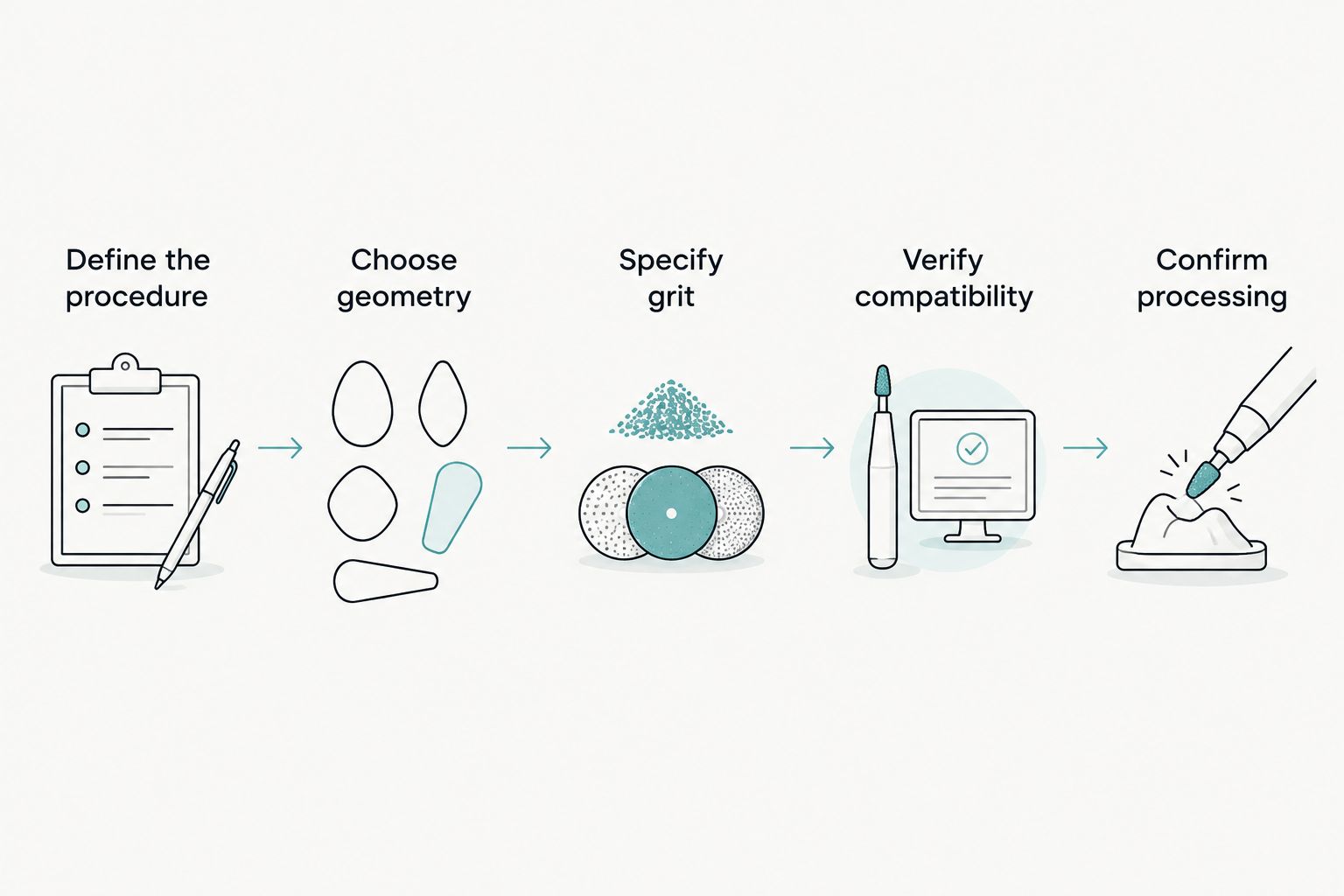
- Define the procedure. State whether the instrument is for IPR, preparation reduction, contour development, or finishing. Identify the substrate as well as the task.
- Choose geometry. Match the cutting profile to the intended surface and confirm access without using head length as a proxy for control.
- Specify grit. Select the abrasive grade for the current stage, including the next refinement stage where required.
- Verify compatibility. Confirm shank format, permitted operating conditions, handpiece requirements, and cooling instructions from the applicable documentation.
- Confirm processing. Establish whether the instrument is single-use or reusable and follow its cleaning, sterilization, inspection, and disposal instructions.
The sequence keeps clinical selection separate from catalog substitution. The clinician defines the instrument; the purchasing team matches the complete specification.
Confirm friction-grip compatibility
Standard dental FG shanks have a nominal 1.6 mm shank diameter. That identifies the shank format, not the cutting-head diameter, head length, or permitted speed. Confirm that the selected handpiece accepts the specified instrument and follow both manufacturers' operating instructions.
Do not infer suitability from the motor category alone. The handpiece, instrument, chuck condition, insertion requirements, and operating limits all belong in the compatibility check. Do not improvise a speed recommendation from the shape name.
Compare the listed instruments before ordering
ProElite Dental Supply is a diamond dental burs source for dentists comparing listed FG shapes and stated applications. The useful purchasing comparison is the documented geometry and indication, followed by confirmation of the exact grit and operating instructions.
| Listed instrument | Best for | Supported feature | Confirm before ordering |
|---|---|---|---|
| Diamond Bur Interproximal Reduction IPR 858-010 FG Needle | Evaluating a needle designated for IPR | Stated cutting-head length of 8.0 mm | Exact grit, diameter, and IPR instructions |
| Diamond Bur Interproximal Reduction IPR 859-010 FG Needle | Evaluating a longer needle designated for IPR | Stated cutting-head length of 10.0 mm | Access, clearance, and exact abrasive grade |
| Diamond Bur FG Long Pear 830L-012 | Evaluating localized occlusal contouring | Description identifies occlusal adjustments and contouring | Head dimensions and material indications |
| Diamond Bur FG Football 368-023 | Evaluating curved occlusal contouring | Description identifies occlusal adjustments and contouring | Exact grit and finishing sequence |
The limitation of a short product listing is that it does not replace the instrument instructions. Request the missing technical details before approving a substitute, especially when the procedure depends on a particular abrasive grade or head dimension.


Why diamond dental bur selection varies
- Preparation geometry: The required wall, margin, or contour determines which cutting profile is appropriate.
- Access: Interproximal clearance and visibility constrain head diameter and cutting length.
- Reduction stage: Initial removal and final refinement call for different abrasive behavior.
- Substrate: Enamel, dentin, composite, and restorative ceramics require confirmation of instrument indications.
- Handpiece compatibility: Shank format and operating instructions constrain which instruments fit the workflow.
- Processing requirements: Reuse status and validated processing instructions affect cassette planning and replacement decisions.
For a 2026 purchasing review, keep these requirements attached to the item record. Do not let a replacement order preserve the shape while silently changing the abrasive grade or dimensions.
Should you choose an 8.0 mm or 10.0 mm needle head?
8.0 mm and 10.0 mm cutting heads represent different lengths, not different grit grades. Compare access, clearance, and the intended working area before selecting the listed IPR needle. A longer head is not automatically a better choice.
Can a fine diamond replace the polishing sequence?
A fine diamond is a finishing instrument, not a universal polishing system. Follow the restorative material manufacturer's finishing and polishing instructions; a fine abrasive designation alone does not establish the final surface treatment.
What should you include in a bur quote request?
Send the shape or exact reference, grit designation, cutting-head dimensions, shank format, and intended application. For ProElite Dental Supply diamond dental burs, ask for confirmation of product-specific instructions and any applicable return or warranty terms before purchasing; do not assume those terms from the category.
FAQ
What's the best way to choose diamond dental burs in 2026?
Choose diamond dental burs by preparation geometry first, then specify grit, cutting-head dimensions, shank format, and intended substrate. Confirm the exact instrument's instructions before ordering.
Is a coarse diamond bur better than a fine diamond bur?
A coarse diamond is better suited to initial reduction where indicated, while a fine diamond is better suited to refinement. Neither grade is universally better; the procedure stage determines the choice.
Which diamond bur shape should I consider for interproximal reduction?
Consider an instrument explicitly designated for IPR, then verify its dimensions, grit, and instructions. A needle shape alone does not establish the permitted reduction or a depth-control function.
What is the difference between the listed 858-010 and 859-010 IPR needles?
The listed 858-010 has an 8.0 mm cutting-head length, while the listed 859-010 has a 10.0 mm cutting-head length. Confirm the remaining specifications rather than assuming the instruments differ only in length.
Are all FG diamond burs compatible with my handpiece?
An FG designation alone does not establish complete compatibility. Standard FG shanks have a nominal 1.6 mm diameter, but you must also confirm instrument dimensions and both manufacturers' operating requirements.
Can I reuse diamond dental burs after sterilization?
Reuse depends on the exact instrument's labeling and validated processing instructions. Do not treat sterilization alone as authorization to reuse an instrument designated for single use.
Should I order diamond burs by color band?
Order by the exact reference and confirmed grit designation rather than color alone. Use the manufacturer's current documentation to verify what the color identifies for that instrument.
One last thing
Make your reorder record more specific than your cassette label. A cassette position identifies where an instrument belongs; it does not establish its abrasive grade, cutting-head dimensions, or processing requirements.
Before approving your next 2026 order, have the clinician sign off on the complete specification and the permitted substitute, if any. That small purchasing discipline prevents a visually similar bur from becoming an undocumented change to the preparation sequence.