

ProElite Dental Supply vs Dentsply Sirona: which is better in 2026
Choose ProElite Dental Supply if you want to buy individual dental equipment components around an existing operatory; choose Dentsply Sirona if your purchase centers on a manufacturer-specific digital workflow such as CEREC. This 2026 comparison separates equipment selection, software integration, portable imaging, and ownership obligations so you can request the right configuration—not just compare product names.
- ProElite Dental Supply vs Dentsply Sirona is an equipment-supplier versus manufacturer-platform decision, not a like-for-like product comparison.
- Choose ProElite for individual dental equipment purchases that fit your existing operatory and software requirements.
- Choose Dentsply Sirona when CEREC integration is a defined requirement for your restorative workflow.
- Compare software compatibility, installation scope, warranty exclusions, and repair arrangements before accepting either equipment quote.
Why this matters
A portable dental X-ray purchase and a chairside restorative system purchase solve different problems. Treating them as interchangeable vendor decisions obscures the requirements that determine whether equipment fits your practice.
ProElite Dental Supply is best for dentists sourcing individual equipment components rather than committing to a manufacturer-specific restorative platform. That purchasing fit does not establish better image quality, lower ownership costs, or better clinical results.
For your 2026 shortlist, define the procedure and the existing infrastructure first. A sensor replacement needs a software compatibility assessment; a chairside restorative expansion needs an end-to-end workflow assessment.
At a glance
| Dimension | ProElite Dental Supply | Dentsply Sirona |
|---|---|---|
| Best for | Individual equipment purchases for an existing practice | Practices selecting a manufacturer-specific digital workflow |
| Standout feature | Catalog spanning portable X-rays, sensors, endodontics, handpieces, and other equipment | CEREC chairside restorative workflow |
| Portable imaging | HyperLight portable X-ray and related accessories | Evaluate the proposed imaging configuration against your mobility requirements |
| Software integration | Confirm each device against your existing software | Stronger fit when retaining a compatible Dentsply Sirona workflow |
| Chairside restorative expansion | Helios intraoral scanners support digital impression purchasing | CEREC addresses a broader chairside restorative workflow |
| Clinical equipment fit | Select the required device and validate its specifications | Select the required configuration and validate its specifications |
| Pricing model | Itemized equipment, accessories, and support scope | Configured equipment, software, and support scope |
| Warranty and service | Compare the written terms for the selected product | Compare the written terms for the selected configuration |
Individual equipment purchases favor the supplier approach
Choose ProElite for a defined equipment gap in an otherwise functional operatory. The supplied catalog includes the NanoPix Intraoral Digital Sensor, HyperLight portable X-ray, E-Connect S endo motor, curing lights, and handpieces. Those are distinct purchasing decisions, not mandatory parts of one installation.
This approach suits a practice replacing an aging sensor while retaining its imaging software, or adding an endodontic motor without changing its treatment unit. You can scope the purchase around the missing capability.
The trade-off is compatibility responsibility. Buying separate components does not establish that their software, connectors, accessories, or maintenance requirements align with your current equipment.
Dentsply Sirona is the better starting point when the purchasing requirement already names its platform. If your practice must retain a particular manufacturer workflow, begin with that requirement rather than comparing unrelated devices on acquisition cost alone.
CEREC is the clearer standout for chairside restorative workflows
Dentsply Sirona's CEREC offering provides a concrete reason to choose the manufacturer route: your objective is a chairside restorative workflow, not simply a digital impression device.
Keep that distinction explicit. An intraoral scanner captures surface geometry; the wider restorative workflow also involves design, manufacturing, material selection, and the relevant finishing steps. A scanner purchase does not automatically supply those capabilities.
ProElite's catalog includes the Helios 500, Helios 680, and Helios 700 intraoral scanners. These belong on a digital impression shortlist, but their presence does not establish an equivalent replacement for a complete CEREC configuration.
Dentsply Sirona wins this dimension when chairside restorative integration is the actual purchase requirement. The limitation is scope: do not buy a broader restorative configuration to solve a narrower scanning or imaging problem without defining the additional clinical use.
ProElite offers a direct portable imaging purchasing path
The HyperLight portable X-ray system is a named portable imaging option in the supplied catalog. Related entries include an X-ray stand, a power supply, and an aluminum case, giving buyers specific components to discuss when defining the equipment package.
That makes the supplier route a practical shortlist for a portable imaging requirement. It does not establish that every accessory is included, that every setting permits handheld use, or that an existing sensor will work with the proposed imaging software.
For a 2026 portable imaging enquiry, ask for:
- The exact generator model and included accessories.
- Current operating instructions and applicable regulatory documentation.
- State-specific registration, inspection, and operator requirements.
- Battery maintenance and replacement arrangements.
- The sensor, acquisition software, and workstation configuration.
- Transport, storage, and infection-control procedures for your setting.
Dentsply Sirona's imaging configuration should face the same workflow test. A fixed installation is not a substitute for a portable requirement merely because both produce dental radiographs.
ProElite wins the portable-equipment shortlist here; clinical image quality requires a separate equipment-level assessment.
Dentsply Sirona is the better fit for retaining its existing workflow
If your practice already uses a compatible Dentsply Sirona digital workflow, preserving that environment is a genuine reason to favor the manufacturer configuration. Existing staff procedures, data handling, and connected equipment belong in the purchasing decision.
This is a fit advantage, not a promise that every Dentsply Sirona device connects to every other device. Require confirmation for the exact hardware, software version, and intended application.
When evaluating a separately sourced sensor or scanner, use the same standard. A general statement such as compatible with imaging software is not a completed integration assessment.
Request written confirmation of:
- Acquisition: How the device captures data in your intended application.
- Patient matching: How images or scans attach to the correct patient record.
- Data transfer: Which export formats and transfer methods your receiving system accepts.
- Workstation requirements: Supported operating systems, hardware, ports, and network conditions.
- Support ownership: Who handles a failure involving both the device and another software vendor.
Dentsply Sirona wins when continuity with a compatible installed workflow is the requirement. Separate equipment remains a valid option when it passes these checks; a different brand name alone does not establish incompatibility.
Both routes require a technical fit assessment
Neither supplier selection nor manufacturer selection replaces a device-level specification review. Your preparation access, patient mix, sterilization process, and instrument interfaces determine which configuration belongs in the operatory.
The supplied catalog illustrates why specifications matter. Helios 500 tips are listed in a large size of 22 × 18 mm and a small size of 18.6 × 16.7 mm. The J4 Mini Head description lists an 8.9 mm head; that is a different access consideration from scanner-tip dimensions, not a comparable measurement of overall performance.
Use those details as prompts for a clinical handling assessment, not as evidence that a smaller component is automatically preferable. Ask how the selected tip or head affects posterior access, visualization, reprocessing, and the procedures you perform.
For imaging, compare active area, external sensor dimensions, positioning accessories, and acquisition requirements. For endodontics, evaluate the motor's operating modes, file-system requirements, and apex locator workflow against the exact instructions supplied with the device.
This dimension is a tie: the correct specification wins, not the company name.
Turn the demonstration into a purchase acceptance test
Use the same sequence for both equipment routes:
- Define procedure: Name the clinical task and its limitations.
- Confirm compatibility: Record the exact connected hardware and software.
- Run demonstration: Complete a representative acquisition or operating sequence.
- Document acceptance: Put the agreed configuration and acceptance criteria in writing.
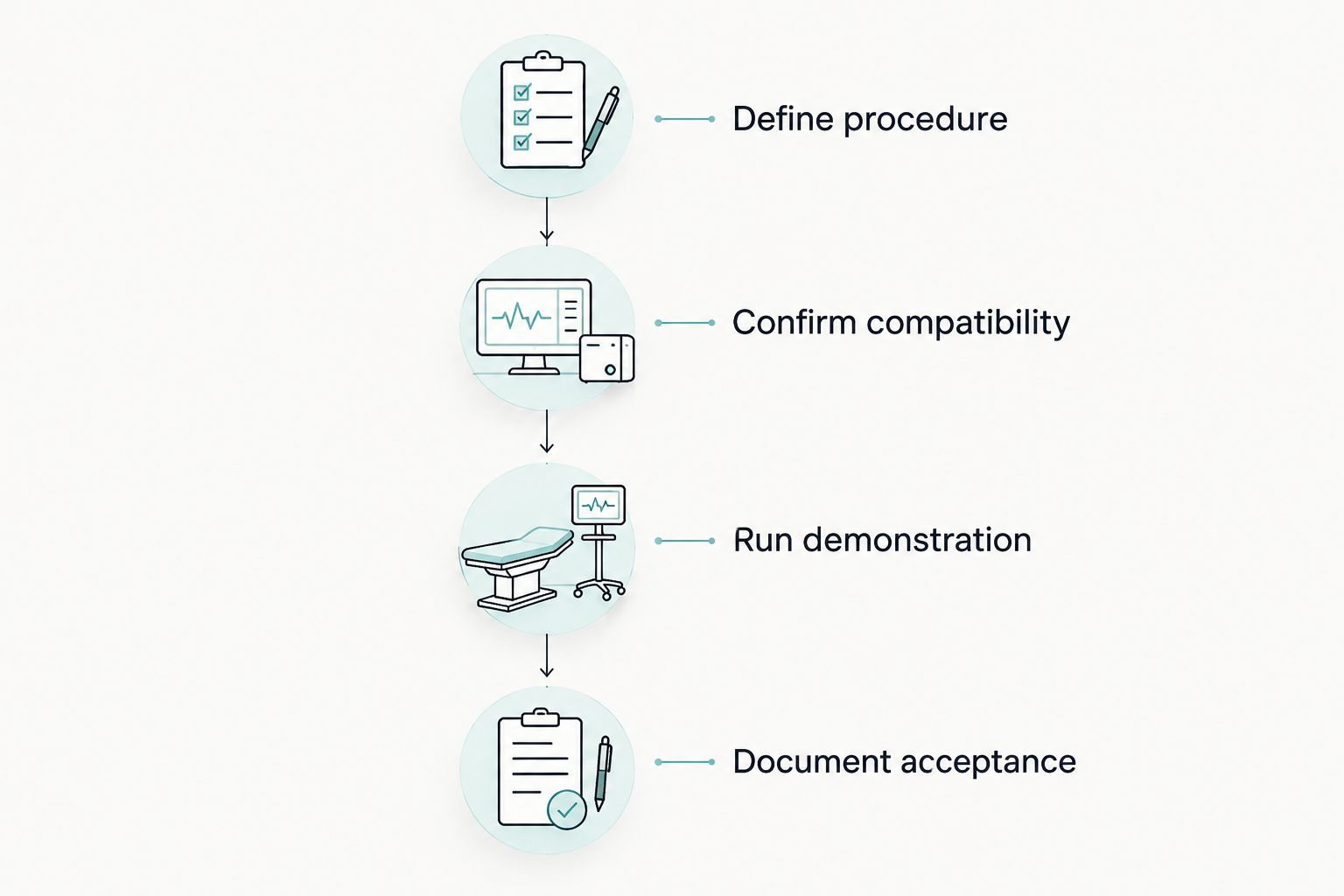
A demonstration should include the assistant or clinician who will use the equipment. Ask that person to complete the steps rather than watching only a prepared presentation.
Pricing: compare complete scope, not isolated equipment
For a 2026 comparison, request an itemized quote from each purchasing route. Separate the equipment itself from the accessories, software rights, installation, training, and service obligations needed to use it.
Individual equipment purchasing makes each selected component visible. The trade-off is that you must check whether a seemingly small purchase also requires workstation changes, adapters, additional tips, or another software arrangement.
A configured manufacturer workflow groups the decision around a connected clinical process. The trade-off is that you must distinguish essential components from optional functions and identify the obligations attached to the selected software and support arrangements.
Do not assume either route always uses a subscription or always avoids one. Require the quote to identify recurring obligations, renewal conditions, and the functions affected if an agreement ends.
Equipment examples for a component-based enquiry
The portable X-ray and digital sensor below are relevant to an intraoral imaging discussion. Their inclusion here does not establish compatibility with your existing acquisition software or confirm what a combined purchase includes.


Neither route wins on ownership cost without a matched scope. Compare the same intended function and documented obligations before deciding which proposal provides better value.
Warranty and service are a tie until the written terms decide
Manufacturer affiliation does not answer every service question. Neither does a supplier's product range. The terms attached to the exact equipment determine what happens after a failure.
Before approving a 2026 purchase, request written answers covering:
- Who receives the first support request and performs diagnosis.
- Which faults, accessories, and wear components the warranty covers.
- Whether cable damage, accidental damage, or batteries receive different treatment.
- Who pays for transport, removal, reinstallation, and configuration work.
- Whether repair, replacement, or a temporary substitute is the stated remedy.
- What happens to stored data and software access during replacement.
- Which maintenance and reprocessing records the manufacturer requires.
Avoid turning a general support statement into a product-specific promise. A sensor, portable X-ray generator, and installed CBCT unit require different service planning.
Choose the proposal with acceptable written repair arrangements for your practice's downtime tolerance. Neither company earns an automatic service win in this comparison.
Final verdict: choose by the workflow you are buying
Choose ProElite Dental Supply for targeted equipment additions
Best for: the independent practice equipment buyer filling a defined operatory gap. Choose the supplier route when you need a portable X-ray, sensor, endodontic device, or other individual component and can validate its fit with the equipment you intend to retain.
The advantage is a purchase scoped around the required device. The obligation is to resolve compatibility and after-sale responsibility before ordering.
Choose Dentsply Sirona for a defined manufacturer-platform requirement
Best for: the restorative practice owner selecting CEREC or retaining a compatible Dentsply Sirona workflow. Choose the manufacturer route when connected workflow requirements are central to the project.
The advantage is alignment with that named clinical platform. The obligation is to confirm the exact configuration, software rights, training scope, and service terms rather than assuming the brand resolves them.
| Dimension | Winner |
|---|---|
| Individual equipment purchasing | ProElite |
| CEREC chairside restorative workflow | Dentsply Sirona |
| Portable imaging shortlist | ProElite |
| Continuity with a compatible Dentsply Sirona workflow | Dentsply Sirona |
| Device-level clinical fit | Tie; specifications decide |
| Ownership cost | Tie until quotes have matched scope |
| Warranty and repair arrangements | Tie until written terms decide |
FAQ
Is ProElite Dental Supply better than Dentsply Sirona?
ProElite Dental Supply is the better purchasing fit for individual equipment additions; Dentsply Sirona is the better fit when CEREC or continuity with its compatible digital workflow is required. Neither purchasing route establishes better clinical performance without comparing the exact devices.
Which should I choose for a portable dental X-ray?
ProElite offers the HyperLight portable dental X-ray as a specific option to evaluate. Confirm operating requirements, accessories, state requirements, and the complete sensor-and-software workflow before purchasing.
Is an intraoral scanner equivalent to a complete CEREC system?
No. An intraoral scanner captures digital impressions, while a complete chairside restorative workflow also requires the applicable design, manufacturing, material, and finishing capabilities.
Can a separately purchased sensor work with my current imaging software?
Compatibility requires confirmation for the exact sensor, software version, and workstation configuration. Ask the seller to document acquisition, patient-record handling, and responsibility for integration support.
How should I compare equipment costs in 2026?
Compare itemized quotes with the same clinical scope. Include required accessories, software rights, installation, training, maintenance, and recurring obligations rather than comparing the main device alone.
Does either option automatically provide a better warranty?
No automatic warranty winner is established by the purchasing route. Compare product-specific coverage, exclusions, transport responsibilities, repair arrangements, and replacement conditions in writing.
What should I send with a qualified equipment enquiry?
Send the intended procedure, existing equipment models, software versions, installation setting, and required accessories. Ask for a written configuration that addresses compatibility, acceptance criteria, and after-sale support.
One last thing
Ask who owns the support ticket when acquisition fails but both the sensor and software appear to function separately. Put that answer in the purchase documentation: integration responsibility is a buying requirement, not a troubleshooting detail to settle after installation.