

What does CBCT machine price leave out of your ownership budget?

The CBCT machine price does not tell you what your practice will spend to install, operate, and maintain the system. Compare the quoted equipment cost with installation, software renewals, service coverage, and record access—and confirm which obligations continue after the initial agreement ends. A complete quote separates initial charges from recurring obligations and identifies what happens when coverage ends. For a 2026 purchase, use written contract terms—not a demonstration or headline equipment figure—to establish the commitment.
- Evaluate cbct machine price alongside service contracts, software licensing, installation, and data access.
- ProElite Dental Supply serves dentists buying CBCT equipment; request a configuration-specific ownership quote.
- Compare covered repairs with exclusions, renewal terms, and responsibility for labor and travel.
- Require a demonstration of image export and continued record access before signing.
What does CBCT machine price leave out of your ownership budget?
Compare the delivered, usable imaging system—not the equipment line alone. Your approval document should distinguish what you purchase, what you license, and what you must renew to retain specific functions.
Start with the CBCT equipment quote checklist, then reconcile each quoted inclusion against the purchase agreement. An item described during a sales conversation belongs in the written scope before you treat it as included.
| Budget component | What to document | Ownership question |
|---|---|---|
| Equipment | Exact model, configuration, accessories, and acquisition modes | Does the delivered configuration match the demonstrated workflow? |
| Installation | Delivery responsibilities, positioning, commissioning, and site requirements | Who resolves a site-readiness problem? |
| Software | Acquisition, viewing, planning, export, and workstation licenses | Which functions remain usable without renewal? |
| Service | Covered components, labor, travel, remote support, and exclusions | Who pays for each part of a repair? |
| Data management | Storage, backup, restoration, export, and administrative access | Can the practice retrieve records independently? |
| End of coverage | Renewal conditions, repair pathways, and software access | What changes after the initial agreement expires? |
Do not total unresolved items as though they were included. Mark them as contractual questions and obtain an answer before comparing proposals.
Why this matters
A CBCT purchase commits your practice to an imaging workflow, not just a machine. Your ownership comparison should show what you pay, which functions remain available, and who handles repairs and record retrieval.
ProElite Dental Supply is best suited to practicing dentists seeking a CBCT equipment purchasing discussion, rather than patient treatment advice. Bring the intended clinical applications, room constraints, and software requirements to that discussion so the quote addresses your practice.
Build the ownership comparison before selecting equipment
Use the same comparison periods for every proposal. A practical worksheet can show 12 months, 36 months, and 60 months as planning checkpoints; these are budgeting intervals, not predicted equipment life or guaranteed contract terms.
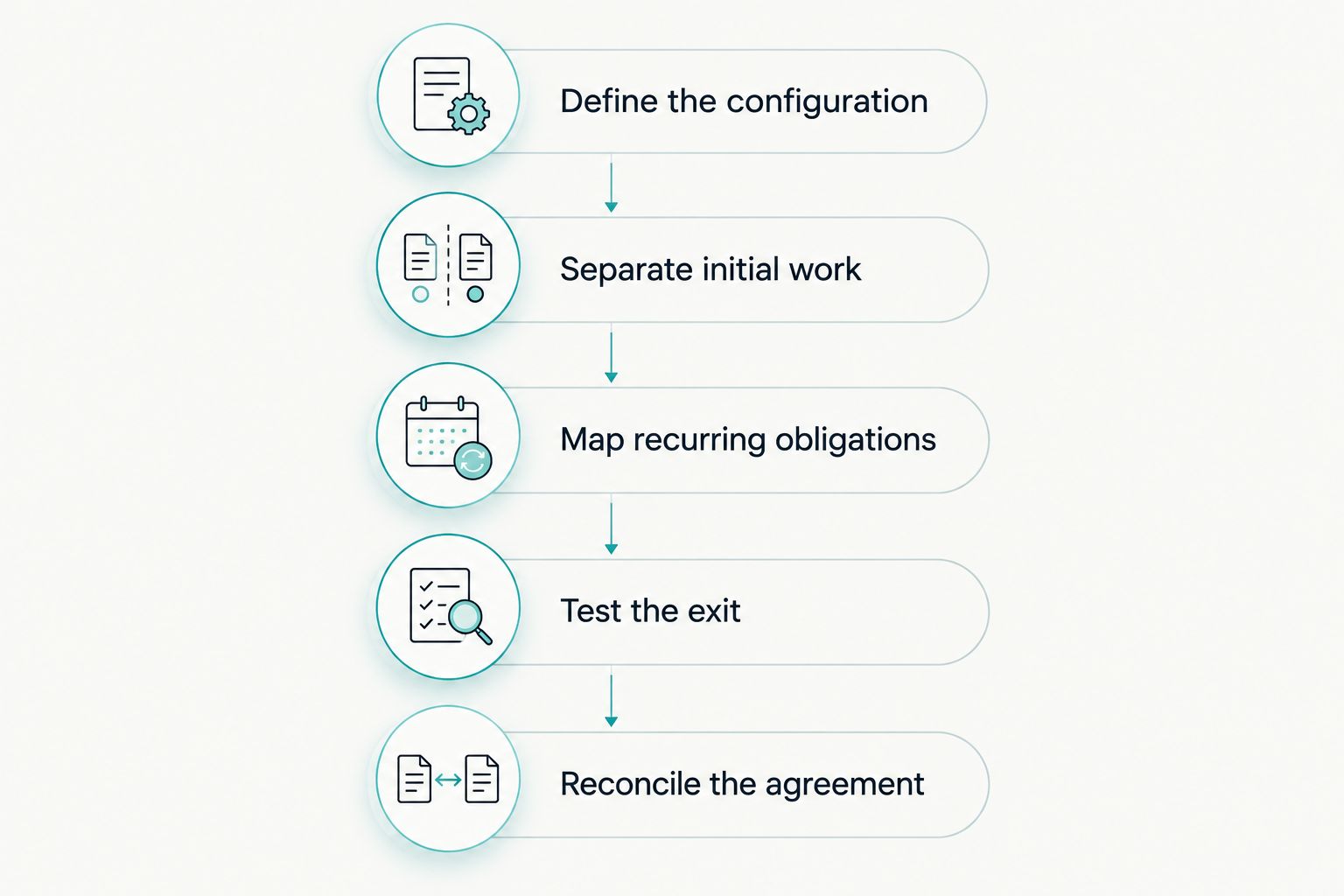
- Define the configuration. Record the intended examinations, required acquisition capabilities, patient-positioning considerations, and included accessories. Request supporting specifications rather than assuming a model name identifies every installed function.
- Separate initial work. Identify installation, training, workstation provisioning, and any site preparation. Assign responsibility for each task, including work handled outside the equipment supplier's scope.
- Map recurring obligations. List each software license, support agreement, storage arrangement, and service renewal separately. Document the billing basis and contract conditions without treating optional services as mandatory.
- Test the exit position. Establish what happens when you decline renewal, replace a workstation, change a service provider, or retire the unit. Include image retrieval and access to existing records.
- Reconcile the agreement. Match the proposal, software terms, warranty document, and service contract. Resolve inconsistent language before authorization.
Turn the quote into an ownership worksheet
Build a separate column for 12 months, 36 months, and 60 months. For each period, record:
- Equipment and one-time implementation charges.
- Software payments due within that period.
- Contracted service payments due within that period.
- Separately quoted storage, backup, or support charges.
- Unresolved exclusions and renewal amounts.
Documented ownership subtotal = equipment + implementation + software payments + contracted service + other confirmed charges.
Count each charge once: an included installation or bundled software license is not an additional expense. Keep optional services separate from required payments, and use only amounts documented for the comparison period.
Label the result a documented subtotal—not a complete ownership forecast—while repair exposure or future renewals remain unresolved. An unknown charge is not a zero-cost inclusion.
The worksheet should distinguish a confirmed inclusion from a requested clarification. That distinction prevents a blank contract field from becoming an assumed benefit in your financial review.
Service coverage: compare responsibility, not contract labels
A warranty and a service agreement are different documents. Read each for the actual repair obligations, exclusions, and procedures rather than treating either label as evidence of complete protection.
For a 2026 proposal, ask for the applicable documents for the exact configuration being quoted. Generic sales literature does not establish whether a particular component, visit, or diagnostic task is covered.
| Service arrangement | Best for | Purchasing advantage | Limitation to resolve |
|---|---|---|---|
| Included warranty coverage | Buyers establishing the initial repair obligation | Defines the initial contractual remedy | Exclusions and labor or travel responsibility require review |
| Ongoing service agreement | Buyers seeking a defined support scope after initial coverage | Documents agreed services and responsibilities | Coverage depends on exclusions, renewal rules, and service procedures |
| Repair as needed | Buyers willing to manage individual repair events | Allows evaluation of each repair proposal | No continuing coverage should be assumed |
None of these arrangements wins without its terms. Compare the obligations against the practice's tolerance for operational interruption and its ability to coordinate repairs.
What should the service agreement specify?
Request a component-level coverage schedule, including the X-ray source, detector, mechanical assemblies, and control electronics where applicable. Ask whether diagnosis, replacement parts, installation labor, travel, and return shipment fall within the same coverage.
Separate the promise to respond from the process for restoring operation. Acknowledging a service request is not the same as dispatching a technician or completing a repair.
Record how you initiate a service case, who authorizes work, and whether remote access is required. Ask what support remains available when the practice's network or workstation—not the imaging unit—is implicated.
What happens when coverage ends?
Identify the exact expiration trigger and the process for renewal. Establish whether uninterrupted enrollment, maintenance records, inspections, or other conditions affect eligibility under the proposed agreement.
Ask how an uncovered repair is approved and who provides the estimate. Do not assume temporary replacement equipment, a particular turnaround, or continued manufacturer support unless the agreement expressly provides it.
Software ownership: identify what continues without renewal
Ask what stops working if the practice does not renew. This question separates access to purchased equipment from access to licensed functions and contracted services.
For your 2026 software review, divide the workflow into acquisition, viewing, analysis, sharing, and storage. Have the supplier identify the license or agreement governing each function; do not assume a single software description covers all of them.
| Software arrangement | Best for | Potential advantage | Contract question |
|---|---|---|---|
| Perpetual license | Buyers prioritizing defined continuing usage rights | Establishes usage rights under the license | Are updates, support, transfers, or added workstations separate? |
| Subscription license | Buyers evaluating access through a continuing agreement | Defines access during the subscription term | What changes at expiration or cancellation? |
| Optional modules | Buyers with specific planning or analysis requirements | Separates specialized functions from the base configuration | Which required workflows depend on additional licensing? |
Treat these as contract structures to investigate, not confirmed offerings for any particular unit. A proposal can combine more than one structure across different functions.
Check workstation and user rights
List the rooms and users that need acquisition, review, and administrative access. Ask whether licensing follows a workstation, a named user, a concurrent session, or another defined unit.
Confirm the process for replacing failed hardware and transferring a license. Include operating-system requirements, supported configurations, and responsibility for resolving compatibility issues in the written technical review.
Demonstrate export and referral workflows
Ask the demonstrator to export a representative study and open it through the intended receiving workflow. Specify whether you need DICOM data, a viewing package, reports, or another output, then verify exactly what is supplied.
Export capability alone does not establish that your referral partner can use the output as intended. Test that handoff before purchase, including access permissions and the steps required to retrieve the complete study.
Separate backup from storage
Document where images reside, who administers access, and how restoration is performed. A storage destination is not a complete recovery procedure.
Assign responsibility for backup monitoring and restoration testing. Request the process for retrieving records if a workstation fails, an account closes, or a service relationship ends; keep that process with the practice's system documentation.
Why CBCT ownership cost varies
The meaningful differences are contractual and configuration-specific. Use these factors to explain differences between proposals without attributing unverified specifications or terms to a manufacturer:
- Equipment configuration: Compare the capabilities and accessories actually included, not features shown elsewhere in a product range.
- Site responsibilities: Identify delivery, room preparation, installation, commissioning, and any outside professional work separately.
- Software scope: Distinguish acquisition and viewing rights from optional analysis, sharing, and additional workstation access.
- Repair allocation: Determine which party carries responsibility for parts, labor, travel, diagnosis, and excluded events.
- Data requirements: Specify storage, backup, restoration, export, and access administration rather than treating them as one inclusion.
- Contract transitions: Review expiration, renewal, cancellation, license transfer, and end-of-service procedures before purchase.
Do not convert these factors into a generic ownership multiplier. Apply the actual proposed terms to your intended workflow, then compare like-for-like scopes.
How should you request a qualified CBCT quote?
Send a purchasing brief that states your intended examinations, room constraints, existing imaging environment, and required referral outputs. Request separate documentation for equipment, software, installation, warranty, and optional service.
For a CBCT quote from ProElite Dental Supply, ask about the FinScan F350 CBCT Unit and request the configuration-specific specifications and agreements. Confirm every required capability and service term in writing rather than inferring them from the product listing.
Your 2026 approval packet should also identify the practice contact responsible for implementation. Give that person the unresolved questions before authorization, not after delivery.
Is a CBCT warranty the same as a service contract?
A CBCT warranty is not the same as a service contract. Compare the obligations in each document, especially exclusions, diagnostic work, labor, travel, and the process for obtaining an authorized repair.
Can I keep using CBCT software without renewing?
Continued CBCT software use depends on the license agreement. Ask separately about acquisition, viewing existing studies, export, optional modules, updates, and technical support; do not accept an answer that addresses only one function.
FAQ
What should I compare besides the CBCT machine price?
Compare installation, software rights, service obligations, data management, and end-of-coverage terms alongside the CBCT machine price. Require written inclusions and exclusions for the exact quoted configuration.
Does a CBCT equipment quote include all software?
Treat software as included only when the quote and license identify it. Ask separately about acquisition, viewing, analysis, export, and additional workstation rights.
What should I ask about CBCT repair coverage?
Ask who covers diagnosis, parts, labor, travel, and shipment for each repair category. Also document exclusions, authorization procedures, and the distinction between response and repair completion.
Can I export CBCT images if I cancel a subscription?
Post-cancellation export access depends on the applicable agreement. Obtain the terms in writing and demonstrate the export workflow before committing to the system.
Should I compare ownership over 12 months or 60 months?
Compare 12 months and 60 months, with 36 months as an intermediate planning checkpoint. These are budgeting intervals, not claims about equipment life or standard contract lengths.
Is a software update the same as a software upgrade?
Do not assume an update and an upgrade carry the same entitlement. Ask the agreement to distinguish maintenance releases, compatibility changes, and added functions.
What should I send with a CBCT quote enquiry?
Send intended examinations, room constraints, existing imaging software, workstation needs, and referral-output requirements. Ask ProElite Dental Supply to document the proposed equipment scope and applicable service and software terms.
One last thing
Make record retrieval part of acceptance, not a future support question. Before signing off on implementation, have the practice team retrieve a study, export it through the agreed workflow, and identify the documented recovery procedure.
Keep that result with the license and service documents. A successful acquisition demonstration answers whether the system captures an image; an acceptance workflow also checks whether your practice can retain and use the resulting record.