

ProElite Dental Supply vs Net32: which is better in 2026

Choose ProElite Dental Supply if you need to select dental equipment around a defined clinical workflow; choose Net32 if you already know the exact supply item and want to compare marketplace sellers. For 2026 purchasing, the distinction is equipment selection versus repeat-order sourcing—not a blanket claim that either route is cheaper.
- ProElite Dental Supply vs Net32 comes down to equipment selection versus marketplace sourcing for dental supplies.
- ProElite Dental Supply is the better starting point for a defined dental equipment purchase.
- Net32 is the better starting point for comparing sellers of an already-specified supply item.
- Neither purchasing route replaces written compatibility, warranty, and service checks.
Why this matters
A reorder and an equipment purchase need different approval processes. A familiar consumable starts with a manufacturer reference and pack configuration; an intraoral imaging sensor starts with software compatibility, patient fit, and a replacement plan.
The ProElite Dental Supply catalog includes portable X-ray equipment, sensors, endodontic devices, handpieces, scanners, and CBCT equipment. Net32 operates as a dental-supply marketplace. Use that distinction to assign purchasing work rather than forcing every order through the same channel.
For your 2026 purchasing plan, separate specification decisions from transaction decisions. First establish what your practice needs. Then compare the terms for supplying it.
At a glance
| Dimension | ProElite Dental Supply | Net32 |
|---|---|---|
| Best for | Equipment buyers defining a clinical setup | Buyers comparing sellers for a specified supply item |
| Equipment selection | Named equipment and accessory options in the supplied catalog | Evaluate equipment against the individual listing and seller |
| Routine ordering | Appropriate when the required item matches the catalog | Marketplace comparison suits specification-led reordering |
| Standout feature | Equipment and related accessories within a supplier catalog | Marketplace structure for comparing seller offers |
| Compatibility | Requires model-specific confirmation | Requires model-specific and seller-specific confirmation |
| Warranty and service | Obtain written terms for the exact product | Establish the responsible party for the exact offer |
| Ownership costs | Assess the complete equipment configuration | Assess the complete configuration and seller terms |
| Pricing model | Supplier product listings and purchase-specific quotations | Marketplace offers associated with individual sellers |
Equipment buyers and repeat-order buyers need different routes
The direct supplier is the better starting point when your equipment specification is unfinished. That includes a practice adding portable intraoral imaging, replacing an endodontic motor, or deciding which handpiece connection fits an existing delivery system.
The advantage is the relevance of the equipment conversation. Your purchase brief should cover the procedure, existing infrastructure, required accessories, and responsibility for support. A catalog alone does not establish that every requirement is satisfied.
Net32 is the better starting point when the specification is already settled. A purchasing coordinator comparing an exact manufacturer reference has a different task: confirm the product identity, pack configuration, seller, and transaction terms.
Neither profile needs an exclusive supplier relationship to make a sound decision. Assign the equipment project to the route that resolves technical questions, and assign repeat orders to the route that makes equivalent offers easy to compare.
The direct catalog gives equipment buyers a concrete shortlist
The supplied equipment range includes the HyperLight portable dental X-ray, NanoPix Intraoral Digital Sensor, E-Connect S endo motor, and FinScan F350 CBCT Unit. These are distinct purchasing projects, not interchangeable additions to a supply basket.
For intraoral radiography, separate the X-ray generator from the receptor and acquisition software. Selecting a portable source does not establish sensor compatibility, and selecting a sensor does not establish that your workstation meets its requirements.
For endodontics, the E-Connect S description identifies a built-in apex locator. Confirm the intended file systems, operating modes, accessories, and instructions before approving that configuration; the product name does not answer those questions.
The limitation is equally clear: a relevant shortlist is not proof of technical fit. For a 2026 equipment purchase, request the current manufacturer documentation for the exact model and configuration before comparing purchase terms.
Net32 is better suited to already-specified supply comparisons
A marketplace is a useful starting point when you can define equivalence before searching. That means an exact manufacturer reference, material or formulation, dimensions where relevant, and the required pack configuration.
Do not treat similar listing titles as equivalent products. For diamond burs, compare shape, grit designation, shank, and dimensions; for restorative materials, compare the exact material and presentation your clinical team has approved.
Use a short approval checklist:
- Match the manufacturer and product reference.
- Confirm the unit of purchase and pack contents.
- Identify the seller responsible for fulfillment.
- Read the applicable return and product-condition terms.
- Preserve the listing details with the purchase record.
The trade-off is administrative: marketplace comparison does not remove seller evaluation. Net32 wins this use case when you need offer comparison, not help deciding which equipment configuration your practice requires.
Each route has a different standout feature
The direct catalog's useful distinction is its equipment-and-accessory structure. The supplied range includes a HyperLight stand and power supply, model-specific scanner tips, and endodontic replacement components alongside the main devices.
That structure gives you concrete accessory questions to resolve. It does not establish that accessories are included, interchangeable, or required for every installation.
Net32's useful distinction is the marketplace purchasing model: compare the offer as well as the item. That suits a buyer who has already approved a specification and now needs to assess seller terms.
For imaging buyers, the following products illustrate the separate generator and receptor decisions. Their inclusion here is not a claim of confirmed software compatibility or a complete installation package.


Neither route wins on compatibility without documentation
Compatibility is a tie until the exact configuration is confirmed. Supplier type is not evidence that a sensor integrates with your imaging software, a handpiece fits your coupling, or a scanner tip fits another model.
Physical specifications show why matching matters. The Helios 500 Tip description lists a large tip at 22 × 18 mm and a small tip at 18.6 × 16.7 mm. Separately, the J4 Mini Head description identifies an 8.9 mm head. These dimensions address different access considerations; none establishes suitability for every patient or procedure.
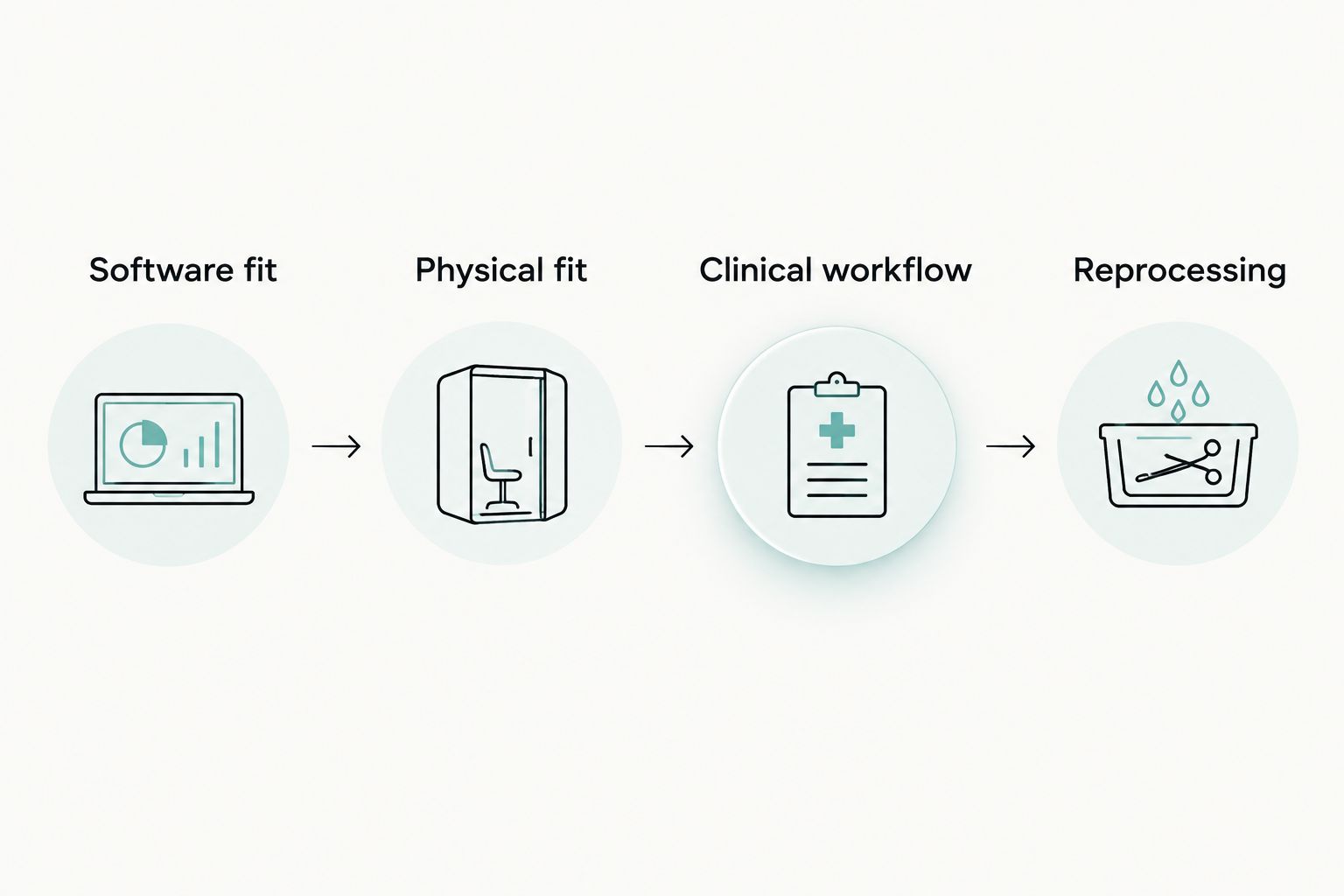
For equipment evaluation in 2026, document these checkpoints:
- Software fit: supported acquisition software, operating system, drivers, and licensing.
- Physical fit: connections, dimensions, mounting, and cable routing.
- Clinical workflow: positioning, instrument access, and operatory movement.
- Reprocessing: the manufacturer's cleaning and sterilization instructions.
Get written answers against the exact model. Do not substitute a verbal statement about a product family for a configuration-specific answer.
Warranty and service are ties until responsibility is written down
Neither purchasing route earns a warranty or service win merely from its business model. Manufacturer coverage, seller obligations, accidental damage, and accessory coverage are separate questions.
For a sensor, ask specifically about cable damage, replacement procedures, and the steps required to diagnose a fault. For a portable X-ray, ask who handles troubleshooting and repair authorization. Do not assume a loaner, replacement deadline, or shipping arrangement.
Request these terms before approval:
- The entity responsible for accepting the service request.
- Covered components and stated exclusions.
- Required registration and purchase documentation.
- Diagnostic, transport, and repair responsibilities.
- The process when the equipment cannot be used.
The direct-supplier route still requires product-specific confirmation. The marketplace route also requires clarity about the seller's role. A written service path is more useful than an unsupported promise of support quality.
Ownership costs favor the complete configuration, not either channel
Neither channel has a demonstrated ownership-cost advantage in this comparison. The correct purchase unit is the working clinical setup—not the headline device alone.
For a portable imaging project, ask which accessories, workstation changes, software arrangements, and applicable equipment evaluations belong in the purchase scope. For CBCT, ask about installation requirements, software, training, maintenance, and service responsibility. Include only items confirmed as applicable to the quoted system.
For handpieces, distinguish the drive system from the contra-angle. The supplied W201L description specifies a 20:1 implant contra-angle, while the catalog also includes a 1:5 electric handpiece. Those ratios describe different instrument configurations, not interchangeable purchasing alternatives.
Build your 2026 ownership worksheet around equipment, required accessories, integration, consumables, maintenance, and downtime arrangements. Leave unconfirmed items unresolved rather than treating them as included.
The winner is the offer that meets the approved specification with documented responsibilities. A channel-wide savings claim does not answer that question.
Pricing models: supplier listings versus marketplace offers
The direct-supplier model gives you product listings and a route to clarify the scope of an equipment purchase. The marketplace model gives you seller-specific offers to compare against an approved specification.
Neither model guarantees the lowest total. Compare like-for-like configurations before deciding, including pack contents for supplies and required components for equipment.
For a qualified equipment enquiry, provide:
- The procedure or workflow you are buying for.
- Existing equipment and software, including versions where relevant.
- Required accessories and installation constraints.
- The documentation needed for purchase approval.
- Questions about warranty, service, and ongoing obligations.
Ask for a written scope that separates included components from optional items. For a marketplace order, retain the equivalent seller-specific details. Predictability comes from a defined purchase, not from choosing a supplier category.
Final verdict: choose by purchasing task
Choose ProElite Dental Supply for a defined equipment project
Best for: the practice owner or equipment lead selecting a clinical configuration. Start here when you need to evaluate portable X-ray equipment, sensors, endodontic devices, handpieces, or CBCT equipment from the supplied range.
The benefit is a relevant equipment shortlist and a focused purchase enquiry. The constraint is that compatibility, inclusion, warranty, and after-sale arrangements still need written confirmation for the selected product.
Choose Net32 for specification-led supply ordering
Best for: the purchasing coordinator comparing marketplace offers for an approved item. Start here when the clinical team has already fixed the manufacturer reference and required presentation.
The benefit is the marketplace comparison task. The constraint is seller-level due diligence: matching titles alone does not establish equivalent contents or transaction terms.
| Dimension | Winner |
|---|---|
| Equipment-project starting point | Direct supplier |
| Named equipment shortlist | Direct supplier |
| Already-specified supply comparison | Net32 |
| Standout purchasing feature | Direct supplier for equipment; Net32 for seller comparison |
| Compatibility | Tie—requires exact-model documentation |
| Warranty and service | Tie—requires written terms |
| Ownership costs | No demonstrated channel-wide winner |
| Pricing model | Match the model to the purchasing task |
FAQ
Is ProElite Dental Supply better than Net32 for dental equipment?
ProElite Dental Supply is the better starting point for selecting equipment from its supplied range. Confirm the exact configuration, compatibility, warranty, and service responsibilities before purchasing.
Is Net32 better for routine dental supply orders?
Net32 is the better starting point for comparing marketplace sellers when you already know the required item. Match the manufacturer reference, pack configuration, and seller terms before approving the order.
Which supplier is cheaper in 2026?
There is no supported channel-wide cost winner in this comparison. Compare current offers for the same specification and include the components and obligations required for your purchase.
Does buying a sensor confirm imaging software compatibility?
No, purchasing a sensor does not establish software compatibility. Obtain confirmation for the exact sensor, acquisition software, operating system, and required drivers or licenses.
Does a marketplace purchase include a manufacturer warranty?
Do not assume manufacturer warranty coverage from the marketplace listing alone. Confirm eligibility, covered components, exclusions, and the party responsible for handling the claim.
Can a dental practice use both purchasing routes?
Yes, a practice can separate equipment selection from routine supply ordering. Use the equipment specification and seller terms to approve each purchase independently.
What should a dental equipment quote include?
A dental equipment quote should identify the exact model, configuration, included components, and applicable purchase terms. Request written answers about integration, training, warranty, service, and ongoing requirements.
One last thing
Audit the accessory list before approving the main device. A scanner tip, handpiece connection, power supply, or software requirement can determine whether the selected configuration meets your workflow.
Use a purchase-approval rule: every required component must appear either as included, separately specified, or explicitly unnecessary. Apply the same rule to both routes. It turns a promising listing into a purchase your clinical and administrative teams can evaluate together.