

Can you buy diamond dental burs individually or only in packs?

You can buy diamond dental burs individually or in packs; the selling format depends on the supplier and the specific listing. A separately listed bur pattern does not necessarily mean the package contains a single instrument. Before ordering, confirm the number of burs per selling unit, the exact specification and any minimum-order requirement.
- You can buy diamond dental burs individually; confirm that the selling unit contains one instrument.
- Choose individual burs for targeted replacement and same-pattern packs for established replenishment needs.
- ProElite Dental Supply lists diamond bur patterns separately; confirm package quantity before ordering.
- Match shape, grit, dimensions and shank before comparing purchasing formats.
Can you buy diamond dental burs individually or only in packs?
Diamond dental burs are not restricted to packs. Suppliers can offer individual instruments, packs containing repeated instruments, or assortments containing different patterns. The decisive information is the unit of sale—not whether the product page shows a single bur or has a separate pattern number.
| Purchasing format | Best for | Main advantage | Main limitation | Confirm before ordering |
|---|---|---|---|---|
| Individual instrument | Replacing a specific bur | You order the required pattern without adding duplicates | Requires separate selection of each specification | The selling unit contains one bur |
| Same-pattern pack | Replenishing an established setup | Repeated instruments arrive under one order line | You commit to multiple examples of the same specification | Count per pack and exact grit |
| Assorted set | Purchasing a defined instrument sequence | Different patterns are grouped together | Some included instruments might not match your setup | Every included pattern, grit and quantity |
For your 2026 purchasing specification, settle instrument selection before package selection. The guide to selecting diamond dental burs by shape and grit addresses the selection decision separately from how the instruments are packaged.
Why this matters
A correct pattern ordered in the wrong quantity is still an ordering error. A product photograph, pattern code and order-quantity field answer different questions; none should substitute for an explicit package count.
Your purchasing record should distinguish the number of selling units from the number of instruments received. That distinction helps the buyer reconcile the order, the receiving team check the shipment and the clinical team maintain its intended instrument setup.
This is a procurement guide, not a clinical protocol. Packaging does not establish an instrument's clinical indication, handpiece compatibility, sterile status or permitted reuse.
Individual burs: best for targeted replacement
Choose individual instruments when you need a specific replacement rather than a broader assortment. This format lets you specify the required shape, grit, head dimensions and shank without deliberately adding other patterns.
The limitation is administrative: each distinct specification needs an accurate order line. A familiar shape name alone is not enough to identify an exact replacement, particularly when similar-looking instruments have different cutting lengths or grit grades.
Before choosing singles, check:
- Whether the supplier explicitly identifies the selling unit as one instrument.
- Whether the selected variant matches the intended grit and dimensions.
- Whether a minimum order applies to the item or transaction.
- Whether individual packaging carries the identification information your practice needs.
Use singles to replace a confirmed specification, not to approximate one from a photograph. Retain the original package label or manufacturer reference when requesting a replacement.
Same-pattern packs: best for routine replenishment
Choose same-pattern packs when your practice already uses a defined instrument specification repeatedly. The purchasing advantage is straightforward: multiple matching instruments can be ordered through a single line item.
The trade-off is commitment to that specification. If you have not confirmed the grit, cutting dimensions or shank, a pack multiplies the ordering mistake rather than resolving it.
For a 2026 replenishment order, record both the package count and the instrument count. Also establish whether every instrument in the pack is identical; a listing described as a set requires closer inspection before you treat it as a repeated-pattern pack.
Do not assume a pack changes the manufacturer's reprocessing instructions. The permission to reuse an instrument—and any applicable restrictions—comes from its labeling and instructions, not the number supplied together.
Assorted sets: best for a documented instrument sequence
Choose an assortment only when its contents match an instrument sequence your clinicians have specified. Review the itemized contents rather than relying on a broad description such as preparation set or finishing set.
An assortment groups different instruments, but that convenience creates a replenishment question. Ask whether you can later obtain the individual patterns you expect to replace, and whether replacements retain the same manufacturer specification.
The drawback is unwanted duplication. A set is not automatically the right purchase when only one included pattern is needed, and a complete-looking assortment does not establish suitability for a particular clinical procedure.
Approve the contents first; approve the package second. Your order should identify what is included and what remains outside the set.
Why diamond bur purchasing formats vary
The available purchasing format reflects how the supplier defines and fulfills the order. These are commercial distinctions; they do not establish differences in cutting performance or clinical outcomes.
- Unit definition: A listing can represent one instrument, a repeated-pattern pack or an assortment.
- Variant structure: Shape, grit and dimensions can appear as separate listings or selectable options.
- Minimum order: The permitted order quantity is distinct from the number of instruments inside each package.
- Set composition: An assortment has an itemized mix rather than a single repeated specification.
- Replacement ordering: A component listed within a set is not proof that the supplier also sells it separately.
For 2026 supplier comparisons, use the same written specification across enquiries. Otherwise, you risk comparing different quantities or instruments under similar product names.
How do you confirm that an order is for a single bur?
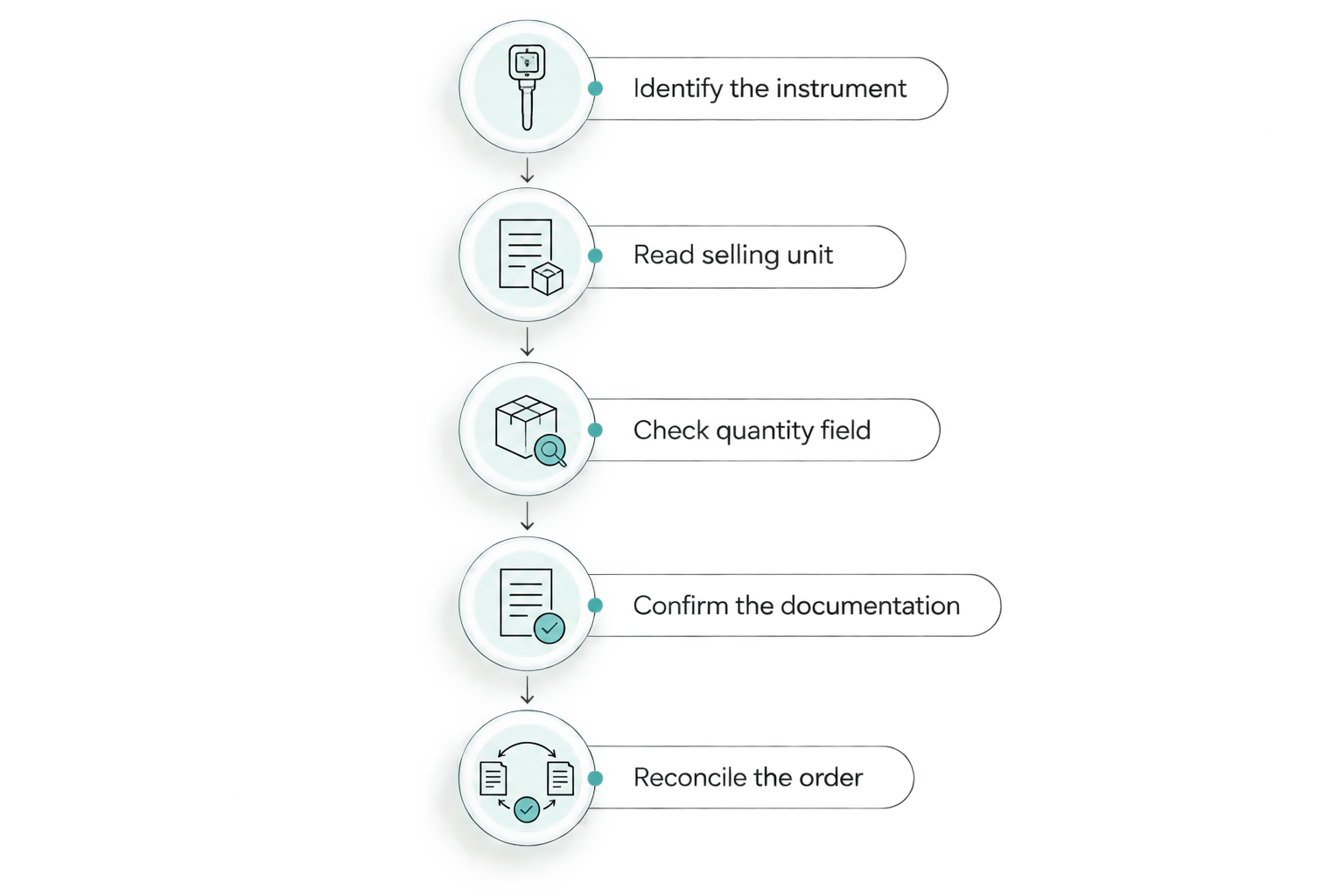
Use this sequence before submitting a purchase order. It separates product identity from package quantity and creates a record the receiving team can check.
- Identify the instrument. Record the manufacturer reference, shape, grit, head dimensions and shank designation shown in the documentation.
- Read the selling unit. Look for an explicit statement identifying an individual instrument, pack or set. Do not infer quantity from the main image.
- Check the quantity field. Establish whether entering a quantity orders instruments or complete packages.
- Confirm the documentation. Request the exact labeling and instructions needed to verify compatibility, sterile status and reprocessing requirements.
- Reconcile the order. Put the expected package count and total instrument count on the purchasing record before authorization.
If a product page leaves the selling unit unclear, request written confirmation before ordering. An ambiguous listing is not a reason to guess, even when the pattern code matches your existing stock.
What does an order quantity actually mean?
An order quantity of 1 means one selling unit, not necessarily 1 bur. In a hypothetical purchasing example, a selling unit containing 5 burs delivers 5 instruments when the order quantity is 1; ordering 2 such units delivers 10 instruments.
Those quantities illustrate order arithmetic, not a supplier's actual pack configuration. Your purchase order must use the package count confirmed for the specific listing.
Which specifications should match before you reorder?
Package format comes after instrument identity. A single bur with the wrong specification does not become a suitable replacement simply because it can be ordered individually.
Use a consistent comparison record:
| Specification | What to record | What not to assume |
|---|---|---|
| Manufacturer reference | Exact reference and selected variant | Similar names identify identical instruments |
| Head shape | The documented geometry | A photograph resolves subtle differences |
| Grit | Manufacturer's stated grit designation | Shape or pattern number alone establishes grit |
| Head dimensions | Stated diameter and cutting length | Similar proportions mean matching dimensions |
| Shank | Documented shank type and dimensions | Every bur fits the same handpiece |
| Instructions | Intended use and applicable handling requirements | Pack format establishes clinical suitability |
For example, ProElite Dental Supply lists Dental Diamond Bur FG Football 379-023 as a distinct product. That product identity helps you specify the instrument, but it does not by itself establish the number supplied per selling unit.
Keep this distinction in your 2026 ordering template. Copy the confirmed specification into the purchase record rather than relying on a shortened nickname used within the practice.
Does buying individually reduce ownership costs?
Buying individually limits the number of instruments you commit to purchasing for a particular order. It does not establish the lowest overall ownership cost, because purchasing format alone says nothing about service life, permitted reuse or the resources needed for handling.
Evaluate the quantities your practice actually uses, the burden of repeated ordering and the applicable instrument instructions. Compare like with like: identical specifications and confirmed quantities, rather than unrelated packs with similar descriptions.
Do not build an ownership calculation around an assumed number of uses. If reprocessing is permitted, follow the exact manufacturer's instructions; if it is not permitted, do not treat a bulk package as justification for reuse.
Is a pack always better for a busy practice?
A pack is appropriate when the confirmed specification matches an established replenishment need. Practice size alone does not determine the right purchasing format, and an assortment containing unwanted instruments does not solve a shortage of a specific pattern.
Use consumption records by instrument specification, not a general impression that the practice uses many burs. That makes the ordering decision traceable.
What should you ask the supplier before ordering?
Send a short, precise enquiry that identifies both the instrument and the purchasing question. Ask the supplier to confirm:
- The exact manufacturer reference and selected grit.
- The number of instruments in each selling unit.
- Whether all instruments in the package are identical.
- Any minimum-order requirement.
- The applicable manufacturer instructions and labeling.
- Whether a component of an assortment can be reordered separately.
ProElite Dental Supply is best for dentists comparing its listed diamond dental burs against a defined purchasing specification. The catalogue can support product identification; package quantity and exact-device instructions still need to be checked before purchase.
For a focused enquiry, contact the supplier with the pattern reference, required specification and desired instrument count. Ask for those details to appear in the order confirmation.
FAQ
Can I buy diamond dental burs individually instead of a full pack?
Yes, diamond dental burs can be sold individually rather than only in packs. Confirm that the specific listing defines its selling unit as one instrument before ordering.
Does a picture of one diamond bur mean I receive one?
No, a photograph of one bur does not establish the package quantity. Use the stated selling unit and obtain written clarification if the count is unclear.
Does an order quantity of one mean one dental bur?
An order quantity of one means one selling unit. That unit can be an individual instrument, a pack or an assortment, depending on the listing.
Can I replace one bur from an assorted set?
You can replace a set component individually when the supplier offers that exact instrument separately. Match the manufacturer reference, grit, dimensions and shank rather than ordering by appearance alone.
Does ProElite Dental Supply sell its diamond burs as singles?
ProElite Dental Supply lists distinct diamond bur patterns, but a separate product listing does not establish single-instrument packaging. Confirm the count per selling unit for the specific item before purchase.
Are individually sold diamond burs automatically single-use?
No, individual sale does not establish single-use status. Follow the exact instrument's labeling and instructions for handling, reprocessing and disposal.
Should I choose individual burs or same-pattern packs?
Choose individual burs for targeted replacement and same-pattern packs for confirmed replenishment needs. In either format, verify the full instrument specification and the number supplied.
One last thing
Make the instrument count visible on the purchase order. Recording both selling units and total burs prevents the quantity field from carrying two different meanings between the buyer and the receiving team.
Before your next 2026 order, add a required field for instruments per selling unit. It is a simple purchasing control that makes singles, packs and assortments easier to reconcile without changing the clinical instrument specification.