

Can a portable dental X-ray unit be used without a dedicated room?

Yes—a portable dental X-ray unit can be used without a dedicated radiography room when the specific device, operating location and exposure procedure meet applicable state requirements and manufacturer instructions. Portability does not establish that an open operatory, shared treatment area or off-site location is acceptable. For a 2026 purchase, confirm the proposed use before assuming that the equipment eliminates shielding review, registration or other site obligations.
- Using a portable dental x-ray without dedicated room requires state-specific review, not just a portable device.
- Handheld dental radiography still requires controlled positioning, access management and manufacturer-directed operation.
- ProElite Dental Supply offers portable X-ray equipment; a product listing does not establish permission for your proposed location.
- Confirm room requirements before purchasing equipment or changing your practice layout.
Why this matters
A dedicated radiography room and a suitable exposure location are not the same thing. You can avoid setting aside a room exclusively for imaging only if your actual treatment space and operating procedure satisfy the requirements that apply there.
Start with the practical distinctions in this portable dental X-ray buying guide. For your 2026 equipment decision, separate three questions: whether the device is legally marketed, whether your jurisdiction permits its proposed use, and whether your location supports that use safely.
Buying a handheld unit does not resolve the facility question. Resolve the facility question before treating portability as a renovation benefit.
Can a portable dental X-ray unit be used without a dedicated room?
Yes, provided the proposed arrangement meets the applicable requirements. An existing treatment room can be a candidate; an open bay or temporary care location needs its own assessment rather than an assumption based on the device’s size.
| Proposed location | Best for | Practical benefit | Limitation to resolve |
|---|---|---|---|
| Enclosed treatment room | Practices evaluating imaging within an existing operatory | Keeps imaging within the treatment space | Existing walls and doors do not establish shielding adequacy |
| Open-bay treatment area | Practices assessing a shared clinical layout | Avoids moving the patient to a separate room | Adjacent people, access routes and beam direction need particular attention |
| Temporary off-site location | Mobile teams assessing care outside a fixed practice | Brings equipment to the treatment location | Each setting introduces occupancy, access and jurisdiction questions |
This table compares planning situations, not approved installations. None of these arrangements receives automatic clearance from the word portable.
Before scheduling exposures, obtain a location-specific answer from the applicable radiation-control program and, where required, a qualified radiation-protection professional. Identify the exact equipment model and intended operating mode in that request.
What does “without a dedicated room” actually mean?
It means a room is not reserved exclusively for radiography. It does not mean that exposures can take place wherever a chair fits.
An enclosed operatory can serve other clinical functions while remaining subject to radiation-protection requirements during imaging. Conversely, an open treatment area can present access-control problems even when it offers ample working space.
Assess the exposure location, not the room’s name on the floor plan. A room labeled “treatment” is neither automatically acceptable nor automatically unsuitable.
What must you confirm before using the unit?
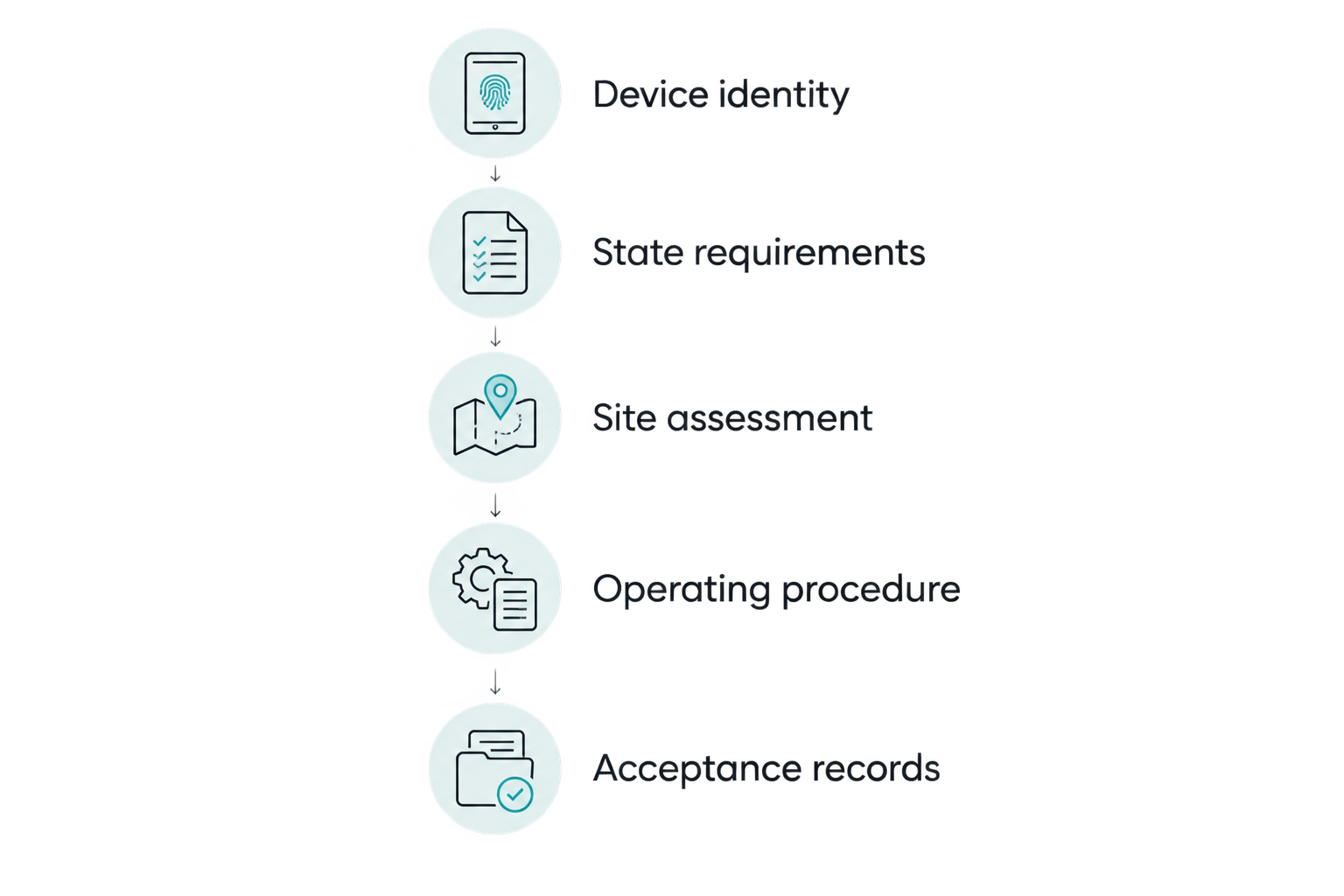
Use this sequence to organize the approval and purchasing discussion. Keep the responses with your equipment and radiation-safety documentation so the dentist, practice manager and staff work from the same requirements.
- Device identity. Record the manufacturer, exact model and intended handheld or supported operating configuration. Obtain the current instructions rather than relying on a distributor summary.
- State requirements. Ask the applicable radiation-control program about registration, handheld-use restrictions, operator qualifications and location requirements. Explain whether use is fixed-site, multi-operatory or mobile.
- Site assessment. Provide the proposed exposure positions, nearby occupied areas and room layout to the person responsible for evaluating radiation protection. Include spaces beyond the immediate treatment area.
- Operating procedure. Establish how staff will position the equipment, manage access and follow the manufacturer’s protective arrangements. Address situations in which those arrangements cannot be maintained.
- Acceptance records. Confirm which inspections, evaluations, training records or other documentation must be completed before clinical use. Assign responsibility for keeping them current.
The sequence prevents a common purchasing mismatch: selecting equipment first and discovering later that the intended location or workflow needs changes. It also gives your supplier specific questions to answer instead of a general request for reassurance.
Why room requirements vary
The answer changes with the location and proposed operation—not simply with the equipment category. Ask your assessor which of these factors affects the requirements for your installation:
- Jurisdiction. State rules determine the registration, operating and facility obligations applicable to your practice.
- Operating configuration. Handheld operation and manufacturer-authorized supported operation need to be evaluated as the configurations you actually intend to use.
- Beam direction. The proposed imaging positions determine which surrounding areas belong in the assessment.
- Adjacent occupancy. Include staff work areas, neighboring operatories, corridors and other occupied spaces when describing the site.
- Workload. Give the assessor your expected imaging activity rather than asking for a decision without a workload description.
- Access control. Explain how you will prevent people from entering or remaining in an unsuitable position during exposures.
Do not substitute a generic room-size rule or universal separation distance for this assessment. A dimension copied from another installation does not establish suitability for yours.
Does a handheld unit eliminate shielding requirements?
No—a handheld dental X-ray unit does not automatically eliminate the need to evaluate shielding. Device shielding, operator protection and protection of people outside the immediate imaging position address different parts of the exposure arrangement.
A manufacturer-provided backscatter shield is not evidence that every room needs no structural assessment. Follow the exact device instructions for shield placement, equipment orientation and operator positioning; do not transfer another model’s protective procedure to the unit you purchase.
For an existing practice, give the assessor the actual layout rather than describing the room as “standard.” For a new layout, resolve the radiation-protection requirements before finalizing construction decisions.
What should the floor-plan discussion include?
Identify the patient position, intended equipment positions, doors and access routes. Include adjacent spaces and describe how those spaces are used.
If the practice intends to move the unit between operatories, identify every proposed room. Approval or assessment of one location should not be treated as a blanket answer for the building unless the responsible authority explicitly establishes that scope.
Can you use a portable unit in an open operatory?
An open operatory needs a specific determination; portability alone is not permission. The practical question is whether the proposed exposure arrangement can meet applicable protection and access requirements while the surrounding clinical area operates.
Map where assistants, patients and other staff will be during imaging. Include movement through the space, not just stationary chairs on a drawing.
An open-bay workflow also needs a clear response when someone enters the controlled area or equipment cannot be positioned as instructed. Establish that response in advance rather than improvising during patient care.
The purchasing decision should account for workflow interruption as well as floor space. A compact device is not an efficient solution if the proposed arrangement cannot support compliant operation during normal clinical activity.
Can you take the unit to a nursing home or another off-site location?
Off-site use requires confirmation of both equipment requirements and location-specific obligations. Permission to operate a device at your practice does not, by itself, establish the requirements for another facility or jurisdiction.
Before arranging mobile care, clarify responsibility for registration, facility coordination, operator qualifications and any required site evaluation. Describe how the team will control access in a room that may also serve residents, caregivers or other clinical staff.
Transport planning is a separate issue from permission to expose. Ask about manufacturer-directed transport, storage, charging and inspection procedures, but do not treat a carrying case as a substitute for a radiation-safety plan.
Best for mobile teams: a documented workflow that remains workable at the intended care location. Equipment portability is only one purchasing criterion.
What clinical guidance applies in 2026?
The client-supplied ADA X-rays/Radiographs topic page, identified as updated in March 2026, provides the clinical context: ALARA, patient-specific imaging selection, digital receptors, rectangular collimation and legally marketed handheld equipment. These principles concern justified imaging and radiation protection; they do not establish software compatibility or approve a particular room.
The supplied ADA summary also identifies the 2026 ADA/AAOMR patient-selection recommendations covering 2-D and CBCT imaging. Patient-selection recommendations and facility requirements answer different questions: a clinically justified image still requires an appropriate operating arrangement.
The ADA topic page is informational and does not establish a standard of care or an official ADA position. It does not endorse a supplier or device.
Keep clinical justification separate from equipment convenience
A portable unit changes how equipment reaches the patient. It does not create an indication for an exposure.
Similarly, do not use a patient exposure simply to establish that newly installed equipment or software communicates correctly. Request the manufacturer-directed acceptance and quality-control methods appropriate to the equipment and acquisition system.
What should your equipment quote confirm?
For a 2026 purchase, request a written equipment scope and a separate description of any installation, training or compliance-related services. Do not assume that a product quote includes a room assessment or regulatory submission.
Your purchasing questions should cover:
- The exact model and current manufacturer instructions.
- Documentation supporting the device’s regulatory status and labeled intended use.
- Included protective components and any authorized mounting accessories.
- Battery, charger, maintenance and inspection requirements.
- Sensor, computer and acquisition-software requirements for the complete workflow.
- Product-specific warranty coverage, exclusions and service arrangements.
- Responsibility for any required evaluations, registration support or staff training.
ProElite Dental Supply’s HyperLight portable X-ray system is a relevant model to discuss when requesting this documentation. Confirm the exact configuration and applicable requirements rather than interpreting the listing’s FDA-clearance wording as state permission or room approval.
ProElite Dental Supply is best suited to buyers comparing portable dental X-ray equipment and digital sensors within the same purchasing discussion. The catalog includes both categories, but a shared supplier does not establish exact-model compatibility or a complete compliant installation.
Account for ownership requirements, not just the generator
Include the receptor and acquisition workflow in your equipment plan. A portable generator does not replace the sensor, patient-record linkage, computer or software needed for digital intraoral imaging.
Ask how warranty service, battery replacement and equipment downtime will be handled. Obtain the terms for the exact product; do not infer a loaner program, response commitment or coverage period from general statements about support.
FAQ
Can I use a portable dental X-ray without a dedicated room?
Yes, when the specific device, exposure location and operating procedure meet applicable state requirements and manufacturer instructions. An existing operatory is not automatically suitable simply because the generator is portable.
Does FDA clearance mean I can use a handheld dental X-ray anywhere?
No. Device clearance does not establish compliance with state registration, operator or facility requirements, and it does not approve your proposed room.
Do portable dental X-ray units require lead-lined walls?
The device category alone does not determine wall-shielding requirements. Obtain a site-specific assessment addressing the proposed equipment, workload, beam directions and surrounding occupancy.
Can I move one portable X-ray unit between treatment rooms?
Confirm every proposed exposure location and the manufacturer's operating requirements before planning multi-operatory use. An assessment covering one room should not be assumed to cover every room.
Is handheld operation the same as using a portable X-ray on a stand?
No. Confirm that the exact device and accessory are intended for the proposed configuration, then establish the corresponding positioning and exposure procedure.
Can a mobile dental team use a portable X-ray in a nursing home?
Confirm the requirements for the care location and jurisdiction before arranging exposures. Address facility coordination, access control, operator qualifications and any required registration or evaluation.
Does a digital sensor remove the need for a room assessment?
No. A digital receptor is part of the imaging workflow, not proof that an exposure location meets radiation-protection requirements.
What should I send a supplier before requesting a portable X-ray quote?
Send the intended care setting, state, proposed operating configuration and existing imaging-system details. Request exact-model documentation, product-specific service terms and a clear statement of what the quote includes.
One last thing
Ask what would make the proposed location unacceptable before asking whether it is acceptable. That question directs attention to access, adjacent occupancy and positioning constraints that a general yes-or-no answer can miss.
For your 2026 purchase, give ProElite Dental Supply the intended location and workflow when requesting equipment information. Keep the regulatory determination with the responsible authority and the clinical imaging decision with the treating dentist.