

How much do diamond dental burs cost per pack?

Diamond dental burs cost per pack depends on the exact bur, confirmed pack quantity and current supplier quote; a displayed listing amount alone does not establish cost per bur. For a defensible 2026 comparison, match shape, grit, shank and intended use before comparing quantities, then account for any applicable purchasing and reprocessing costs.
- Compare diamond dental burs cost only after confirming pack quantity, bur specifications and current purchasing terms.
- ProElite Dental Supply lists FG diamond burs for IPR and contouring; compare the exact instrument, not just its name.
- Calculate unit cost from the confirmed pack total divided by the number of burs included.
- Do not assume a reusable designation establishes a fixed number of clinical uses.
Why this matters
A pack is a purchasing unit, not a standardized specification. You need to know exactly what arrives before a pack-level comparison becomes useful. A quantity difference, unmatched grit or unsuitable shank can invalidate an otherwise straightforward purchasing comparison.
Start with the instrument your clinicians require. The guide to selecting diamond dental burs by shape and grit addresses that specification step; this article explains how to turn a defined requirement into a comparable purchase.
For your 2026 procurement worksheet, keep the clinical specification separate from the commercial terms. That separation makes substitutions visible instead of letting a similar product name conceal a different instrument.
How much do diamond dental burs cost per pack?
Request the current total for a confirmed quantity of the exact bur you intend to buy. Do not describe an amount as a pack price until the supplier identifies the number of instruments included and the selected variant.
Use the following breakdown when comparing supplier quotes. It distinguishes the amount being quoted from the instrument specification and any additional costs that apply to your order.
| Quote component | What to confirm | Why it belongs in the comparison |
|---|---|---|
| Exact item | Manufacturer reference, shape, grit and shank | Establishes whether quotes cover equivalent instruments |
| Pack quantity | Number of burs included | Provides the denominator for unit cost |
| Pack composition | Identical burs or a stated assortment | Shows how much of the purchase matches your requirement |
| Current pack total | Written amount for the selected quantity and variant | Prevents a different option from entering the comparison |
| Applicable order charges | Shipping, handling and tax treatment | Separates instrument cost from transaction costs |
| Reprocessing requirements | Exact device instructions, when reuse is permitted | Identifies operating requirements beyond acquisition |
Calculate acquisition cost per bur by dividing the confirmed pack total by the confirmed bur count. If you compare delivered costs, apply the same treatment of order charges to each quote. Do not compare one supplier's instrument-only total with another supplier's delivered total.
Keep clinical-use costing separate. Dividing acquisition cost by an assumed reuse count produces an unsupported estimate when the device instructions and your practice records do not establish that denominator.
What should a comparable quote identify?
A useful quote describes the instrument precisely enough for your clinical lead to recognize it without opening a product photograph. Ask for the product reference, selected grit, shank designation, pack contents and relevant instructions.
Record the quote date as well. Your 2026 purchasing file should preserve what you evaluated, rather than relying on a product page that can change after the order.
Compare the instrument before comparing the pack
Shape names alone are insufficient for purchasing equivalence. Check the reference and dimensions against manufacturer documentation, particularly when similar names describe instruments with different working lengths.
The ProElite Dental Supply listings below illustrate that distinction. Their descriptions identify different head lengths, but those listing details do not establish equivalent pack quantities, approved operating parameters or interchangeable clinical applications.
| Listed instrument | Best for purchasing review | Listed head length | Useful distinction | Limitation to resolve |
|---|---|---|---|---|
| Diamond Bur Interproximal Reduction IPR 859-010 FG Needle | Buyers evaluating the listed longer needle option for IPR | 10.0 mm | Provides a defined length to check against the required instrument | Verify dimensions, grit, intended use and pack quantity in current documentation |
| Diamond Bur Interproximal Reduction IPR 858-010 FG Needle | Buyers evaluating the listed shorter needle option for IPR | 8.0 mm | Distinguishes it from the longer listed option | Verify dimensions, grit, intended use and pack quantity in current documentation |
The listed head-length difference is 2.0 mm. That is a specification difference, not evidence that either instrument cuts better, improves access in every situation or produces a particular clinical result.
ProElite Dental Supply suits practices sourcing FG diamond burs for IPR and contouring. Select the exact instrument against your requirements; the catalog category does not replace device-specific instructions or your clinical assessment.
These product listings provide a starting point for a qualified purchasing enquiry. Confirm pack contents and current manufacturer documentation before treating either listing as a like-for-like quotation.


Why diamond dental burs cost comparisons vary
Differences in a quotation need explanation, not assumptions about quality. Use these factors to identify whether you are comparing different instruments, different quantities or different purchasing terms.
- Pack quantity: Confirm the count before calculating unit cost. A listing title that names a bur does not necessarily state how many instruments the selected option contains.
- Shape and dimensions: Match the working-end geometry and documented dimensions. The listed 10.0 mm and 8.0 mm needle options demonstrate why the product reference matters.
- Grit selection: Record the exact selected grit. Do not infer equivalent abrasive characteristics from a broadly similar product image or an incomplete title.
- Shank and handpiece requirements: Confirm the shank designation and relevant handpiece instructions. A familiar shape does not establish mechanical compatibility.
- Use and reprocessing instructions: Establish whether the exact device permits reuse and what processing it requires. Do not assign a universal reuse count to diamond burs.
- Order and resolution terms: Confirm applicable transaction charges and the process for incorrect or damaged items. Do not assume a policy for equipment also applies to rotary instruments.
These factors explain why quotes need normalization; they do not establish a predictable premium for a particular shape, coating or supplier. Ask the supplier to explain each difference against the same specification sheet.
How do you calculate a meaningful cost per bur?
Use a repeatable purchasing sequence. For a 2026 reorder, start from the instrument your practice has approved rather than reconstructing its identity from an invoice description.
- Define the bur. Record its manufacturer reference, shape, grit, shank and documented dimensions. Include the intended application without inventing a substitute indication.
- Confirm contents. Obtain the instrument count and, for an assortment, the quantity of each included reference. Keep accessories separate from the bur count.
- Normalize costs. Divide the confirmed pack total by the confirmed instrument count. Apply an identical method for any applicable order charges across quotations.
- Check instructions. Review intended use, compatibility and processing requirements for the exact device. Treat missing documentation as an unresolved purchasing question.
- Approve the order. Confirm the selected variant and quantity against the quote before authorization. Preserve the accepted specification with your purchasing record.
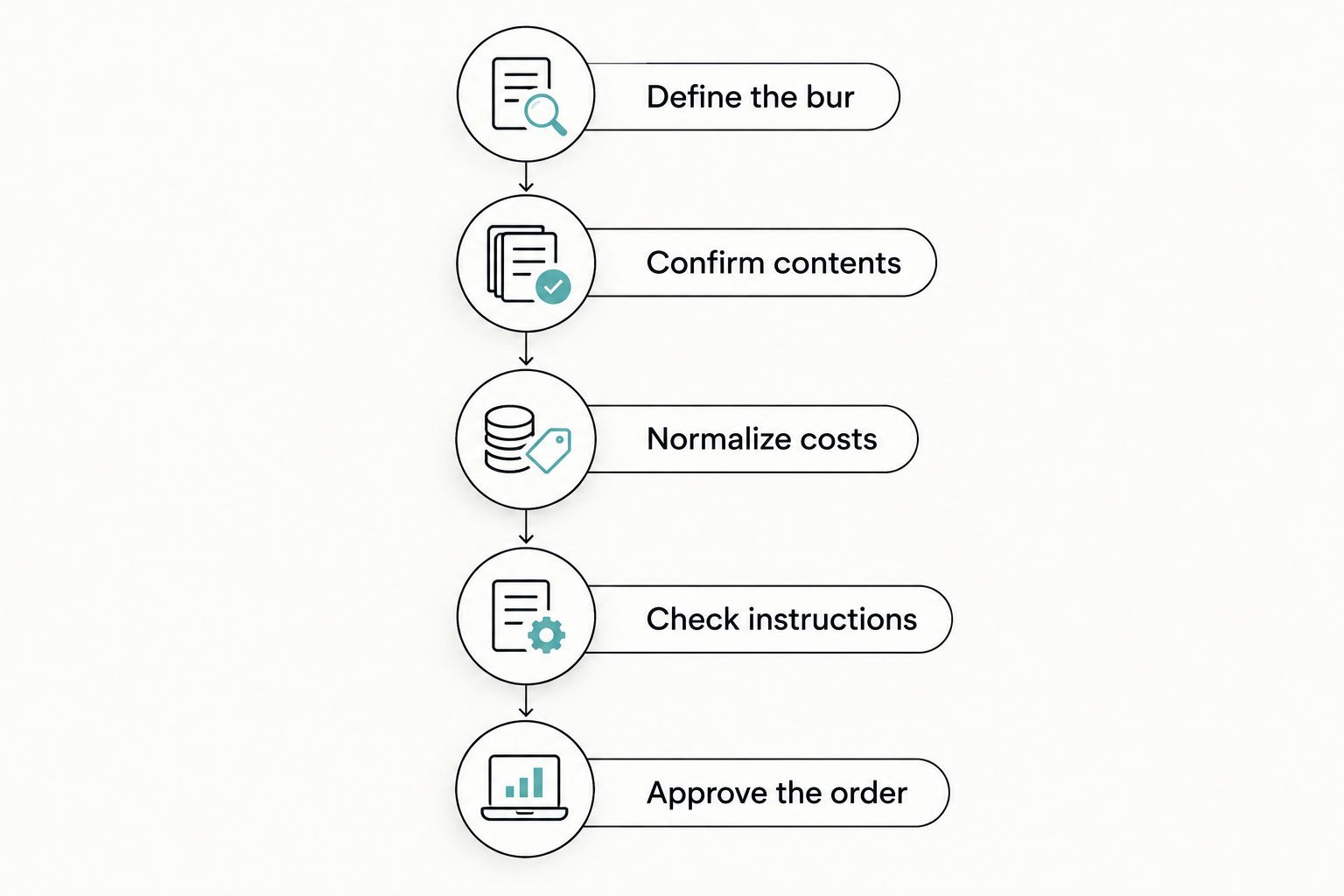
The calculation is simple once the inputs are reliable. The purchasing work lies in establishing those inputs, especially when an assortment, a variant selector or an abbreviated invoice description obscures what is included.
Retain the supplier's written confirmation with the order. That gives your receiving team a concrete reference for checking the delivered items without treating a photograph as the specification.
Is an assortment better value than identical burs?
An assortment is useful only when its contents match your practice's requirements. Compare the included references against actual ordering needs before treating every instrument in the pack as equally useful.
| Purchasing format | Best for | Advantage | Trade-off |
|---|---|---|---|
| Identical-bur pack | Replenishing a defined, approved instrument | Keeps the ordered reference consistent | Does not cover other shapes or grits your clinicians require |
| Mixed assortment | Purchasing a documented combination of required instruments | Groups different specified instruments in one order | Requires checking the usefulness and quantity of every included reference |
Do not recommend an assortment solely because it contains more instruments. Equally, do not assume an identical-bur pack is automatically the better purchase. Your required mix determines which format deserves a quote.
For a new assortment, obtain an itemized contents list. Ask whether replacement references can be ordered individually, but do not assume that option exists without confirmation.
Does a lower unit cost mean a lower ownership cost?
A lower acquisition cost establishes only that the quoted instrument costs less under the comparison method you used. It does not establish service life, cutting performance or cost per clinical use.
For devices whose instructions permit reuse, keep processing requirements in the ownership assessment. Review the specified cleaning, inspection, packaging and sterilization instructions without substituting a generic bur-processing protocol.
Your practice's records can support an internal operating assessment when they identify the exact instrument and documented reason for removal from use. Do not turn an isolated observation into a promised lifespan for future purchases.
Do not extend use to reach a purchasing target. Manufacturer instructions and clinical suitability govern use; a spreadsheet does not establish that an instrument remains appropriate for another procedure.
What should you ask before placing a bur order?
Send a defined request instead of asking only for the best pack deal. For your 2026 enquiry, identify the required references and separate non-negotiable specifications from alternatives you want the clinical team to evaluate.
Ask the supplier to confirm:
- The exact reference, selected grit and shank designation.
- The number of burs in each selected pack.
- The contents of any mixed assortment.
- Current manufacturer instructions and documented intended use.
- Applicable purchasing terms and the process for resolving an incorrect shipment.
- Any product-specific policy being relied on in the purchasing decision.
You can contact the dental supply team with that specification list. Request written confirmation rather than assuming a product title answers questions about quantity, processing or policy.
Do not substitute general supplier assurances for exact-device information. Responsive communication helps resolve a purchasing question, but it does not independently verify a bur's specifications or establish a clinical indication.
FAQ
How do I compare diamond dental burs cost per pack?
Compare the current quote for the same instrument specification and a confirmed pack quantity. Divide the pack total by the included bur count, then apply the same treatment of applicable order charges to every quote.
Does a diamond bur listing amount mean the amount for a whole pack?
Do not assume a listing amount covers a whole pack until the selected option identifies its contents. Confirm the quantity and exact variant with the supplier before ordering.
Are diamond bur assortments better value than identical-bur packs?
An assortment is better suited to your purchase only when its included references match your requirements. Review each shape, grit and quantity instead of treating every included instrument as equally useful.
How many times can I reuse a diamond dental bur?
There is no reuse count established here for these diamond burs. Follow the exact device instructions, including any single-use designation, processing requirements and inspection criteria.
What is the difference between the listed IPR needle bur lengths?
The listed IPR needle head lengths are 10.0 mm for 859-010 and 8.0 mm for 858-010. Confirm the dimensions and intended use in current manufacturer documentation before selecting either instrument.
Can I compare burs with the same shape name as equivalent products?
A shared shape name does not establish equivalent instruments. Match the reference, documented dimensions, grit, shank and intended use before comparing unit costs.
What should my dental practice request in a bur quotation?
Request the exact reference, selected variant, pack count, current total and applicable order terms. Obtain the device instructions and clarify any product-specific policy relevant to your decision.
One last thing
The denominator is the purchasing detail to settle first. A pack count tells you how many instruments arrive; it does not tell you how many match your requirement or how many clinical uses they will provide.
Before approving a 2026 reorder, ask someone other than the person preparing it to match the quote against the approved instrument list. Check references, variants and quantities—not just the order total. Resolve any mismatch before purchase rather than accepting an undocumented substitution.