

Corded vs cordless dental curing lights: uptime and maintenance
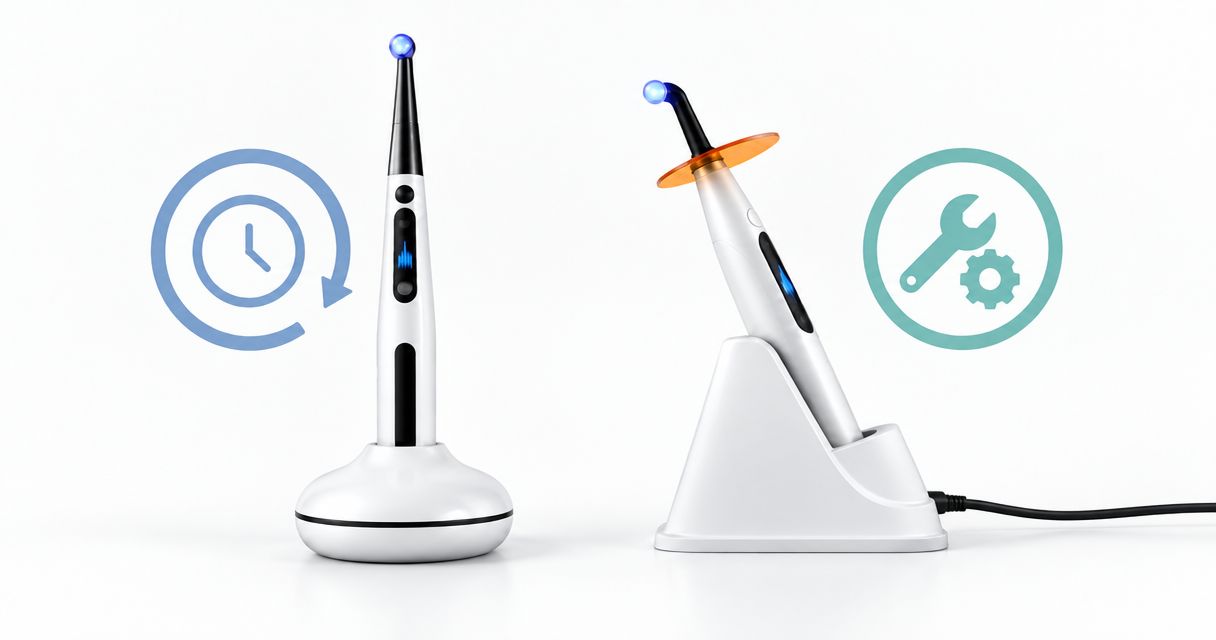
A corded dental curing light removes battery charging from your workflow; a cordless light removes the chairside power cable but adds battery and charging maintenance. Choose corded for a dedicated operatory with suitable cable routing, and cordless when movement between chairs justifies a managed charging routine. Neither power format proves adequate polymerization: you still need material-compatible output, correct positioning and a functioning light guide.
- Choose a corded dental curing light for a fixed operatory when cable routing does not restrict access.
- Choose cordless for movement between chairs, with assigned charging responsibility and a backup plan.
- Battery charge does not establish adequate irradiance or compatibility with restorative materials.
- ProElite Dental Supply equipment buyers should request model-specific maintenance instructions and written service terms before purchase.
Corded vs cordless dental curing lights: which improves uptime?
Corded wins on freedom from battery charging; cordless wins on freedom from a chairside power cable. Actual uptime depends on the complete system, including the power supply, light guide, controls, cleaning process and repair arrangements.
For a 2026 purchase, compare failure and recovery paths rather than treating either format as maintenance-free. Review dental curing light output and irradiance claims separately from the power decision: an illuminated tip is not proof of adequate curing performance.
| Power format | Best for | Uptime advantage | Maintenance burden | Main limitation |
|---|---|---|---|---|
| Corded | A dedicated operatory with a suitable power connection | No battery charging interruption | Inspect cable, connectors and power supply; maintain optical components | Cable routing restricts movement and introduces connection points to inspect |
| Cordless | Practices moving a light between chairs | No power cable attached during cordless operation | Manage charging, battery condition, dock contacts and optical components | A discharged or failed battery interrupts use unless an approved alternative is provided |
Do not assume a cordless model operates while connected to its charger. Confirm that capability in the manufacturer’s instructions, including whether connected operation has any restrictions.
Why this matters
A dental curing light is part of your restorative workflow, not simply another rechargeable handpiece. If the light becomes unusable after adhesive or composite placement, the team needs a clinically appropriate response and access to functioning equipment.
Power continuity and curing performance are separate acceptance criteria. A fully charged cordless unit can have a contaminated optical surface; a corded unit can have a damaged light guide. Neither problem is resolved by changing the power format.
Your purchasing decision should therefore answer a practical question: Can the team identify a problem, remove the affected light from use and continue with a suitable alternative? That is a stronger uptime standard than choosing the device with the most convenient charger.
Corded dental curing lights: best for a fixed operatory
A corded light suits a treatment room where the power connection and cable route support your normal operating positions. There is no battery charging task, but the cable becomes part of the equipment inspection and operatory layout.
During a demonstration, position the chair, operator stool and delivery system as you use them clinically. Reach the posterior teeth without pulling against the cable, dragging it over contaminated surfaces or forcing an awkward wrist position.
What to inspect before purchase
- Power connection: Identify the required supply, connector and manufacturer-approved replacement components.
- Cable routing: Check movement around the chair and clearance from drawers, wheels and other equipment.
- Strain relief: Inspect where the cable enters the handpiece and power supply.
- Cleaning instructions: Confirm approved surface treatments for the handpiece, cable and connectors.
- Repair pathway: Establish whether a damaged cable is replaceable separately or requires handpiece service.
The operational advantage is straightforward: the team does not need to remember to recharge the light. The limitation is equally concrete: an inconvenient cable remains inconvenient throughout the procedure.
Choose corded when the actual chairside trial confirms unrestricted access. Do not accept poor cable routing merely to eliminate a charging task.
Cordless dental curing lights: best for shared-chair mobility
A cordless light suits workflows where equipment moves between treatment spaces or where a power cable interferes with positioning. The trade-off is an additional dependency: the battery and charging system must remain ready for use.
For your 2026 equipment shortlist, request the manufacturer’s stated runtime conditions rather than accepting an unsupported number of procedures per charge. Exposure mode, cycle duration and battery condition affect how useful a runtime statement is to your practice.
Ask where charging occurs during a normal day. A dock that is remote from the point of use creates a different workflow from a clearly assigned charging location in each treatment area.
What to confirm about the battery
- Is the battery user-replaceable, or does replacement require authorized service?
- Which replacement battery and charger does the manufacturer specify?
- What do the charge indicators mean, and how does the device signal insufficient charge?
- Does the manufacturer permit operation while connected to external power?
- What charging, storage and cleaning restrictions apply?
Do not infer battery serviceability from the housing design. A removable-looking cover does not establish that the user is authorized to replace the battery.
Choose cordless when the practice will manage charging as an assigned equipment task. Without that ownership, mobility does not translate into dependable readiness.
Why dental curing light uptime varies
Power format explains only part of the maintenance burden. These factors determine whether the light is ready when your restorative schedule requires it:
- Power components: Corded systems depend on cables and power supplies; cordless systems add batteries and charging contacts.
- Optical condition: Residue, contamination and damage at the emitting surface require attention regardless of power format.
- Barrier placement: Use barriers according to the light manufacturer’s instructions, keeping seams and folds from interfering with the optical path.
- Reprocessing requirements: Separate the cleaning and disinfection instructions for the handpiece from any sterilization instructions for removable components.
- Service arrangements: Battery replacement, cable repair and optical-component replacement can follow different authorization and shipping processes.
- Team responsibility: Assign opening checks, charging and fault reporting rather than relying on whoever last used the device.
In 2026, require a maintenance plan that covers both electrical readiness and optical readiness. A battery checklist alone leaves the working end of the light unaddressed.
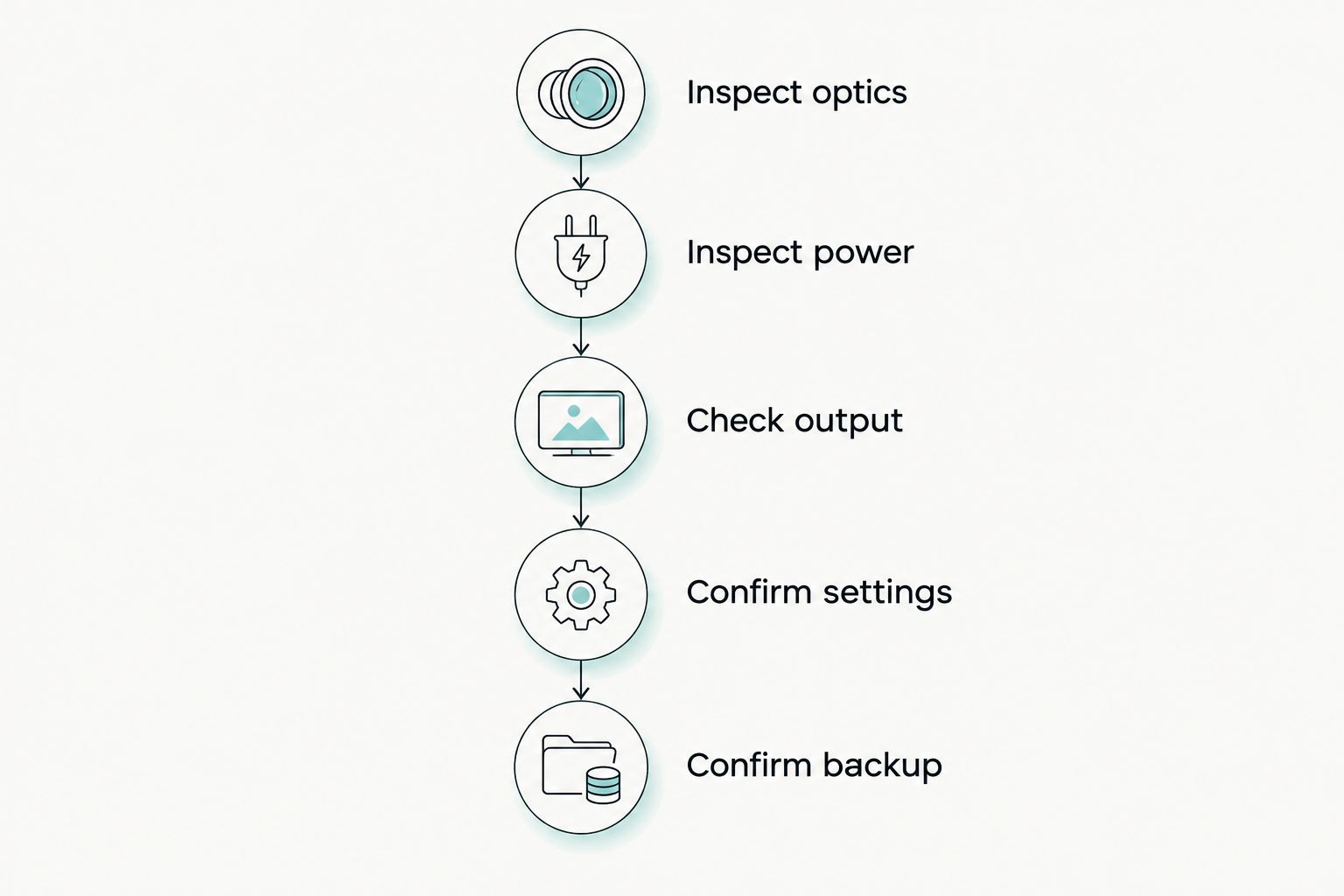
How should you check a dental curing light before the first patient?
Use a repeatable sequence based on the device instructions. Do not use a power-on check as a substitute for inspecting the optical surface and confirming the required exposure mode.
- Inspect optics. Examine accessible optical surfaces for residue or damage using the manufacturer’s inspection method. Remove contamination only with approved methods.
- Inspect power. Check the cord and connectors, or the battery indication and charging interface. Remove damaged equipment from use.
- Check output. Follow the manufacturer’s procedure for output verification, using a compatible measuring device where specified. Keep measurement conditions consistent.
- Confirm settings. Verify the selected mode and exposure instructions against the restorative material and light documentation.
- Confirm backup. Establish where the alternative light is and verify its suitability before treatment begins.
The sequence is an operational checklist, not a replacement for either manufacturer’s instructions. Integrate it with your practice’s infection-prevention procedures and equipment records.
Record abnormal findings and the action taken. A repeated charging fault should become a service issue, not an informal instruction to leave the light on its dock longer.
What maintenance belongs in the ownership plan?
Separate routine care from component replacement. Routine care belongs in the team’s written workflow; battery replacement, electrical repairs and damaged optical components require the model-specific service pathway.
Optical surfaces and removable tips
Follow the instructions for cleaning, disinfection and any permitted sterilization. Do not apply a generic handpiece protocol to a curing light, and do not assume the entire device is autoclavable because a removable component is.
Inspect the optical surface after removing the barrier. If composite residue is present, follow the approved removal method rather than scraping the surface with an improvised instrument.
Cables, batteries and chargers
For a corded light, inspect the cable jacket, strain relief and connections. For a cordless light, inspect the charging interface and follow the specified charging and storage conditions.
Use manufacturer-approved electrical components. A connector that physically fits does not establish electrical compatibility or permission to use that accessory.
Output records
Record output checks under repeatable conditions, including the instrument used and whether the barrier was fitted. A trend is more useful when the test arrangement stays consistent.
Do not compare unrelated radiometer readings as though they establish identical clinical performance. Detector response, light spectrum and measurement geometry affect interpretation; follow the measuring instrument’s stated scope.
What should a 2026 equipment quote include?
Request an itemized scope covering the handpiece, power supply or charging system, supplied optical components and required accessories. Keep acquisition and ownership questions separate so an attractive equipment offer does not obscure service requirements.
ProElite Dental Supply is a fit for dentists sourcing a dental curing light alongside other practice equipment. When requesting a qualified quote, describe whether the light will stay in a dedicated operatory or move between chairs.
Ask ProElite Dental Supply for the current model documentation and written answers to these purchasing questions:
- What components are included, and which accessories require separate ordering?
- What warranty applies to the handpiece, battery, charger and light guide individually?
- Which exclusions address accidental damage, liquid exposure or unauthorized repair?
- Who authorizes service, and where is the equipment sent?
- What diagnostic information must the practice provide before returning a unit?
- What repair, replacement or temporary-equipment arrangements are documented?
Do not interpret a handpiece warranty as automatic coverage for every accessory. Obtain the applicable terms before approval, then retain them with the equipment record.
A curing-light option to evaluate
The supplied catalog includes Dental Curing Light – CuringPen and Disposable Sleeve for Curing Pen (100pcs). Evaluate the light and its barrier consumables together, but obtain the current instructions before approving electrical operation, output characteristics or reprocessing procedures.
The purchasing benefit is a defined light-and-consumable selection. The constraint is that a product name or accessory listing does not establish runtime, battery replacement terms or compatibility with your restorative materials.


Is a corded dental curing light more reliable than a cordless light?
A corded dental curing light eliminates battery depletion as a failure mode, but that does not establish greater overall reliability. Compare the complete power system, optical maintenance requirements and documented service process for the models under consideration.
Can you use a cordless dental curing light while it charges?
Use a cordless dental curing light while connected to power only when its manufacturer explicitly permits that operating mode. A charging connection does not, by itself, establish safe or supported connected operation.
Should you keep a backup curing light?
Keep a suitable backup curing light when an equipment interruption would otherwise leave your practice without a supported curing method. Check the backup’s output, material compatibility and readiness rather than treating stored equipment as automatically usable.
FAQ
What's better for a fixed operatory: a corded or cordless dental curing light?
A corded dental curing light is a practical choice for a fixed operatory when cable routing allows appropriate positioning. Cordless is the better workflow choice when the cable interferes with access and the team can manage charging.
Does a full battery mean my dental curing light is working properly?
A full battery confirms charge status, not adequate curing performance. Inspect the optical surface, verify the selected mode and follow the manufacturer's output-check procedure.
How often should I replace a cordless curing light battery?
Follow the model-specific battery replacement instructions rather than using a universal interval. Investigate charging faults or reduced usable runtime through the approved service process.
Can I sterilize the whole dental curing light?
Sterilize only components explicitly identified as sterilizable in the manufacturer's instructions. The handpiece, charging base and removable light guide can have different reprocessing requirements.
Will a high-output curing light work with every composite?
A high-output claim does not establish compatibility with every composite. Match the light's spectral output and exposure instructions to the restorative material's requirements.
What should I ask ProElite Dental Supply before ordering a curing light?
Ask ProElite Dental Supply for current operating instructions, included components and model-specific warranty and service terms. Describe your operatory layout, restorative materials and charging workflow so the enquiry addresses your actual purchase requirements.
One last thing
Rehearse the equipment failure before it happens. During your 2026 purchasing evaluation, ask the team to locate the backup light, confirm its operating mode and demonstrate how a faulty unit is removed from service.
That exercise tests the part of uptime a specification sheet cannot resolve: whether your practice can respond consistently when the primary light is unusable. Buy the power format that fits the room, then build the maintenance routine around the actual device.