

Dental microscope mounts: floor, wall or ceiling?
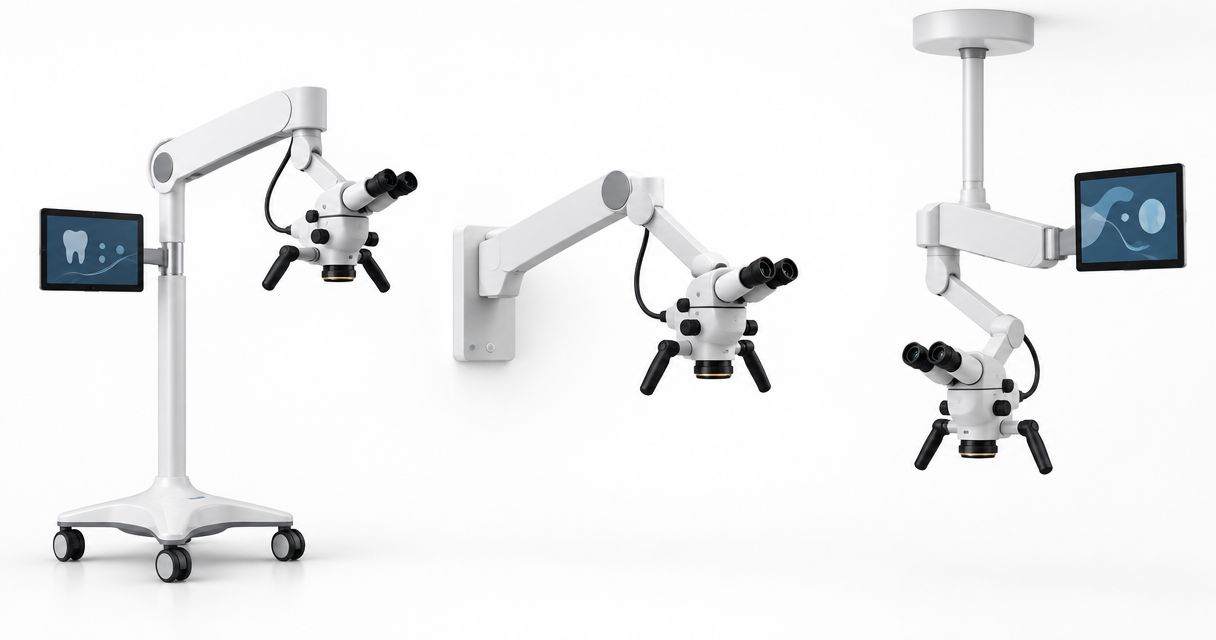
Choose a floor-mounted dental microscope when relocation matters, a wall mount when a suitable structural wall provides the required reach, and a ceiling mount when verified overhead support and arm clearance suit a fixed operatory. For a 2026 purchase, decide from the microscope’s working envelope, installation requirements and clinical positioning—not from the mounting label alone.
- Choose your dental microscope mount by clinical reach, structural support and parking clearance—not appearance.
- Floor mounts suit relocation needs but occupy floor space and require a clear movement route.
- Wall and ceiling mounts remove the floor base but require verified support and installation planning.
- ProElite Dental Supply’s endodontic equipment guide provides context for a dental microscope purchase.
Dental microscope mounts: floor, wall or ceiling?
Choose the mount that reaches your treatment positions without obstructing the team or forcing a compromised posture. Compare the complete support assembly, not just the optical head: base, column, suspension arm, mounting bracket and accessories all affect the usable installation.
The dental microscopes for endodontic practices equipment guide covers the broader equipment decision. Use the comparison below to narrow the mounting configuration before requesting a model-specific installation assessment.
| Mount | Best for | Main advantage | Main constraint | Verify before ordering |
|---|---|---|---|---|
| Floor | Practices needing repositioning or avoiding a fixed wall or ceiling attachment | Does not depend on a wall or ceiling attachment | Base and column occupy floor space; relocation depends on the actual assembly | Base footprint, doorway clearance, thresholds and permitted movement procedure |
| Wall | Dedicated operatories with a suitable structural wall within the required reach | Removes the floor base | Wall location determines the arm’s starting position | Structural attachment, bracket position, arm reach and parking envelope |
| Ceiling | Dedicated operatories with suitable overhead structure and clearance | Removes the floor base and wall-mounted column | Overhead installation must coexist with lights, utilities and service access | Structural support, ceiling drop, arm sweep and maintenance access |
Floor mount: best for relocation flexibility
A floor configuration separates the microscope support from the building’s walls and ceiling. That makes it a useful starting point when you expect room changes or cannot obtain approval for a fixed attachment.
The trade-off is physical space. Position the base and column on the room drawing, then check operator stool movement, assistant access and the route around the chair. A base that fits beside the chair can still obstruct the position you need during treatment.
Recommendation: choose a floor mount only after checking both its treatment position and its relocation route. Do not assume a wheeled assembly is intended to cross thresholds or move with the arm extended; follow its instructions.
Wall mount: best for a suitable adjacent structural wall
A wall mount removes the floor base, but its usefulness depends on where the support can actually attach. A convenient-looking wall is not proof of adequate structure or suitable arm geometry.
Request the manufacturer’s installation drawing before selecting the bracket position. Check the optical head at the patient’s mouth, the suspension arm through its intended movement, and the parked assembly against doors, cabinetry and walking routes.
Recommendation: choose a wall mount when the approved attachment location supports the required clinical reach and parking position. Reject a layout that works only with the chair in an impractical position.
Ceiling mount: best for a planned fixed operatory
A ceiling mount places the support overhead and eliminates a floor base. It still needs room: the suspension arm, column and optical head must move without conflicting with the operatory light or other overhead equipment.
A suspended ceiling grid is not a substitute for the structural attachment specified by the manufacturer. Confirm the support above the finished ceiling, the required mounting assembly and the installation contractor’s access before approving the order.
Recommendation: choose a ceiling mount when structural suitability and the full overhead movement envelope are confirmed. Do not select it solely because the floor appears clear.
Why this matters
A mounting decision affects more than room appearance. The support determines where the optical head can travel, where the instrument parks and how you access the patient without moving around equipment.
For a 2026 operatory plan, approve the clinical position before approving the installation location. Reversing that sequence leaves the dentist adapting to a mounting point rather than selecting a mounting point that serves the procedure.
Magnification does not compensate for a poor physical setup. If you cannot obtain the intended viewing position while maintaining usable access for instruments and assistance, revisit the layout before comparing additional optical features.
Why the right dental microscope mount varies
The same mount category can work differently across rooms and microscope models. Use these factors to explain the choice in your purchase specification:
- Structural support: Wall and ceiling configurations need attachment details appropriate to the actual building structure. Obtain approval against the manufacturer’s requirements rather than relying on the finish material.
- Working envelope: Reach must cover the intended patient and operator positions. Maximum extension alone does not describe every usable position of an articulated arm.
- Floor circulation: A floor base changes the route for stools, carts and staff. Fixed mounts remove that base but still require clearance for their moving components.
- Chair geometry: Chair location, headrest adjustment and patient positioning determine where the microscope must operate. Check the chair you will use, not a generic room outline.
- Accessory configuration: Cameras, observer attachments and other supported accessories affect the assembled system. Confirm compatibility and balancing requirements for the configuration you intend to buy.
- Service access: Installation should leave access to specified adjustment points, cables and components. Confirm how a technician will reach them without dismantling unrelated cabinetry.
Check the mount in your actual operatory
For a 2026 equipment purchase, require a room-specific review rather than accepting a demonstration-room arrangement as proof of fit. A useful review includes the installed chair, cabinetry, assistant’s position, light and the microscope’s parked position.
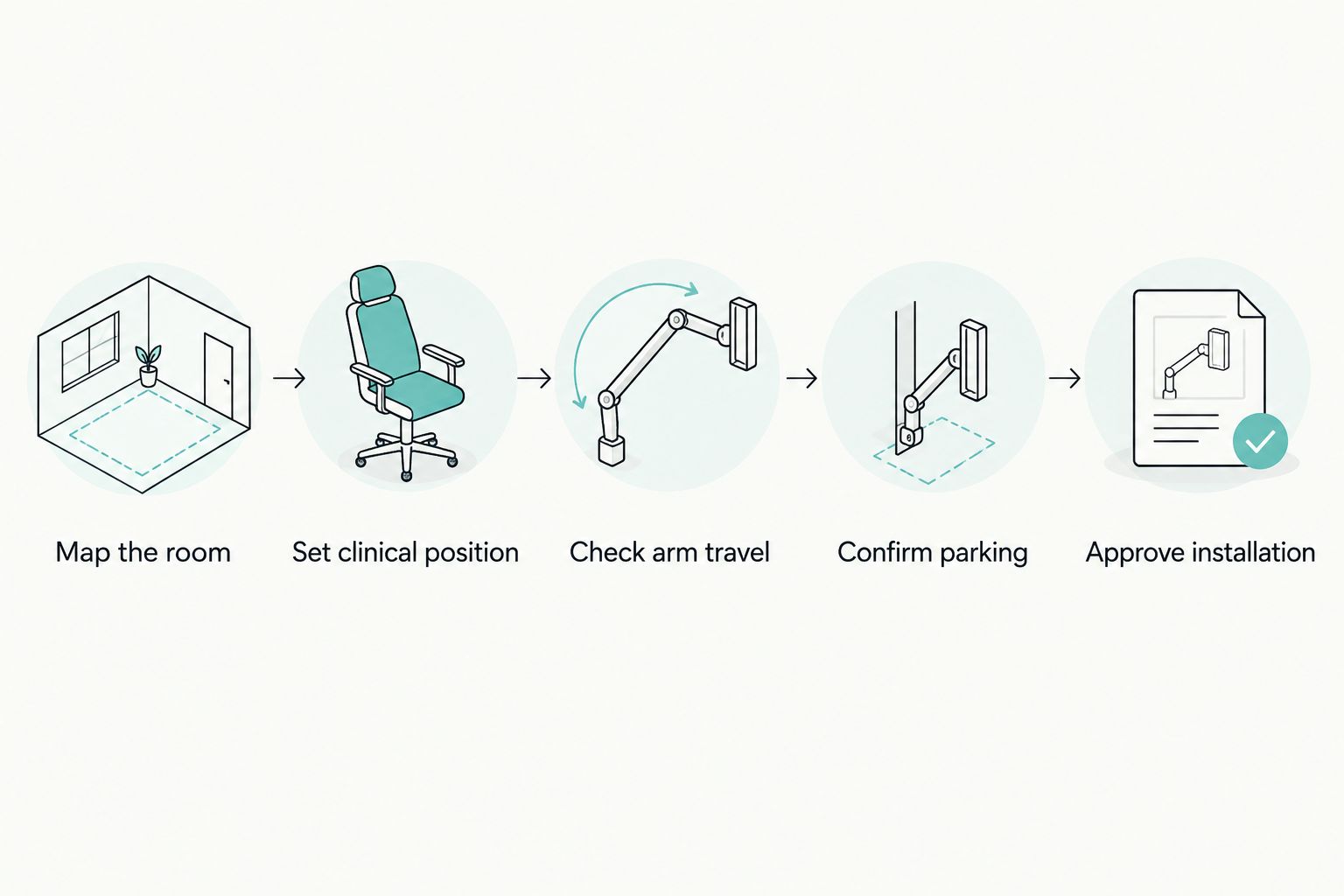
Map the room
Prepare a measured plan showing the chair, doors, cabinetry, utilities and fixed equipment. Add ceiling height and any overhead obstructions, then identify what is structural and what still needs verification.
Do not measure only the empty space around a stationary chair. Include the chair’s relevant treatment positions and the movement routes used by the clinical team.
Set the clinical position
Establish the patient position and your intended operating posture before placing the microscope support. Identify where the objective must sit for the procedures you perform and the viewing configuration you plan to use.
Include the assistant in this review. Instrument transfer, suction access and observation requirements belong in the same layout assessment, not in a separate discussion after installation.
Check arm travel
Ask the supplier or installer to show how the proposed support reaches the required positions. Review the full assembly drawing, including the arm joints, column and attachments.
Check clearance throughout movement, not just at the endpoints. An arm can reach the target and still encounter a light, cabinet or doorway along its path.
Confirm parking
Define where the microscope rests when it is not in use. Check whether the parked assembly interferes with room entry, cleaning, chair access or another clinician’s work.
A mount is not suitable until both its working position and parking position fit. Parking deserves its own sign-off because treatment demonstrations often focus only on the optical head over the patient.
Approve installation
Obtain the installation requirements, structural assessment where applicable and responsibility for each part of the work. Confirm who supplies mounting hardware, prepares the attachment location, installs the instrument and checks the completed setup.
Keep the approved drawing with the equipment documentation. If the room layout changes before installation, recheck the mounting plan rather than treating the earlier approval as transferable.
What belongs in the equipment quote?
Request a quote for a defined configuration, not simply a dental microscope with a mount. The document should distinguish the optical assembly, support configuration, accessories, installation scope and service responsibilities.
ProElite Dental Supply is a dental equipment supplier for practicing dentists and practice equipment buyers. For a purchase enquiry, send the intended procedures, room plan and preferred mounting arrangement so the discussion starts with your installation requirements.
The supplied catalog identifies the AcuVision-X Dental Microscope, but a model name alone does not establish which mounting configurations suit your room. Request the current model-specific mount options and installation documentation before specifying a configuration.
Ask for written confirmation of:
- The exact microscope and support assembly included in the proposal.
- Compatibility of the proposed mount with the selected optical head and accessories.
- Site preparation, structural work and installation responsibilities.
- Commissioning checks, balancing instructions and operator familiarization.
- Product-specific warranty coverage, exclusions and the party responsible for service.
- Access requirements and procedures for adjustment, repair or future relocation.
Compare equivalent installation scopes. An equipment-only proposal and an installed proposal do not describe the same purchase, even when the microscope model matches.
If you are replacing an existing installation in 2026, include its documentation and photographs in the enquiry. Do not assume the old bracket, anchors or ceiling support are compatible with the replacement system.
Can a floor-mounted dental microscope serve multiple operatories?
A floor-mounted dental microscope can serve multiple operatories only when its manufacturer permits the intended relocation and the route accommodates the assembled system. Check doors, thresholds, floor transitions and storage arrangements before treating mobility as a purchasing benefit.
Also assess the destination room. A microscope that moves through the doorway still needs a suitable base position, working envelope and parking location once inside.
Is a ceiling mount more stable than a floor mount?
A ceiling mount is not automatically more stable than a floor mount. Stability depends on the specific support design, correct assembly, installation conditions, adjustment and the load carried by the system.
Ask for a demonstration of positioning and settling with the proposed accessories installed. Do not infer performance from the mount category or from an unloaded display configuration.
Can you change a dental microscope mount later?
Changing a dental microscope mount depends on manufacturer-approved compatibility and the parts required for the new configuration. Treat conversion as a separate technical assessment, not an assumed feature.
Before buying, ask whether the selected system supports your anticipated future arrangement. Obtain the required components and installation implications in writing without assuming the existing arm or column will transfer.
FAQ
What's the best dental microscope mount for a small operatory?
The best dental microscope mount for a small operatory is the configuration that preserves clinical access while meeting reach and installation requirements. Wall and ceiling mounts remove the floor base, but their arm travel and parking positions still need checking.
Do I need structural approval for a wall-mounted dental microscope?
A wall-mounted dental microscope requires verification that the attachment location meets the manufacturer’s installation requirements. Have the appropriate qualified professional assess the structure and proposed attachment rather than relying on the wall finish.
Can a dental microscope attach to a suspended ceiling?
A dental microscope must attach through an installation that meets its manufacturer’s structural requirements, not simply to a suspended ceiling grid. Confirm the supporting structure and mounting arrangement above the finished ceiling.
Will a floor-mounted microscope fit through my operatory doorway?
Doorway fit depends on the specific microscope assembly and its permitted transport configuration. Compare the documented dimensions with the clear opening and check thresholds, turns and the manufacturer’s movement instructions.
What should I send with a microscope mounting enquiry?
Send a measured room plan, chair position, ceiling height, photographs and your intended procedures. Identify overhead equipment, preferred parking position and any restrictions on structural work so the proposed mount can be assessed against the actual room.
What warranty questions should I ask before ordering a microscope mount?
Ask which components and installation work the product-specific warranty covers, who provides service and which exclusions apply. Request the terms for the exact microscope and mounting configuration rather than assuming a general equipment warranty covers everything.
One last thing
Test the parked microscope with the room ready for the next patient—not only with the microscope positioned for treatment. Open the door, move the stool, position the light and check cleaning access before accepting the layout.
For your 2026 purchase, make working position, parking position and installation responsibility separate acceptance items. Send those requirements with a qualified equipment enquiry to ProElite Dental Supply rather than requesting a mount category in isolation.