

Electric vs air-driven dental handpieces: equipment trade-offs
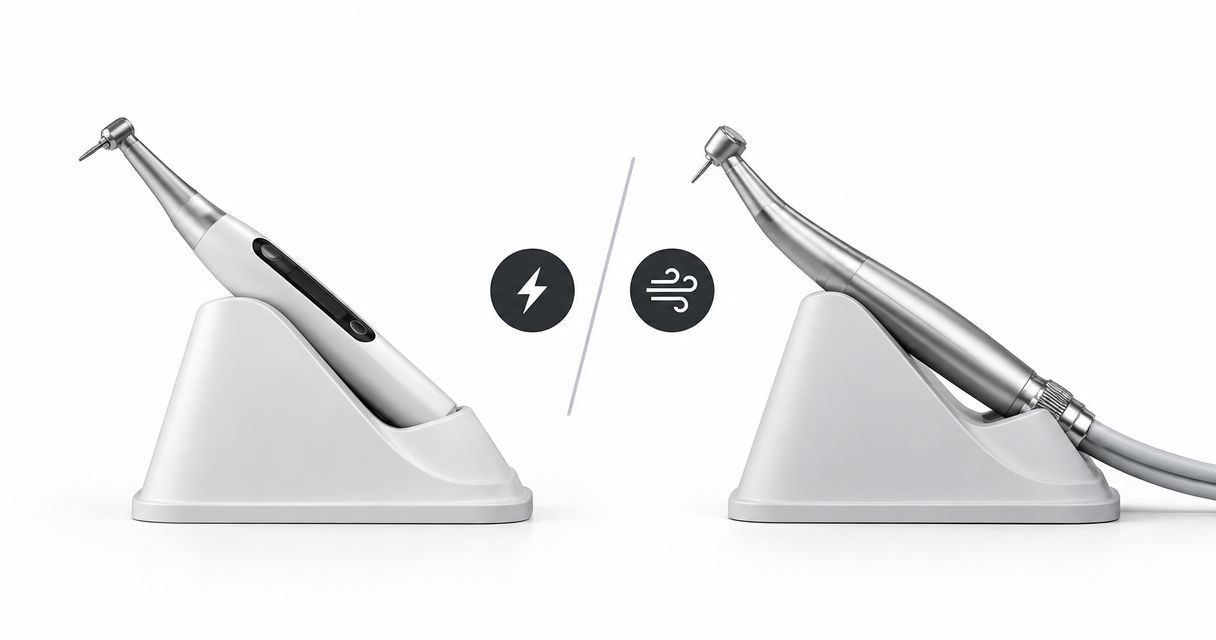
Choose an electric dental handpiece when controlled bur speed under load is your priority; choose an air-driven turbine when you want a lighter working assembly that fits an existing air-delivery setup. For a 2026 purchase, compare the complete operating system—not just the handpiece—because the motor, coupling, coolant supply, reprocessing requirements and repair arrangements determine whether it fits your practice.
- An electric dental handpiece favors speed control under load; an air-driven turbine favors a lighter working assembly.
- Compare motor speed, attachment ratio and permitted bur speed together—not as separate specifications.
- ProElite Dental Supply serves dentists buying dental equipment; confirm the exact handpiece configuration before ordering.
- Evaluate coupling compatibility, coolant delivery, sterilization instructions and service terms before replacing an existing system.
Why this matters
A handpiece purchase changes more than cutting performance. It affects hose drag, posterior access, assistant setup, sterilization turnover and the equipment you need when a unit goes out for repair.
ProElite Dental Supply sells dental handpieces and other practice equipment. For a useful equipment enquiry, identify your delivery unit, current connection, principal procedures and replacement requirements before requesting a configuration. That makes the discussion about clinical fit rather than an isolated specification.
Which dental handpiece is better: electric or air-driven?
Electric wins when maintaining controlled rotational speed under load matters most; air-driven wins when low assembly weight and continuity with an existing turbine setup matter most. Neither drive type establishes clinical suitability by itself. Head dimensions, coolant coverage, bur retention and the manufacturer's intended use still govern the selection.
| Buying criterion | Electric motor with attachment | Air-driven high-speed turbine |
|---|---|---|
| Best for | Buyers prioritizing controlled speed across compatible attachments | Buyers prioritizing a lighter assembly and existing air-delivery compatibility |
| Drive mechanism | An electric motor drives the attachment through a transmission | Compressed air drives a turbine rotor in the head |
| Behavior under load | Motor control supports speed regulation within the system's operating limits | Rotational speed falls as cutting load increases |
| Speed selection | Motor setting and attachment ratio determine bur speed | Supply conditions, turbine design and cutting load determine operating speed |
| Handling trade-off | Motor and attachment add mass; balance depends on the assembly | Typically lighter at the working end; coupling and hose still affect handling |
| Installation check | Controller, power, motor connection, coolant and foot-control integration | Coupling, drive air, exhaust, coolant and illumination connection |
| Service exposure | Motor, cable, controller and attachment are separate potential service items | Turbine cartridge, bearings, chuck and coupling require attention |
Use this comparison to choose a shortlist, not to approve a purchase. A compact attachment and a larger attachment on the same electric motor can feel very different intraorally.
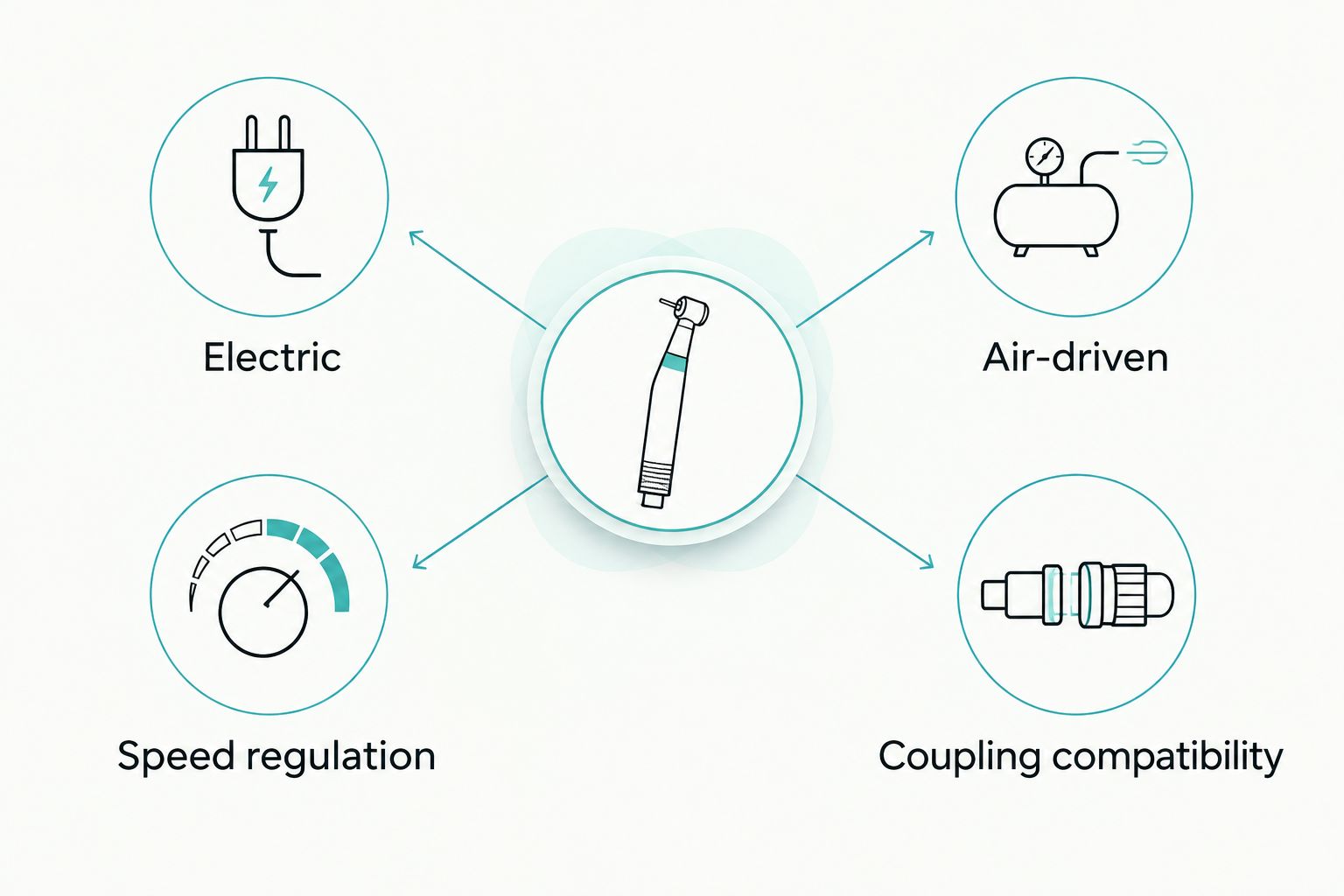
Electric handpieces: best for controlled speed under load
An electric system separates the drive motor from the working attachment. The attachment's gear ratio determines how motor speed translates into bur speed, while the controller provides the available operating settings.
That distinction matters during purchasing. A motor specification is not a bur-speed specification, and an attachment ratio is not proof that the assembly supports your intended procedure.
Read the ratio before comparing speed
A 1:5 speed-increasing attachment turns the bur five times for each motor revolution. As a calculation example, a motor running at 40,000 rpm produces a theoretical bur speed of 200,000 rpm through that ratio, provided the motor and attachment are rated for that combination.
A 1:1 attachment transmits the same nominal rotational speed. A 20:1 reduction attachment produces a theoretical 2,000 rpm from a 40,000 rpm motor input. These figures explain transmission ratios; they are not specifications for any particular product offered here.
For your 2026 shortlist, request the permitted motor input, attachment output and compatible bur specifications together. Never infer approved use from the ratio alone.
Where the electric system earns its place
Electric drive suits buyers who want selectable speed and speed regulation within the motor's operating envelope. It also supports workflows using different compatible attachments, provided each attachment is approved for the motor and procedure.
The compromise is system complexity. Your assessment must include the motor, cable, controller, attachment and delivery integration rather than treating the contra-angle as the entire purchase.
Recommendation: choose electric for controlled-speed workflows only after confirming assembly balance and integration at the chair. A favorable specification does not compensate for an uncomfortable grip or an incompatible controller.
Air-driven turbines: best for lighter handling and existing setups
An air-driven high-speed handpiece places the turbine in the head. Compressed air supplies the drive energy, so the connection must provide the correct air supply, exhaust and coolant arrangement for that model.
Air turbines typically offer a lighter working assembly than an electric motor-and-attachment combination. That advantage is useful only if the selected head, coupling and hose also suit your access and handling requirements.
Compare operating conditions, not free-running speed alone
A turbine's unloaded rotational speed does not describe its cutting behavior under pressure. Speed falls as load increases, and excessive pressure is not a substitute for an appropriate bur, adequate coolant and correct operating conditions.
For a 2026 replacement purchase, ask for the manufacturer's specified supply pressure and where that pressure must be measured. A pressure reading elsewhere in the delivery system does not establish that the handpiece receives its required operating conditions.
Where the air-driven system earns its place
An air turbine is a practical candidate when you want to retain a compatible delivery setup and familiar handling. Confirm the exact coupling rather than assuming that a visually similar connector will fit or provide the required functions.
The compromise is load-dependent speed behavior and reliance on the specified air supply. Coupling condition, water delivery, chuck performance and turbine maintenance remain part of the ownership decision.
Recommendation: choose air-driven for lighter handling and delivery continuity, not because its headline speed appears higher. Compare performance under the conditions in which you actually prepare teeth.
Why dental handpiece performance varies
Drive type explains only part of what you feel at the bur. Evaluate these factors before deciding that an unsatisfactory result requires switching systems:
- Operating supply: Electric systems need the approved motor and controller combination; turbines need the specified air supply. Incorrect setup makes comparisons unreliable.
- Transmission and limits: Attachment ratio, motor setting and permitted bur speed must agree. A displayed motor setting does not automatically represent bur speed.
- Bur selection: Shank compatibility, cutting geometry, grit, wear and intended material affect cutting behavior. A worn or unsuitable bur confounds a handpiece comparison.
- Coolant delivery: Check spray direction, outlet condition and water delivery according to the manufacturer's instructions. Do not judge cooling from outlet count alone.
- Access and balance: Head size, neck geometry, motor mass and hose resistance affect visibility and working posture. Test the complete assembly rather than holding a disconnected head.
- Maintenance condition: Chuck wear, bearing condition, contamination and incorrect lubrication can alter performance. Follow the instructions for the exact component, not a general routine applied to every handpiece.
How should you compare systems before buying?
Use the same evaluation framework for both drive types. For a 2026 equipment decision, record the exact configuration demonstrated so that the quoted assembly matches the one you assessed.
- Document the existing setup. Record the delivery-unit model, connection, coupling, illumination arrangement and foot-control functions. Photograph the connection for the supplier without treating the photograph as final compatibility confirmation.
- Specify the clinical task. Identify whether the purchase supports restorative preparation, finishing or another intended use. Surgical and endodontic applications require their own approved configurations; do not assume a restorative setup transfers to those procedures.
- Confirm the bur interface. Check the approved shank type, permitted dimensions and speed limits. Include the burs you intend to retain in the compatibility discussion.
- Assess the complete assembly. Evaluate grip, posterior access, visibility and hose resistance in a nonclinical demonstration. Use manufacturer-approved demonstration conditions rather than improvising a clinical trial.
- Check setup and turnover. Have the assistant review attachment changes, disassembly, cleaning, lubrication where required, packaging and sterilization instructions.
- Approve the service plan. Obtain written coverage terms and identify which organization handles each component. Separate attachment service from motor or controller service.
ProElite Dental Supply's dental handpiece range includes different equipment types. Ask for a task-matched recommendation rather than treating a slow-speed set, high-speed handpiece and surgical motor as interchangeable purchases.
What belongs in the ownership assessment?
Compare the complete installed configuration and its maintenance requirements, not the handpiece body alone. The purchasing decision should identify what is included, what your practice already owns and what requires separate provision.
For an electric system, establish whether the proposed configuration includes the controller, motor, cable, working attachment and required installation components. Ask who confirms delivery integration and whether the existing foot control retains the functions you need.
For an air-driven system, establish whether the correct coupling is included and whether illumination and coolant functions match the delivery setup. Specify any installation work separately so that a compatible head does not arrive without the connection it needs.
For either option, request the following in writing:
- Product-specific warranty duration, exclusions and service responsibility.
- Instructions for cleaning, lubrication where required and heat sterilization.
- Repair routing and any stated turnaround commitment.
- Terms for any loan equipment, if offered.
- Consumables and maintenance items required by the manufacturer.
- The exact components and accessories included in the proposed supply.
For ProElite Dental Supply dental handpiece enquiries, provide those requirements with your existing equipment details. Product-specific written terms—not general assurances—should govern the purchase.
Can I replace an air-driven handpiece with an electric one?
An electric conversion requires more than replacing the turbine head. You need a compatible motor, controller and attachment, together with the required power, coolant and delivery connections.
Best for: practices prepared to assess the complete installation. If you want a direct replacement without changing the operating system, first establish which air-driven configurations match your current coupling.
Does a higher rpm make a dental handpiece better?
Higher rpm does not establish better suitability. Compare the permitted operating range, speed behavior under load, bur limits, coolant delivery and intended procedure.
The 200,000 rpm transmission example above is a calculation, not a recommendation to operate every bur at that speed. The manufacturer's limits for the complete assembly and bur remain controlling.
Can one electric motor cover every procedure?
One electric motor does not automatically support every attachment or procedure. Confirm the approved combinations, available operating modes, torque-control requirements and irrigation arrangements for each intended use.
A reduction attachment alone does not establish suitability for implant surgery. Likewise, an electric restorative setup is not automatically an endodontic system.
FAQ
What's the best dental handpiece for crown preparation?
Choose a handpiece approved for the preparation task that provides suitable access, bur compatibility and coolant delivery. Electric systems favor controlled speed under load; air turbines favor lighter handling, but the exact assembly determines suitability.
Is an electric dental handpiece always more powerful than an air turbine?
Drive type alone does not establish the cutting performance of two specific systems. Compare manufacturer data under stated operating conditions rather than treating motor torque, turbine output and unloaded speed as equivalent measurements.
What does a 1:5 dental handpiece ratio mean?
A 1:5 speed-increasing ratio means the bur turns five times for each motor revolution. A 40,000 rpm motor input therefore gives a theoretical 200,000 rpm output, subject to the approved operating limits of the assembly.
Will my existing dental burs fit a new handpiece?
Existing burs fit only when their shank type and dimensions match the handpiece's approved specifications. Confirm permitted speed and intended use as well; physical insertion alone does not establish compatibility.
Can electric and air-driven handpieces use the same sterilization cycle?
Use a shared sterilization cycle only if each component's instructions permit it. Cleaning, lubrication, packaging, cycle parameters and drying requirements must all match the instructions for the exact items being processed.
What should I request in a dental handpiece quote in 2026?
Request the exact handpiece, required motor or coupling, installation components and included accessories. Obtain product-specific warranty, maintenance and repair terms in writing before approving the configuration.
One last thing
Approve the setup instructions alongside the purchase. Before placing a 2026 order, have the dentist and the team member responsible for reprocessing review the same configuration and instructions. A system that suits the operator but disrupts cleaning, assembly or sterilization turnover is not a complete fit.