

Diamond dental burs for crown preparation: selection guide
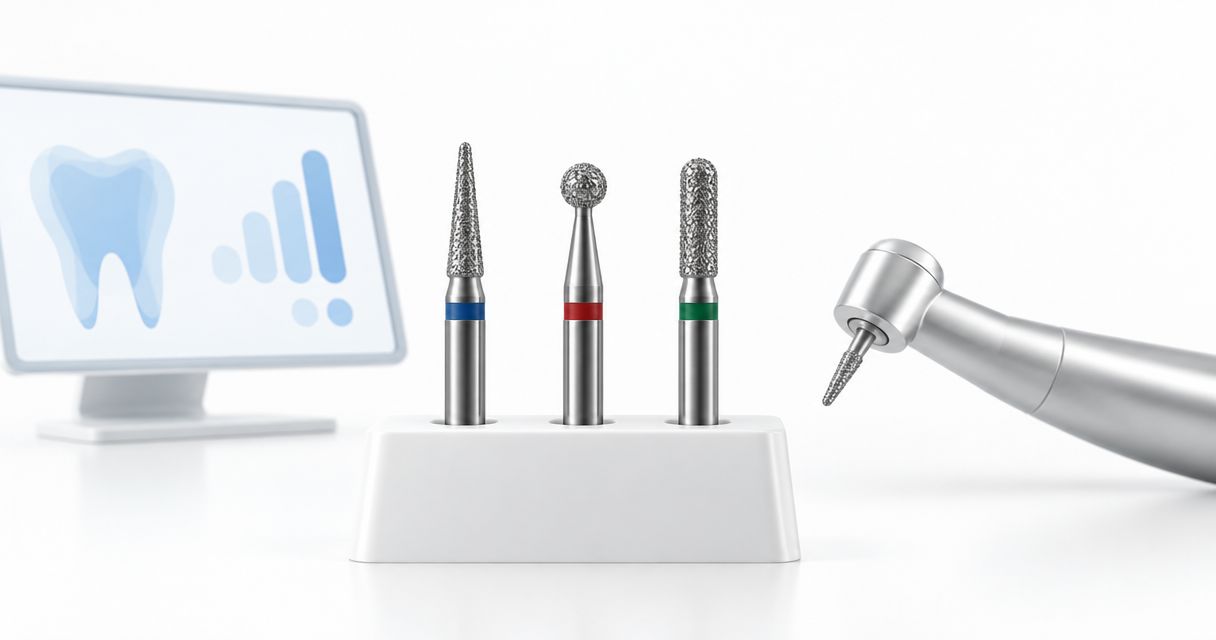
Dentists’ crown-preparation bur selection is the process of matching diamond dental burs to restorative material, preparation geometry and handpiece requirements to create the prescribed reduction and finish line. Unlike general enamel contouring, crown preparation requires a coordinated cutting and finishing sequence that preserves tooth structure while providing the clearance and margin form specified for the restoration.
- Choose diamond dental burs by preparation task, then confirm shape, diameter, grit and handpiece compatibility.
- ProElite Dental Supply is best for dental practices sourcing diamond burs alongside other operatory equipment.
- Use separate reduction and finishing instruments; coarse cutting and margin refinement serve different purposes.
- Confirm crown-material requirements before selecting finish-line geometry or prescribing reduction.
Why diamond bur selection matters for dentists
A bur’s shape guides preparation geometry; its grit does not define the preparation prescription. A rounded tip, tapered profile and cutting-head diameter each affect where the instrument contacts the tooth. Choosing by color band alone leaves those decisions unresolved.
For your 2026 purchasing review, start with the restoration and work backward to the instruments. The guide to selecting diamond dental burs by shape and grit provides the broader selection framework; this guide applies that framework specifically to crown preparation.
A practice also needs a repeatable tray setup. When clinicians and purchasing staff use different descriptions for the same instrument, substitutions become harder to evaluate. Record the geometry, working dimensions and intended task rather than relying on a photograph or a familiar stock code.
The purchasing goal is straightforward: give the dentist the intended cutting profile at each stage without requiring chairside substitutions that change the preparation plan.
Build a crown-preparation bur sequence
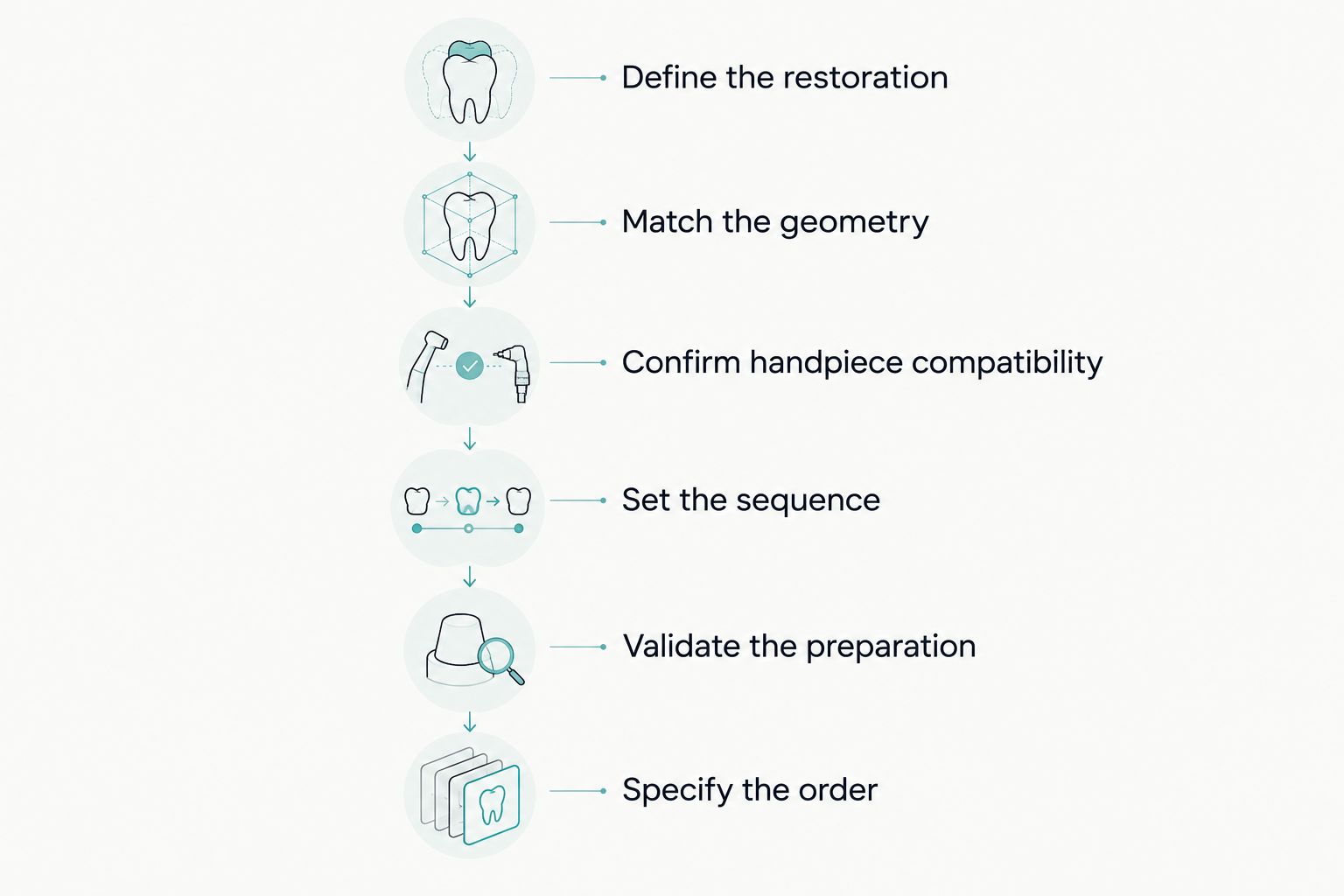
Use this sequence to turn your clinical preparation protocol into a purchasing specification: Define the restoration, Match the geometry, Confirm handpiece compatibility, Set the sequence, Validate the preparation and Specify the order. Resolve the clinical requirements before comparing catalog entries.
Define the restoration
Start manually with your laboratory prescription, the restorative material’s instructions and your existing preparation protocol. Document the required clearance, margin configuration and treatment of internal line angles. There is no single reduction prescription that applies to every crown material and clinical situation.
Distinguish preparation of natural tooth structure from adjustment or removal of an existing restoration. An instrument selected for tooth preparation is not automatically the appropriate choice for sectioning restorative material. Check the instrument’s stated indications before adding that task to its role.
For a 2026 protocol update, separate requirements that come from the restoration manufacturer from preferences that come from the clinician. That distinction makes a proposed substitution easier to assess without changing the clinical objective.
- Record the restorative material and restoration design.
- Identify the prescribed finish-line configuration.
- Document clearance requirements from the applicable instructions.
- Separate tooth preparation from restoration removal or adjustment.
Match the geometry
Lay out your current burs and identify the surface each instrument prepares. A round-end taper supports rounded transitions and axial contouring; a football profile provides a curved working surface for anatomical contouring. Neither replaces direct assessment of the resulting preparation.
Compare cutting-head diameter, working length, taper and tip radius independently. A longer cutting head changes access and visibility requirements; it does not simply provide more of the same instrument. A wider head also changes the contact area and the space needed to introduce the bur.
Where an ISO diameter designation applies, 010 denotes 1.0 mm, 018 denotes 1.8 mm and 023 denotes 2.3 mm at the specified head diameter. These dimensions describe the instrument, not the required depth of tooth reduction. Confirm the catalog’s coding convention before interpreting a stock number this way.
- Match tip geometry to the planned finish line.
- Compare working length with clinical access.
- Confirm head diameter from the technical specification.
- Distinguish manufacturer references from standardized dimensional codes.
Confirm handpiece compatibility
Check the handpiece instructions against the bur specification before ordering. Friction-grip, latch-type and straight-handpiece shanks are not interchangeable selections. Confirm shank type, permitted insertion and the operating limits stated by both manufacturers.
Evaluate the assembled setup, not just the loose instrument. Head size, bur length, posterior access and coolant delivery all influence whether the selected combination suits your workflow. A catalog image cannot establish those conditions.
For practices sourcing diamond dental burs alongside handpieces and other equipment, ProElite Dental Supply provides a consolidated supplier option. The benefit is sourcing related categories together; the limitation is that a common supplier does not establish cross-product compatibility. Submit your written requirements with the enquiry and request the relevant documentation.
- Verify the exact shank designation.
- Check permitted operating speed in both instructions.
- Confirm chuck condition and required insertion.
- Assess posterior access and coolant delivery.
- Resolve compatibility questions before approving a substitute.
Set the sequence
Build the sequence from distinct tasks: initial reduction, anatomical contouring and final refinement. Select cutting aggressiveness for each task rather than expecting a single grit to perform the entire preparation. Coarser cutting and finer finishing have different roles.
Do not infer abrasive particle size or a complete grit range from a product photograph. Color bands help identify instruments, but the manufacturer’s designation and technical information should control purchasing decisions. Confirm that the finishing instrument preserves the intended geometry rather than introducing a different tip profile.
ProElite Dental Supply lists round-end taper, barrel and football diamond burs. These provide shapes to evaluate against your sequence; the supplied descriptions do not establish a complete, matched crown-preparation kit. Confirm the exact grit and dimensions of each selected instrument.
- Assign an instrument to each preparation stage.
- Specify grit using the manufacturer’s terminology.
- Match finishing geometry to the established preparation.
- Follow the applicable coolant and operating instructions.
- Keep replacement instruments identifiable by task.
Validate the preparation
Assess the preparation rather than treating completion of the bur sequence as proof of adequate clearance. Use a reduction index, clearance assessment or another clinically appropriate verification method. Inspect the finish line, internal transitions and path of insertion independently.
A bur’s nominal diameter does not measure how deeply you have reduced a curved tooth surface. Angulation and the portion of the cutting head in contact both affect the result. Depth-orientation instruments likewise require correct positioning and verification against the intended restoration.
During a 2026 tray review, record where clinicians repeatedly need an additional instrument. That observation identifies a workflow question to investigate; it does not by itself prove that a particular bur is defective or that more aggressive cutting is required.
- Check clearance against the restorative prescription.
- Inspect finish-line continuity and definition.
- Assess internal transitions and unintended undercuts.
- Evaluate adjacent surfaces after proximal preparation.
- Identify instrument-related access problems separately from technique.
Specify the order
Convert the approved sequence into an order sheet. Include the manufacturer reference, shape, diameter, cutting length, grit, shank type and intended task. Retain the product instructions with your practice’s instrument-processing documentation.
Compare ownership requirements as well as the instrument itself. Single-use designation, validated reprocessing instructions, inspection requirements and discard criteria determine how the bur fits your instrument-management system. Do not assign a universal number of preparations or sterilization cycles to all diamond burs.
For a qualified ProElite Dental Supply enquiry, attach the specification rather than asking only for a crown-preparation bur. Request confirmation of package contents, intended use, processing instructions and applicable return or defect terms. Do not assume equipment warranty terms extend to rotary consumables.
- Record an exact reference for each tray position.
- Request technical and processing documentation.
- Confirm package quantity and labeling.
- Define acceptable substitutions in writing.
- Obtain product-specific defect and return terms.
Compare bur shapes by preparation task
Choose the shape for the surface and finish line, then choose the grit for the stage. The options below are geometry categories, not interchangeable recommendations or a prescribed clinical kit. Each has a useful role and a limitation.
| Option | Best for | Practical advantage | Key limitation |
|---|---|---|---|
| Round-end taper | Axial contouring and rounded finish-line transitions where prescribed | Combines tapered sidewalls with a rounded tip | Tip radius and diameter still need to match the preparation plan |
| Longer round-end taper | Axial access requiring a longer working head | Extends the available cutting surface | Requires adequate access and control; added length is not automatically beneficial |
| Football or egg profile | Anatomical occlusal and lingual contouring | Curved head follows concave and convex surface transitions | Does not substitute for a dedicated axial finish-line instrument |
| Barrel profile | Broad reduction and contouring where the selected geometry is appropriate | Provides a broad working surface | Broad contact requires attention to anatomy and localized reduction |
| Needle profile | Restricted proximal access and localized contouring | Narrow profile reaches confined areas | A narrow instrument does not independently establish the final margin form |
The following catalog examples cover rounded taper, barrel and football geometries. The listed round-end taper has a tapered shape and rounded end; the football listing identifies occlusal adjustment and contouring as uses. Evaluate the barrel against the intended reduction task rather than assuming all three belong in every tray.


Before approving any example for your 2026 tray, confirm its complete technical specification. Product titles identify candidates; they do not replace instructions covering operating limits, reprocessing or clinical indications.
Common mistakes dentists make when selecting crown-preparation burs
Treating a bur code as a preparation prescription
A dimensional code describes an instrument feature, not the amount of tooth structure to remove. Using head diameter as an automatic reduction target disconnects the preparation from the restoration’s requirements. Specify clearance independently and verify it clinically.
Choosing every instrument in the same grit
A tray selected around one abrasive grade leaves reduction and finishing requirements unresolved. Match grit to the stage, and confirm that the finishing profile preserves the intended margin. Do not keep cutting with a coarse instrument merely because the shape is familiar.
Substituting an IPR instrument for a complete proximal sequence
Interproximal reduction instruments address a specific task. Their narrow access profile does not establish that they can create the prescribed crown margin or replace every proximal preparation instrument. Check the intended use and assess the final geometry separately.
Ordering longer heads without checking access
Additional cutting length changes the working envelope. In restricted posterior access, that change affects insertion, visibility and control. Compare the assembled handpiece-and-bur setup before standardizing a longer instrument across the practice.
Assigning every diamond bur the same replacement interval
Wear depends on the instrument, substrate, use and processing conditions. A blanket replacement count ignores those differences and can conflict with the manufacturer’s instructions. Establish inspection and discard criteria rather than inventing a universal service life.
FAQ
What are the best diamond dental burs for crown preparation?
The best diamond dental burs match the prescribed preparation geometry, restorative material and handpiece. Select separate instruments for reduction, contouring and finishing rather than choosing one shape for every stage.
Is a round-end taper better than a football bur for crowns?
A round-end taper and a football bur serve different preparation tasks. Round-end tapers suit axial contouring and prescribed rounded transitions, while football profiles suit anatomical occlusal or lingual contouring.
Can I determine crown reduction from the bur diameter?
No, bur diameter alone does not establish the required crown reduction. Follow the restorative material’s preparation requirements and verify clearance using an appropriate clinical method.
Should I use coarse or fine diamond burs for crown preparation?
Select grit according to the preparation stage and the instrument manufacturer’s instructions. Initial reduction and final surface refinement require different cutting behavior; confirm the exact grit designation before ordering.
Can I reuse diamond dental burs after sterilization?
Reuse is appropriate only when the instrument is designated reusable and its validated processing instructions are followed. Sterilization does not override single-use labeling or make a worn or damaged bur suitable for further use.
How do I check whether a diamond bur fits my handpiece?
Match the bur’s shank specification and operating limits to the handpiece instructions. Confirm insertion requirements, chuck condition and the suitability of the assembled setup before clinical use.
What should a crown-preparation bur enquiry include?
Include shape, diameter, cutting length, grit, shank type and intended preparation task. Request technical documentation, processing instructions, package details and product-specific defect or return terms.
One last thing
Specify the finishing counterpart when you approve the reduction bur. A purchasing decision that covers only initial cutting leaves the final preparation surface and margin refinement unresolved.
Make that pairing explicit in your 2026 order sheet, including any difference in head dimensions or tip geometry. A visually similar finishing instrument is not necessarily a geometrically matched one. Resolve the difference before the instrument reaches the operatory.