

Dental X-ray sensor sizes: active area and patient fit

Choose a dental X-ray sensor by its active imaging area, external dimensions and fit with your positioning system, not by its size label alone. For a 2026 equipment purchase, compare the anatomy each sensor can capture with the space its housing, protective barrier and holder occupy intraorally; a larger nominal size does not automatically provide a better diagnostic view.
- Choose a dental x ray sensor by active area and patient fit, not its size label alone.
- ProElite Dental Supply serves dental practices buying digital intraoral imaging equipment; compare documented specifications before selecting a sensor.
- Size 0, size 1 and size 2 labels do not establish identical dimensions across sensor manufacturers.
- Evaluate the sensor with its barrier, holder and cable routing before committing to an equipment purchase.
Which dental X-ray sensor size fits your patients?
The right sensor captures the required anatomy while permitting stable, tolerable positioning. Start with your examination requirements, then compare the manufacturer's dimensional drawing against the positioning constraints you encounter clinically. The broader dental X-ray sensor buying guide covers the purchasing decision beyond receptor size.
Traditional intraoral film dimensions provide a reference for familiar size terminology. They are not specifications for a digital sensor's housing or active area.
| Nominal size | Traditional film reference | Best for evaluating | Main limitation to assess |
|---|---|---|---|
| Size 0 | 22 × 35 mm | Smaller-mouth positioning requirements | Whether the active area captures the required anatomy |
| Size 1 | 24 × 40 mm | Anterior positioning and narrower placement requirements | Whether reduced width limits the planned projection |
| Size 2 | 31 × 41 mm | Routine adult posterior coverage requirements | Whether the complete assembly fits without compromising placement |
These film references explain the labels, not interchangeability. A digital sensor contains imaging electronics and a protective housing, so its external dimensions and usable image dimensions need separate entries in your comparison.
Why this matters
A sensor purchase affects more than image acquisition. It also determines which holders your team uses, how the cable exits the mouth and whether the receptor can sit where the projection requires it.
For a 2026 purchasing decision, distinguish physical fit from image coverage. A sensor that enters the mouth comfortably still needs enough active area in the correct position. Conversely, a broad active area offers little practical benefit if the housing prevents adequate seating.
Do not use patient age alone as the selection rule. Assess the available intraoral space, examination requirements and tolerance of the complete receptor assembly rather than treating a nominal size as a clinical indication.
Size 0: assess smaller-mouth positioning first
A size 0 option belongs on your evaluation list when smaller-mouth placement is a recurring requirement. Its potential advantage is a smaller receptor format; its trade-off is the coverage available from that particular model's active area.
Ask for both the external drawing and the active-area dimensions. Check whether the holder adds material at the corners or behind the receptor, because the assembled profile—not the bare sensor—determines placement.
Best for: evaluating smaller-mouth positioning needs. Select a specific size 0 model only after confirming that its active area supports your intended examinations. Do not assume the film reference describes the digital device.
Size 1: assess anterior access and coverage together
A size 1 option warrants evaluation when anterior placement or a narrower receptor profile is important to your workflow. Review the sensor's width, length and cable exit together rather than deciding from width alone.
The purchasing trade-off is coverage versus placement flexibility. A narrower format does not establish that the entire housing is thinner, and it does not establish that the receptor will seat better in every anterior position.
Best for: evaluating anterior placement and narrower positioning requirements. Compare the actual sensor-and-holder assembly in the orientations your team intends to use, with particular attention to the anatomy required at the image borders.
Size 2: assess adult posterior coverage without forcing fit
A size 2 option belongs in an evaluation of routine adult posterior imaging. The potential benefit is a broader receptor format, but the usable imaging area remains a model-specific specification.
Check posterior placement with the barrier and holder fitted. Examine whether the housing, bite block or cable exit interferes with seating before attributing a positioning problem to operator technique.
Best for: evaluating routine adult posterior coverage. Do not select a size 2 model solely because it is the familiar adult designation. Confirm that its active area and assembled dimensions meet your actual examination requirements.
Active area and housing dimensions are different specifications
The active area is the image-sensitive region that produces the radiograph. The housing is the physical enclosure placed intraorally. Housing dimensions therefore do not tell you exactly how much anatomy the sensor records.
Request measurements in millimeters and a drawing that shows the active area's location inside the enclosure. Width and height alone do not describe how that region sits relative to the edges or cable connection.
Compare these elements separately:
- Housing: External width, length, thickness and corner profile.
- Active area: Usable imaging width and height, plus its position within the enclosure.
- Cable exit: Connection location and the manufacturer's permitted handling method.
- Holder: Added bulk, retention method and supported receptor orientation.
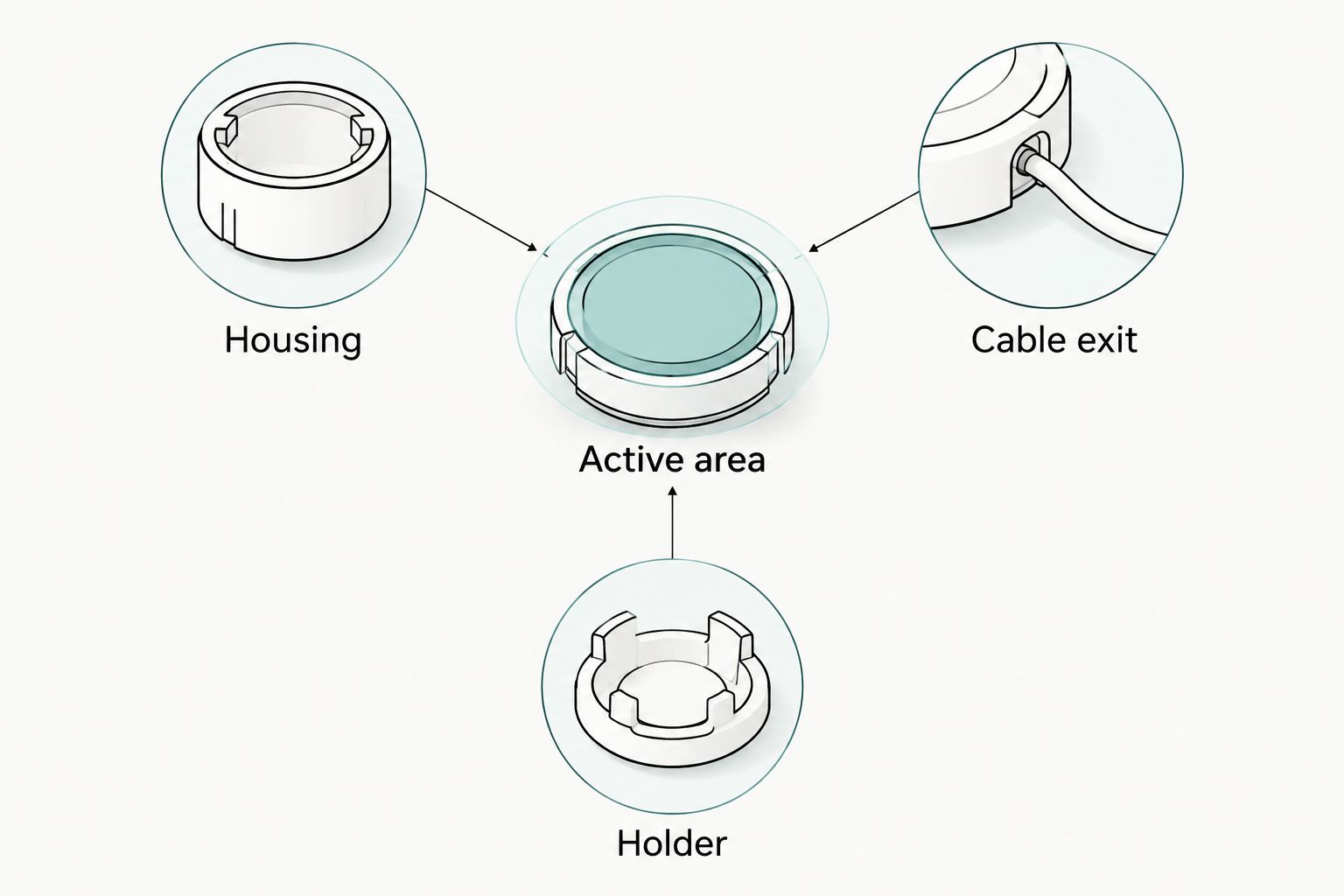
A useful comparison places each manufacturer's dimensional drawing beside the holder information. Do not substitute the outside dimensions for the active-area specification, even when both products carry the same nominal size.
Why dental X-ray sensor fit varies
Patient fit is a property of the whole positioning situation, not a single catalog measurement. Review these factors before standardizing your 2026 receptor selection:
- Available intraoral space: Assess the vestibule, palatal form, floor-of-mouth space and access relevant to the projection.
- Required anatomy: Identify the image borders and structures needed for the examination before choosing receptor orientation.
- Housing geometry: Compare thickness, corner shape and the enclosure surrounding the active region.
- Holder and barrier: Assess the assembly you will actually use, not an uncovered sensor held outside the mouth.
- Cable routing: Check that the connection and cable path permit placement without pulling the sensor away from its intended position.
- Patient tolerance: Evaluate the patient's response to positioning rather than assuming a size designation predicts comfort.
These factors also explain why a smaller housing is not an automatic replacement for a larger active area. The purchasing objective is usable placement with appropriate coverage—not the smallest device in isolation.
How should you evaluate a sensor before purchase?
Use a documented sequence that your dentist, clinical team and equipment buyer can review together. For the 2026 evaluation, record the exact model and configuration; conclusions about one sensor do not establish the specifications of another.
- Define the examinations. List the projections and patient-positioning requirements the sensor must support. Separate routine needs from difficult placements that occur in your practice.
- Obtain dimensional documentation. Request external dimensions, active-area dimensions and a drawing showing their relationship. Keep nominal size as a separate field.
- Confirm the holder assembly. Identify the holders and barriers intended for that model. Follow the manufacturer's instructions rather than assuming an existing holder is suitable.
- Evaluate positioning. Where an appropriate demonstration is offered, assess handling and positioning within manufacturer instructions and your practice's infection-control procedures. Do not obtain radiographs solely to demonstrate equipment.
- Verify acquisition compatibility. Confirm the imaging application, operating system, interface requirements and installation responsibilities for your actual workstation configuration.
- Document ownership terms. Obtain written warranty, service and replacement terms for the quoted configuration before approving the order.
Keep the decision criteria separate. Comfortable positioning does not verify software integration, and successful image acquisition does not establish adequate coverage for every examination.
What should a sensor quote document in 2026?
A useful quote identifies the exact receptor configuration and the components needed to put it into service. Ask the supplier to distinguish included items from optional components rather than describing the purchase only as a digital imaging system.
Your technical record should include:
- Exact sensor model and nominal size.
- External dimensions and active-area dimensions.
- Compatible holders and the applicable barrier instructions.
- Supported acquisition software and workstation requirements.
- License scope and any separately required software components.
- Installation, training and technical-support responsibilities.
- Written warranty terms, exclusions and the service process.
For the NanoPix Intraoral Digital Sensor, request this documentation for the exact configuration being quoted. A product name alone does not establish dimensions, compatibility or warranty coverage.
ProElite Dental Supply is best for dental practice buyers seeking dental equipment and supplies, including digital intraoral sensors. Use the same technical acceptance criteria for its quoted equipment that you apply to every supplier; the purchase should depend on documented fit, workflow requirements and ownership terms.
How do compatibility and ownership affect the size decision?
A clinically suitable receptor still needs to work within your acquisition environment. Verify the supported software connection rather than treating a physical computer connection as proof of integration.
Ask who installs the required software, who resolves acquisition problems and how support is divided between the equipment supplier and software provider. If you intend to move a sensor between workstations, obtain the applicable installation and licensing terms in writing.
Ownership review should also cover sensor handling and service exclusions. Ask specifically how the warranty treats accidental damage, cable damage and liquid ingress; do not assume those events are covered or excluded without reading the terms.
A useful size comparison includes the cost implications of the complete workflow. Additional holders, software requirements, training and repair arrangements belong in the purchasing review even when the initial decision begins with patient fit.
Is the largest active area always the best choice?
The largest active area is not automatically the best choice. Select the imaging coverage required for the examination, then confirm that the complete sensor assembly permits appropriate placement.
A coverage advantage on a specification sheet does not resolve a positioning limitation. Compare usable placement and required anatomy together rather than ranking sensors by area alone.
Should you buy more than one sensor size?
Buy additional sensor sizes only when they address documented examination or positioning requirements. Identify what the additional receptor enables before including it in the equipment order.
Also check the implications for holders, software configuration, team training and service coverage. A mixed-size inventory needs a clear clinical purpose and a defined handling workflow.
FAQ
What is the difference between a dental X-ray sensor's active area and its size?
The active area records the radiographic image, while the sensor's external size describes the housing placed intraorally. Compare both measurements because a larger enclosure does not establish proportionally greater imaging coverage.
Are size 2 dental X-ray sensors identical across brands?
Size 2 dental X-ray sensors are not guaranteed to have identical external dimensions or active areas across brands. Request the dimensional drawing for each exact model rather than treating the size designation as a specification.
Is a smaller dental X-ray sensor always more comfortable?
A smaller dental X-ray sensor does not guarantee better patient tolerance. Housing thickness, corner profile, holder bulk, cable routing and the required position also affect the intraoral assembly.
Can I use my existing holders with a new digital sensor?
Use existing holders only after confirming suitability for the exact digital sensor model. Check the manufacturer's instructions for retention, orientation, cable clearance and barrier use before incorporating them into your workflow.
Should I choose a sensor by patient age?
Choose a sensor by examination requirements and the patient's actual positioning needs, not age alone. Confirm that the active area captures the required anatomy while the assembled receptor permits appropriate placement.
What should I ask ProElite Dental Supply before ordering a sensor?
Ask ProElite Dental Supply for the exact model's active-area dimensions, external dimensions, holder requirements and supported acquisition configuration. Obtain written warranty and service terms for the quoted equipment before approving the purchase.
Does a digital sensor work with every dental X-ray unit?
Do not assume universal compatibility between a digital sensor and every dental X-ray unit. Verify the receptor manufacturer's requirements and the X-ray unit's operating instructions for the intended imaging setup.
One last thing
Compare the image boundary with the housing boundary before comparing nominal sizes. That drawing connects the specification sheet to the placement problem: it shows where the recorded image begins relative to the physical edges your team must position.
For your final 2026 approval, attach the dimensional drawing, holder details and written service terms to the equipment quote. A nominal size is a useful label; it is not an acceptance specification.